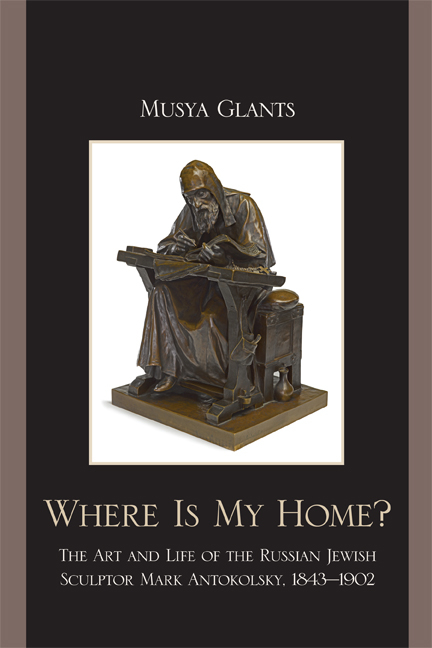
Where Is My Home? (eBook)
410 Seiten
Lexington Books (Verlag)
978-0-7391-4794-8 (ISBN)
Where Is My Home?: The Art and Life of the Russian-Jewish Sculptor Mark Antokolskii, 1843-1902 is the first full-length study in English of the art and life of Mark Antokolskii, the widely recognized Russian and European sculptor of the late 19th century. An originator of novel trends in sculpture in its transition to modernism, Antokolskii was the first artist of Jewish origin to attend the Academy of Art in St. Petersburg and to become an honorable member of the Russian and Western intellectual milieu. Participating in many International World Exhibitions, he received numerous awards, including the Legion d'Honneur (1878, Paris). Antokolskii was a member of many European academies of art, and his works are in museums and private collections worldwide. Where Is My Home? focuses on Antokolski's artistic uniqueness and his fate as a Jewish intellectual who belongs to distinct cultures. Musya Glants pays particular attention to Antokolski's constant struggle between his devotion to Russia and the lifelong commitment to his people. This opens ways to discuss less known aspects of the notions of national identity and spiritual duality. It is an attempt to give an account of the artist as a notable Jewish social and cultural figure, a thinker and essayist whose art reveals his longing for people's reconciliation and overcoming of historical alienation.
Musya Glants is a fellow in the Davis Center for Russian Studies at
Chapter 1 Introduction: Mark Antokolskii and his role in Russian, Jewish, and European Culture.Chapter 2 Chapter 1: Vilna. Childhood and youth. Family and friends. Jewish life under Nicholas I and Alexander II: religion, tradition, and the struggle for secularism and education; the Jewish Enlightenment. Antokolskii's search for his own way in life and his fiChapter 3 Chapter 2: St. Petersburg. The Academy of Arts: a dream fulfilled. The liberal atmosphere of the 1860s-early 1870s. Professors and new friends. Il'ia Repin. Estrangement from classicism. The Russian intellectual milieu. New friends outside the Academy. ThChapter 4 Chapter 3: The strong links to home and Jewishness. Letters to Yakov Barel and the hardship of life in the capital. Between past and present: the intensifying sense of duality. Summer vacations at home. Images of Jews: "The Tailor" (1864), "The Miser" (18Chapter 5 Chapter 4: Towards a new style: "Ivan the Terrible" (1871)-an innovative turn in Russian sculpture. The success and the sweetness of fame. Serious Illness.Chapter 6 Chapter 5: Trip to Italy: a window to the world. Rising hopes and inspirations. Life in Rome. Images of Italy. New friends: the Mamontov family, the Polenovs. The Mamontov circle. "Peter the Great" (1872). Marriage to Elena Apatova (1872).Chapter 7 Chapter 6: Disturbing news from the homeland: the growth of anti-Semitism. The expanding feeling of dual belonging. The death of his son Lev (1876). Search for his own style in sculpture. Christian images as a reflection of his strong ideas to draw Jews aChapter 8 Chapter 7: Removal to Paris, 1877. Life in Paris. The Russian intellectual community. The "Society of Russian Artists in Paris". I. Turgenev; A. Bogoliubov. Art in Paris and French sculpture of that time. The portrait gallery; World Exhibition, 1878 and AChapter 9 Chapter 8: Exploring genres: distinctive memorials (M. Obolenskaia, 1875-1877) and monuments, accomplished (Catherine II, 1901-1902) and unrealized (A. Pushkin, 1875; I. Fiodorov). Political reaction in Russia: persecution of Jews and pogroms. Visits to RChapter 10 Chapter 9: Images of Russian historical figures: "Nestor" (1890) and "Yermak" (1891) as a silent call for national tolerance. Official and unofficial manifestations of intensifying ill will towards the sculptor. Antokolskii and his path to Modernism: a neChapter 11 Chapter 10: The late 1880s and 1890s: prolific last years. Triumph in Munich (1892). Extensive writing. "Dreyfus". "Reminiscences of Italy". "Letter to H. Gintsburg." The pain of lost ideals and illusions. Illness and death. The funeral-a symbolic homecomChapter 12 Conclusion: M. Antokolskii's human and artistic fate as emblematic for an artist and a Jew in Late Imperial Russia.
| Erscheint lt. Verlag | 10.11.2010 |
|---|---|
| Sprache | englisch |
| Themenwelt | Literatur ► Biografien / Erfahrungsberichte |
| Kunst / Musik / Theater ► Fotokunst | |
| Kunst / Musik / Theater ► Kunstgeschichte / Kunststile | |
| Kunst / Musik / Theater ► Malerei / Plastik | |
| Sachbuch/Ratgeber ► Geschichte / Politik | |
| Geisteswissenschaften ► Geschichte ► Regional- / Ländergeschichte | |
| Sozialwissenschaften ► Soziologie ► Spezielle Soziologien | |
| Technik ► Architektur | |
| Schlagworte | History • Russian and East European Studies • Russian and Slavic History • World History |
| ISBN-10 | 0-7391-4794-3 / 0739147943 |
| ISBN-13 | 978-0-7391-4794-8 / 9780739147948 |
| Informationen gemäß Produktsicherheitsverordnung (GPSR) | |
| Haben Sie eine Frage zum Produkt? |
 EPUB (Adobe DRM)
Kopierschutz: Adobe-DRM
Adobe-DRM ist ein Kopierschutz, der das eBook vor Mißbrauch schützen soll. Dabei wird das eBook bereits beim Download auf Ihre persönliche Adobe-ID autorisiert. Lesen können Sie das eBook dann nur auf den Geräten, welche ebenfalls auf Ihre Adobe-ID registriert sind.
Details zum Adobe-DRM
Dateiformat: EPUB (Electronic Publication)
EPUB ist ein offener Standard für eBooks und eignet sich besonders zur Darstellung von Belletristik und Sachbüchern. Der Fließtext wird dynamisch an die Display- und Schriftgröße angepasst. Auch für mobile Lesegeräte ist EPUB daher gut geeignet.
Systemvoraussetzungen:
PC/Mac: Mit einem PC oder Mac können Sie dieses eBook lesen. Sie benötigen eine
eReader: Dieses eBook kann mit (fast) allen eBook-Readern gelesen werden. Mit dem amazon-Kindle ist es aber nicht kompatibel.
Smartphone/Tablet: Egal ob Apple oder Android, dieses eBook können Sie lesen. Sie benötigen eine
Geräteliste und zusätzliche Hinweise
Buying eBooks from abroad
For tax law reasons we can sell eBooks just within Germany and Switzerland. Regrettably we cannot fulfill eBook-orders from other countries.
aus dem Bereich