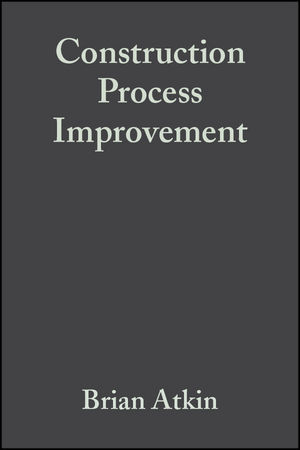
Construction Process Improvement (eBook)
John Wiley & Sons (Verlag)
978-0-470-68042-1 (ISBN)
Construction Process Improvement showcases 21 examples of how directed efforts are being taken to raise productivity and quality, reduce waste and costs, and provide more certain and durable products for the sector's customers. Each example is the subject of a closely coupled collaborative project in which answers are being sought on matters of strategic importance to companies. The chapters that describe and discuss these projects balance state-of-the-art reviews with details of the work being undertaken and, in many cases, the results that are being implemented within the companies.
Construction Process Improvement deals with issues that matter to best practice companies and researchers in industry and universities. It covers, amongst other topics, modularisation for manufactured housing, life cycle methods in housing, commercial buildings and services installations, tools and techniques for performance prediction and diagnostics, coordination of design and production processes, novel use of traditional materials, new forms of procurement and the role of innovation, public private partnerships, partnering structures, learning organisations, management of major refurbishment, management information systems, TQM and continuous improvement, CAAD methodology, tools and 4-D CAD, and facilities management.
This book analyses the way forward for improving the construction process, in particular the links between research and development and industrial competitiveness. The implementation of new methods and thinking in companies is examined and important advice for senior managers and researchers is offered.
The construction process has come under intense scrutiny in recent times and this is set to continue as building owners and users demand better value for money from a more sustainable built environment. The construction sector's actors are responding to the challenges implicit in this drive for greater competitiveness and social responsibility. New forms of procurement, innovation programmes, knowledge management, CAD-supported processes, predictive and diagnostic tools, and many more initiatives are helping to transform the sector. Construction Process Improvement showcases 21 examples of how directed efforts are being taken to raise productivity and quality, reduce waste and costs, and provide more certain and durable products for the sector's customers. Each example is the subject of a closely coupled collaborative project in which answers are being sought on matters of strategic importance to companies. The chapters that describe and discuss these projects balance state-of-the-art reviews with details of the work being undertaken and, in many cases, the results that are being implemented within the companies. Construction Process Improvement deals with issues that matter to best practice companies and researchers in industry and universities. It covers, amongst other topics, modularisation for manufactured housing, life cycle methods in housing, commercial buildings and services installations, tools and techniques for performance prediction and diagnostics, coordination of design and production processes, novel use of traditional materials, new forms of procurement and the role of innovation, public private partnerships, partnering structures, learning organisations, management of major refurbishment, management information systems, TQM and continuous improvement, CAAD methodology, tools and 4-D CAD, and facilities management. This book analyses the way forward for improving the construction process, in particular the links between research and development and industrial competitiveness. The implementation of new methods and thinking in companies is examined and important advice for senior managers and researchers is offered.
Brian Atkin PhD, MPhil, BSc, FRICS, FCIOB, his achievements span the disciplines of project management, construction management and facility management. As a member of British Standards Institutions FM Advisory Group and FM Technical Committee, he is well-placed to advise on current best practices and emerging trends in facility management. He has served on other advisory groups and steering committees covering standards, innovation, competitiveness and information technology (including BIM), and is actively involved in learning and business development for major corporations.
Preface.
Acknowledgements.
Contributors.
Introduction (Brian Atkin, Jan Borgbrant & Per-ErikJosephson).
Modularisation in the Customisation of Manufactured Housing(Carina Johansson).
Application of Integrated Life Cycle Design to Housing (MatsO& #214;berg).
Life Cycle Costs of Commercial Buildings - a Case Study(Eva Sterner).
A Life Cycle Cost Approach to Optimising Indoor (DennisJohansson &Anders Svensson).
Performance Indicators as a Tool for Decisions in theConstruction Process (Veronica Yvera& #229;s).
Reducing the Risk of Failure in Performance within Buildings(Stephen Burke).
Physical Status of Existing Buildings and their Components withthe Emphasis on Future Emissions (Torbjo& #246;rn Hall).
Co-ordination of the Design and Building Process for OptimalBuilding Performance (Niklas So& #246;rensen).
New Concrete Materials Technology for Competitive Construction(Markus Peterson).
Competitiveness in the Context of Procurement (FredrikMalmberg).
Encouraging Innovation through New Approaches to Procurement(Kristian Wide& #233;n).
Public-Private Partnerships - Conditions for Innovationand Project Success (Roine Leiringer).
Pros and Cons in Partnering Structures (Anna Rhodin).
Importance of the Project Team to the Creation of LearningWithin and Between Construction Projects (Fredrik Anheim).
Refurbishment of Commercial Buildings: the Relationship betweenthe Project and its Context (A& #197;sa Engwall).
Improving Project Efficiency through Process Transparency inManagement Information Systems (Christian Lindfors).
Improvements Processes in Construction Companies (PeterSamuelsson).
Design Research and the Records of Architectural Design:Expanding the Foundations of Design Tool Development (RobertFekete).
Communicating Project Concepts and Creating Decision Supportfrom CAAD (Jan Henrichse& #233;n).
Using 4D CAD in the Design and Management of Vertical Extensionsto Existing Buildings (Susan Bergsten).
Importance of Architectural Attributes in Facilities Management(Ulf Nordwall).
Conclusions (Brian Atkin, Jan Borgbrant & Per-ErikJosephson).
Index
I found the chapter on learning organisations in project teams
particularly stimulating.
The book would be especially useful to post graduate and final
year undergraduate students looking for useful advice on a vast
range of research methodologies, as well as examining the topics in
some detail.
Chris Hill Ms PGD MCIOB MCMI ILTM
| Erscheint lt. Verlag | 15.4.2008 |
|---|---|
| Sprache | englisch |
| Themenwelt | Technik ► Bauwesen |
| Schlagworte | Bauausführung • Bauausführung • Baubetrieb • Bauingenieur- u. Bauwesen • challenges • Civil Engineering & Construction • competitiveness • Construction • Construction Management • Drive • efforts • forms • greater • Implicit • initiatives • intense scrutiny • New • Owners • Process • procurement • Programmes • responding • Sector • sectors actors • SET • Times |
| ISBN-10 | 0-470-68042-3 / 0470680423 |
| ISBN-13 | 978-0-470-68042-1 / 9780470680421 |
| Informationen gemäß Produktsicherheitsverordnung (GPSR) | |
| Haben Sie eine Frage zum Produkt? |
 PDF (Adobe DRM)
Kopierschutz: Adobe-DRM
Adobe-DRM ist ein Kopierschutz, der das eBook vor Mißbrauch schützen soll. Dabei wird das eBook bereits beim Download auf Ihre persönliche Adobe-ID autorisiert. Lesen können Sie das eBook dann nur auf den Geräten, welche ebenfalls auf Ihre Adobe-ID registriert sind.
Details zum Adobe-DRM
Dateiformat: PDF (Portable Document Format)
Mit einem festen Seitenlayout eignet sich die PDF besonders für Fachbücher mit Spalten, Tabellen und Abbildungen. Eine PDF kann auf fast allen Geräten angezeigt werden, ist aber für kleine Displays (Smartphone, eReader) nur eingeschränkt geeignet.
Systemvoraussetzungen:
PC/Mac: Mit einem PC oder Mac können Sie dieses eBook lesen. Sie benötigen eine
eReader: Dieses eBook kann mit (fast) allen eBook-Readern gelesen werden. Mit dem amazon-Kindle ist es aber nicht kompatibel.
Smartphone/Tablet: Egal ob Apple oder Android, dieses eBook können Sie lesen. Sie benötigen eine
Geräteliste und zusätzliche Hinweise
Buying eBooks from abroad
For tax law reasons we can sell eBooks just within Germany and Switzerland. Regrettably we cannot fulfill eBook-orders from other countries.
aus dem Bereich