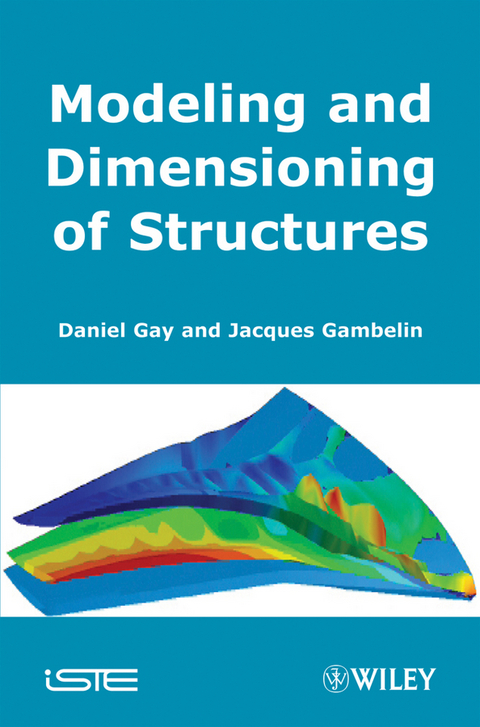
Modeling and Dimensioning of Structures (eBook)
640 Seiten
John Wiley & Sons (Verlag)
9780470393901 (ISBN)
Daniel Gay was Director of the Laboratory of Mechanical Design at the University of Toulouse, France, for more than 15 years. He published numerous papers in international scientific journals and several books on composites materials. Jacques Gambelin is Professor of Mechanical Design at the University of Toulouse, France, and taught structural design andcalculus for aeronautical applications for more than 20 years.
Preface.
Part 1. Level 1.
Chapter 1. The Basics of Linear Elastic Behavior.
1.1. Cohesion forces.
1.2. The notion of stress.
1.3. Hooke's law derived from a uniaxially applied force.
1.4. Plane state of stresses.
1.5. Particular case of straight beams.
Chapter 2. Mechanical Behavior of Structures: An Energy Approach.
2.1. Work and energy.
2.2. Conversion of work into energy.
2.3. Some standard expressions for potential deformation energy.
2.4. Work produced by external forces on a structure.
2.5. Links of a structure with its surroundings.
2.6. Stiffness of a structure.
Chapter 3. Discretization of a Structure into Finite Elements.
3.1. Preliminary observations.
3.2. Stiffness matrix of some simple finite elements.
3.3. Getting the global stiffness matrix of a structure.
3.4. Resolution of the system {F} = [K] * {d}.
3.5. Different types of finite elements available in industrial software.
Chapter 4. Applications: Discretization of Simple Structures.
4.1. Stiffness matrix of a spring.
4.2. Assembly of elements.
4.3. Behavior in the global coordinate system.
4.4. Bracket.
Part 2. Level 2.
Chapter 5. Other Types of Finite Elements.
5.1. Return to local and global coordinate systems.
5.2. Complete beam element (any loading case).
5.3. Elements for the plane state of stress.
5.4. Plate element.
5.5. Elements for complete states of stresses.
5.6. Shell elements.
Chapter 6. Introduction to Finite Elements for Structural Dynamics.
6.1. Principles and characteristics of dynamic study.
6.2. Mass properties of beams.
6.3. Generalization.
6.4. Summary.
Chapter 7. Criteria for Dimensioning.
7.1. Designing and dimensioning.
7.2. Dimensioning in statics.
7.3. Dimensioning in fatigue.
Chapter 8. Practical Aspects of Finite Element Modeling.
8.1. Use of finite element software.
8.2. Example 1: machine-tool shaft.
8.3. Example 2: thin-walled structures.
8.4. Example 3: modeling of a massive structure.
8.5. Summary of the successive modeling steps.
Part 3. Supplements.
Chapter 9. Behavior of Straight Beams.
9.1. The "straight beam" model.
9.2. Mesoscopic equilibrium or equilibrium extended to a whole cross-section.
9.3. Behavior relations and stresses.
9.4. Application: example of detailed calculation of the resultant forces and moments of cohesive forces.
Chapter 10. Additional Elements of Elasticity.
10.1. Reverting to the plane state of stresses.
10.2. Complete state of stresses.
Chapter 11. Structural Joints.
11.1. General information on connections by means of cylindrical fasteners.
11.2. Bolted joint.
11.3. Riveted joint.
11.4. Welded joints.
Chapter 12. Mathematical Prerequisites.
12.1. Matrix calculus.
12.2. Change in orthonormal coordinate system.
Appendix A. Modeling of Common Mechanical Joints.
A.1. Definition.
A.2. Common standardized mechanical joints (ISO 3952).
Appendix B. Mechanical Properties of Materials.
B.1. Mechanical properties of some materials used for structures.
Appendix C. List of Summaries.
Bibliography.
| Erscheint lt. Verlag | 21.1.2010 |
|---|---|
| Sprache | englisch |
| Themenwelt | Technik ► Bauwesen |
| Schlagworte | Applied Mathematics in Science • Bauingenieur- u. Bauwesen • Civil Engineering & Construction • construction materials • Konstruktionswerkstoffe • Materials Science • Materialwissenschaften • Mathematics • Mathematik • Mathematik in den Naturwissenschaften • Structural & Building Engineering • Tief- u. Hochbau / Massivbau |
| ISBN-13 | 9780470393901 / 9780470393901 |
| Informationen gemäß Produktsicherheitsverordnung (GPSR) | |
| Haben Sie eine Frage zum Produkt? |
 PDF (Adobe DRM)
Kopierschutz: Adobe-DRM
Adobe-DRM ist ein Kopierschutz, der das eBook vor Mißbrauch schützen soll. Dabei wird das eBook bereits beim Download auf Ihre persönliche Adobe-ID autorisiert. Lesen können Sie das eBook dann nur auf den Geräten, welche ebenfalls auf Ihre Adobe-ID registriert sind.
Details zum Adobe-DRM
Dateiformat: PDF (Portable Document Format)
Mit einem festen Seitenlayout eignet sich die PDF besonders für Fachbücher mit Spalten, Tabellen und Abbildungen. Eine PDF kann auf fast allen Geräten angezeigt werden, ist aber für kleine Displays (Smartphone, eReader) nur eingeschränkt geeignet.
Systemvoraussetzungen:
PC/Mac: Mit einem PC oder Mac können Sie dieses eBook lesen. Sie benötigen eine
eReader: Dieses eBook kann mit (fast) allen eBook-Readern gelesen werden. Mit dem amazon-Kindle ist es aber nicht kompatibel.
Smartphone/Tablet: Egal ob Apple oder Android, dieses eBook können Sie lesen. Sie benötigen eine
Geräteliste und zusätzliche Hinweise
Buying eBooks from abroad
For tax law reasons we can sell eBooks just within Germany and Switzerland. Regrettably we cannot fulfill eBook-orders from other countries.
aus dem Bereich