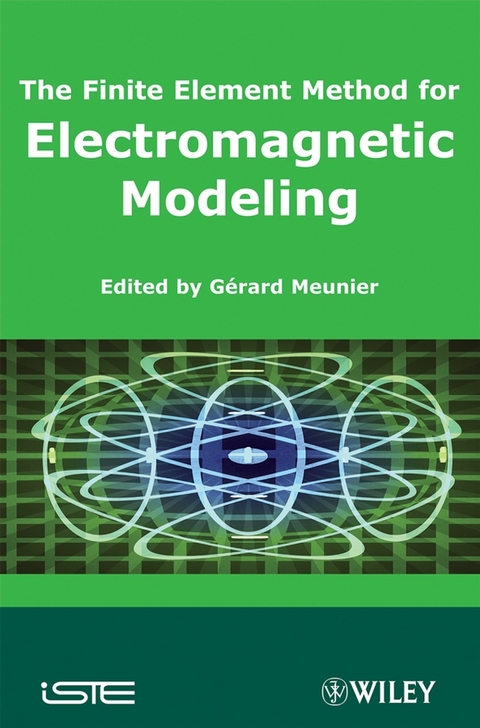
The Finite Element Method for Electromagnetic Modeling (eBook)
832 Seiten
John Wiley & Sons (Verlag)
978-0-470-39380-2 (ISBN)
provides a comprehensive review of the finite element method for
low frequency applications. Fundamentals of the method as well as
new advances in the field are described in detail.
Chapters 1 to 4 present general 2D and 3D static and dynamic
formulations by the use of scalar and vector unknowns and adapted
interpolations for the fields (nodal, edge, face or volume).
Chapter 5 is dedicated to the presentation of different macroscopic
behavior laws of materials and their implementation in a finite
element context: anisotropy and hysteretic properties for magnetic
sheets, iron losses, non-linear permanent magnets and
superconductors.
More specific formulations are then proposed: the modeling of thin
regions when finite elements become misfit (Chapter 6), infinite
domains by using geometrical transformations (Chapter 7), the
coupling of 2D and 3D formulations with circuit equations (Chapter
8), taking into account the movement, particularly in the presence
of Eddy currents (Chapter 9) and an original approach for the
treatment of geometrical symmetries when the sources are not
symmetric (Chapter 10).
Chapters 11 to 13 are devoted to coupled problems: magneto-thermal
coupling for induction heating, magneto-mechanical coupling by
introducing the notion of strong and weak coupling and
magneto-hydrodynamical coupling focusing on electromagnetic
instabilities in fluid conductors.
Chapter 14 presents different meshing methods in the context of
electromagnetism (presence of air) and introduces self-adaptive
mesh refinement procedures. Optimization techniques are then
covered in Chapter 15, with the adaptation of deterministic and
probabilistic methods to the numerical finite element
environment.
Chapter 16 presents a variational approach of electromagnetism,
showing how Maxwell equations are derived from thermodynamic
principles.
Gérard Meunier is the author of The Finite Element Method for Electromagnetic Modeling, published by Wiley.
Chapter 1. The nodal finite element method (J.L. Coulomb).
Chapter 2. Static formulations, P. Dular (F. Piriou).
Chapter 3. Dynamic formulations (Z. Ren, F. Bouillault).
Chapter 4. Mixed formulations (B. Bandelier, F. Rioux).
Chapter 5. Material behavior laws (F. Ossart, F. Bouillault, A. Lebouc, G. Meunier, F. Piriou).
Chapter 6. Thin regions (C. Guerin).
Chapter 7. Infinite domain (X. Brunotte).
Chapter 8. Circuit equations coupled problems (G. Meunier, Y. Lefevre, P. Lombard, Y. Lefloch).
Chapter 9. Movement (V. Leconte).
Chapter 10. Symmetrical components in field problems (J. Lobry, E. Nens, C. Broche).
Chapter 11. Magneto-thermal coupling (M. Feliachi, J. Fouladgar).
Chapter 12. Magneto-mechanical coupling (Y. Lefevre, G. Reyne).
Chapter 13. Magneto-hydro-dynamical coupling (F. Plunian, P. Masse).
Chapter 14. Mesh generation (Y. Du Terrail Couvat, F.X. Zgainski, Y. Marechal).
Chapter 15. Optimization (J.L. Coulomb).
Chapter 16. From thermodynamic principles to Maxwell equations (V. Mazauric).
List of Authors.
Index.
| Erscheint lt. Verlag | 21.1.2010 |
|---|---|
| Sprache | englisch |
| Themenwelt | Naturwissenschaften ► Physik / Astronomie ► Elektrodynamik |
| Technik ► Elektrotechnik / Energietechnik | |
| Schlagworte | Electrical & Electronics Engineering • Electromagnetic theory • Elektromagnetismus • Elektrotechnik u. Elektronik |
| ISBN-10 | 0-470-39380-7 / 0470393807 |
| ISBN-13 | 978-0-470-39380-2 / 9780470393802 |
| Informationen gemäß Produktsicherheitsverordnung (GPSR) | |
| Haben Sie eine Frage zum Produkt? |
 PDF (Adobe DRM)
Kopierschutz: Adobe-DRM
Adobe-DRM ist ein Kopierschutz, der das eBook vor Mißbrauch schützen soll. Dabei wird das eBook bereits beim Download auf Ihre persönliche Adobe-ID autorisiert. Lesen können Sie das eBook dann nur auf den Geräten, welche ebenfalls auf Ihre Adobe-ID registriert sind.
Details zum Adobe-DRM
Dateiformat: PDF (Portable Document Format)
Mit einem festen Seitenlayout eignet sich die PDF besonders für Fachbücher mit Spalten, Tabellen und Abbildungen. Eine PDF kann auf fast allen Geräten angezeigt werden, ist aber für kleine Displays (Smartphone, eReader) nur eingeschränkt geeignet.
Systemvoraussetzungen:
PC/Mac: Mit einem PC oder Mac können Sie dieses eBook lesen. Sie benötigen eine
eReader: Dieses eBook kann mit (fast) allen eBook-Readern gelesen werden. Mit dem amazon-Kindle ist es aber nicht kompatibel.
Smartphone/Tablet: Egal ob Apple oder Android, dieses eBook können Sie lesen. Sie benötigen eine
Geräteliste und zusätzliche Hinweise
Buying eBooks from abroad
For tax law reasons we can sell eBooks just within Germany and Switzerland. Regrettably we cannot fulfill eBook-orders from other countries.
aus dem Bereich