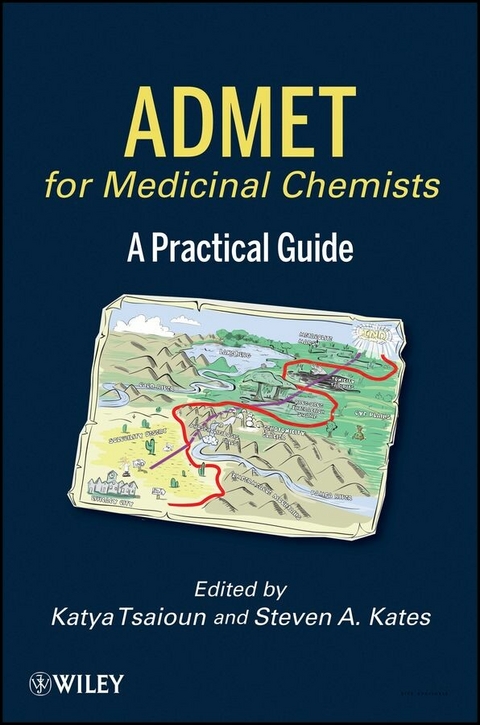
ADMET for Medicinal Chemists (eBook)
John Wiley & Sons (Verlag)
978-0-470-91509-7 (ISBN)
This book guides medicinal chemists in how to implement early ADMET testing in their workflow in order to improve both the speed and efficiency of their efforts. Although many pharmaceutical companies have dedicated groups directly interfacing with drug discovery, the scientific principles and strategies are practiced in a variety of different ways. This book answers the need to regularize the drug discovery interface; it defines and reviews the field of ADME for medicinal chemists. In addition, the scientific principles and the tools utilized by ADME scientists in a discovery setting, as applied to medicinal chemistry and structure modification to improve drug-like properties of drug candidates, are examined.
KATYA TSAIOUN, PhD, is Chief Scientific Officer of Cyprotex and, previously, president and founder Apredica, which was acquired by Cyprotex. Both companies specialize in the rapid preclinical in vitro assessment of the ADME-Tox (Absorption, Distribution, Metabolism, Elimination, and Toxicity) properties of small-molecule and peptide therapeutics. STEVEN A. KATES, PhD is Vice President of Research and Development at Ischemix. He is a highly experienced chemist with over twenty years in R&D for both life science products and human therapeutics, and has advanced several compounds through drug development from early preclinical to early clinical development. He has more than 100 patents and publications, including one book.
ADMET for Medicinal Chemists: A Practical Guide 1
CONTENTS 7
Preface 17
Contributors 21
1 Introduction 23
1.1 Introduction 23
1.2 Voyage Through The Digestive System 24
1.2.1 The Mouth 25
1.2.2 The Stomach 26
1.2.3 The Small Intestine: Duodenum 29
1.2.4 The Small and Large Intestine: Jejunum, Ileum, Colon 31
1.2.5 Hepatic-Portal Vein 35
1.3 The Liver Metabolism 37
1.3.1 CYP450 (CYPs) 39
1.4 The Kidneys 43
1.4.1 Active Tubular Secretion 45
1.4.2 Passive Tubular Reabsorption 46
1.5 Conclusions 47
References 47
2 In Silico ADME/Tox Predictions 51
2.1 Introduction 51
2.2 Key Computer Methods for ADME/Tox Predictions 52
2.2.1 Drug Discovery 52
2.2.2 Applying or Not ADME/Tox Predictions, Divided Opinions 57
2.2.3 In Silico ADME/Tox Methods and Modeling Approaches 61
2.2.4 Physicochemistry, Pharmacokinetics, Drug-Like and Lead-Like Concepts 68
2.2.5 Lipophilicity 73
2.2.6 pKa 75
2.2.7 Transport Proteins 83
2.2.8 Plasma Protein Binding 84
2.2.9 Metabolism 87
2.2.10 Elimination 89
2.2.11 Toxicity 89
2.3 Preparation of Compound Collections and Computer Programs, Challenging ADME/Tox Predictions and Statistical Methods 95
2.3.1 Preparation of Compound Collections and Computer Programs 95
2.3.2 Preparing a Compound Collection: Materials and Methods 97
2.3.3 Cleaning and Designing the Compound Collection 105
2.3.4 Searching for Similarity 107
2.3.5 Generating 3D Structures 108
2.4 ADME/Tox Predictions within Pharmaceutics Companies 108
2.4.1 Actelion Pharmaceuticals Ltd. 108
2.4.2 Bayer 108
2.4.3 Bristol-Myers Squibb 109
2.4.4 Hoffmann-La Roche Ltd. 109
2.4.5 Neurogen Corporation 109
2.4.6 Novartis 110
2.4.7 Schering AG 110
2.4.8 Vertex Pharmaceuticals 110
2.5 Challenging ADME/Tox Predictions 110
2.5.1 Tolcapone 111
2.5.2 Factor V Inhibitors 111
2.5.3 CRF-1 Receptor Antagonists 112
2.6 Statistical Methods 112
2.6.1 Principal Component Analysis 112
2.6.2 Partial Least Square 115
2.6.3 Support Vector Machine 118
2.6.4 Decision Trees 120
2.6.5 Neural Networks 123
2.7 Conclusions 126
References 127
3 Absorption and Physicochemical Properties of the NCE 147
3.1. Introduction 147
3.2. Physicochemical Properties 148
3.3. Stability 149
3.4. Dissolution and Solubility 150
3.4.1. Dissolution Rate, Particle Size, and Solubility 150
3.4.2. pH and Salts 152
3.4.3. In Vivo Solubilization 155
3.5. Solid State 156
References 161
4 ADME 167
4.1 Introduction 167
4.2 Absorption 168
4.2.1 Route of Administration 168
4.2.2 Factors Determining Oral Bioavailability 171
4.3 Distribution 179
4.3.1 Drug Distribution 179
4.3.2 Volume of Distribution 180
4.3.3 Free Drug Concentration 182
4.3.4 CNS Penetration 184
4.4 Elimination 187
4.4.1 Elimination Versus Clearance 187
4.4.2 Metabolism Versus Excretion 187
4.4.3 Drug-Free Fraction and Clearance 188
4.4.4 Lipophilicity and Clearance 188
4.4.5 Transporters and Clearance 188
4.4.6 Metabolism 189
4.4.7 Excretion 193
4.5 Drug Interactions 196
4.5.1 Absorption-Driven DDI 196
4.5.2 Distribution-Driven DDI 196
4.5.3 Excretion-Driven DDI 196
4.5.4 Metabolism-Driven DDI 197
4.5.5 Tools for Studying Drug Metabolism 199
4.5.6 Applications of Drug Metabolism Tools 202
4.5.7 Tools for Studying Drug Excretion 206
4.6 Strategies for Assessing ADME Properties 208
4.6.1 Assessing ADME Attributes at Different Stages of Discovery Projects 208
4.7 Tool Summary for Assessing ADME Properties 212
References 212
5 Pharmacokinetics for Medicinal Chemists 223
5.1 Introduction 223
5.1.1 History of Pharmacokinetics as Science 223
5.2 ADME 224
5.2.1 Absorption 224
5.2.2 Distribution 226
5.2.3 Metabolism 229
5.2.4 Excretion 229
5.3 The Mathematics of Pharmacokinetics 233
5.3.1 Compartmental Versus Noncompartmental Analysis 234
5.4 Drug Administration and PK Observations 234
5.4.1 Analysis of Intravenous PK Data 235
5.4.2 Analysis of Extravascular PK Data 249
5.4.3 Analysis of Intravenous Infusion Data 252
5.4.4 Analysis of PK Data after Multiple Dose Administrations 253
5.4.5 Analysis of PK Data after Escalating Dose Administrations 255
5.5 Human PK Projection 257
5.5.1 Allometric Scaling 257
5.5.2 Scaling by Physiologically Based Pharmacokinetic Modeling 259
5.5.3 In Vitro–In Vivo Correlations 261
5.6 PK Practices 261
5.6.1 PK Studies for Different Stages of Discovery Projects 262
5.6.2 Key Parameters of PK Studies 263
5.7 Engineering Molecules with Desired ADME Profile 291
5.A Appendices 291
5.A.1 General Morphinometric Data for Different Species 291
5.A.2 Organ Weights in Different Species 292
5.A.3 Organ, Tissue, and Fluid Volumes in Different Species 293
5.A.4 Blood Content in Different Rat Organs 293
5.A.5 Biofluid Flow through the Organs in Different Species 294
5.A.6 Anatomical Characteristics of GI Tract in Different Species 295
5.A.7 The pH and Motility of GI Tract in Different Species 296
5.A.8 Phase I and Phase II Metabolism in Different Species 296
Acknowledgments 299
References 299
6 Cardiac Toxicity 309
6.1 Introduction 309
6.2 Ion Channel-Related Cardiac Toxicity 309
6.2.1 Cardiac Electrophysiology 310
6.2.2 Delayed Repolarization: Mechanisms and Models 312
6.2.3 Shortened Ventricular Repolarization 316
6.2.4 Alterations in Intracellular Ca2+ Handling 318
6.2.5 Preclinical Models for Assessment of Ion Channel-Related Cardiotoxicity 319
6.3 Nonarrhythmic Cardiac Toxicity 321
6.3.1 Definition of Drug-Induced Cardiac Toxicity 322
6.3.2 Assays for Detection of Nonarrhythmic Cardiac Toxicity 322
6.3.3 Biochemical and Molecular Basis of Drug-Induced Cardiac Toxicity—Impairment of Mitochondrial Function 326
References 328
7 Genetic Toxicity: In Vitro Approaches for Medicinal Chemists 337
7.1 Introduction 337
7.1.1 Scope of this Chapter 337
7.1.2 Definitions 338
7.1.3 Positive Genotoxicity Data is not Uncommon and Very Costly 338
7.1.4 Why Genome Damage is Undesirable 339
7.1.5 The Inherent Integrity of the Genome and its Inevitable Corruption 339
7.1.6 Many Chemicals can Cause Cancer, but do not Pose a Significant Risk to Humans 340
7.1.7 The False Positives: Many Chemicals Produce Positive Genotoxicity Data that are neither Carcinogens nor In Vivo Genotoxins 340
7.1.8 Defense Against Genotoxic Damage 341
7.1.9 Mechanisms of Genotoxic Damage 342
7.1.10 Genotoxicity Assessment Occurs after Medicinal Chemistry Optimization 343
7.2 Limitations in the Regulatory In Vitro Genotoxicity Tests 344
7.2.1 Biology Limitations of In Vitro Tests 344
7.2.2 Hazard and Safety Assessment have Different Requirements 345
7.2.3 The Data from Genetic Toxicologists 345
7.3 Practical Issues for Genotoxicity Profiling 346
7.3.1 Vehicle 346
7.3.2 Dilution Range 346
7.3.3 Purity 346
7.4 Computational Approaches to Genotoxicity Assessment: The In Silico Methods 347
7.4.1 General Considerations 347
7.4.2 The Chemistry of Genotoxins 350
7.5 Genotoxicity Assays for Screening 357
7.5.1 Bacterial Gene Mutation Assays 359
7.5.2 Mammalian Cell Mutation Assays 360
7.5.3 Saccharomyces cerevisiae (“Yeast”) Mutation Assays 360
7.5.4 Chromosome Damage and Aberration Assays 361
7.5.5 The "Comet" Assay 362
7.5.6 DNA Adduct Assessment 363
7.5.7 Gene Expression Assays 363
7.6 The "Omics" 365
7.7 Using Data from In Vitro Profiling: Confirmatory Tests, Follow-Up Tests, and the Link to Safety Assessment and In Vivo Models 365
7.7.1 Annotations from Screening Data 366
7.7.2 Can a Genetic Toxicity Profile Assist with In Vivo Testing Strategies? 366
7.8 What to Test, When, and How 367
7.9 Changes to Regulatory Guidelines Can Influence Screening Strategy 368
7.10 Summary 369
Acknowledgment 369
References 370
8 Hepatic Toxicity 375
8.1 Introduction 375
8.2 Mechanisms of DILI 376
8.2.1 Reactive Metabolite Formation 377
8.2.2 Mitochondrial Dysfunction and Oxidative Stress 379
8.2.3 Bile Flow, Drug-Induced Cholestasis, and Inhibition of Biliary Efflux Transporters 381
8.3 Assays and Test Systems to Measure Various Types of DILI 382
8.4 Medicinal Chemistry Strategies to Minimize DILI 387
8.5 Future Outlooks 392
Acknowledgment 392
References 392
9 In Vivo Toxicological Considerations 401
9.1 Introduction 401
9.2 Route of Administration 401
9.2.1 Oral Route 402
9.2.2 Intravenous Route 403
9.2.3 Dermal Route 404
9.3 Formulation Issues 405
9.4 Compound Requirements 406
9.5 Animal Models 407
9.5.1 Mouse 407
9.5.2 Rat 408
9.5.3 Dog 408
9.5.4 Swine 408
9.5.5 Nonhuman Primates 409
9.6 IND-Supporting Toxicology Studies 409
9.6.1 Single-Dose Studies 409
9.6.2 Repeat-Dose Studies 410
9.7 Study Result Interpretation 414
9.7.1 Clinical Observations 414
9.7.2 Body Weight/Feed Consumption 415
9.7.3 Clinical Pathology 415
9.7.4 Clinical Chemistry 415
9.7.5 Electrocardiograms 416
9.7.6 Organ Weights 416
9.7.7 Pathology 417
9.8 Genetic Toxicology Studies 417
9.8.1 Gene Mutation 417
9.8.2 Chromosomal Aberration 418
9.8.3 In Vivo Mouse Micronucleus 418
9.9 Conclusion 418
References 419
10 Preclinical Candidate Nomination and Development 421
10.1 Introduction 421
10.2 Investigational New Drug Application and Clinical Development 422
10.2.1 Chemistry, Manufacturing, and Control Information 423
10.2.2 Animal Pharmacology and Toxicology Studies 423
10.2.3 Clinical Protocols and Investigator Information 423
10.3 Strategic Goals for the Preclinical Development 424
10.4 Selection of Preclinical Development Candidate 425
10.4.1 Efficacy 425
10.4.2 Safety/Tolerance 427
10.4.3 PK 429
10.4.4 Non-GLP Toxicological Study 429
10.5 CMC 430
10.5.1 Solubility 430
10.5.2 Solutions Stability 430
10.5.3 Synthetic Feasibility, Solid-State Stability, and Hygroscopicity 430
10.5.4 Patent Position 430
10.6 Preclinical Studies 431
10.6.1 Example 1: IND Enabling Data Package to Support 1 Month Dosing in Man 432
10.6.2 Example 2: Peroxisome Proliferator-Activated Receptor Agonist for Type-2 Diabetes 432
10.6.3 Mass Balance 432
10.6.4 Animal Pharmacology and Toxicology Studies 432
10.6.5 Regulatory 436
10.7 Conclusions 437
References 437
11 Fragment-Based Drug Design: Considerations for Good ADME Properties 439
11.1 Introduction 439
11.2 Fragment-Based Screening 440
11.2.1 Fragment Library Design 441
11.2.2 Detection and Characterization of Weakly Binding Ligands 442
11.2.3 Approaches from Fragment to Lead Structures 449
11.3 Case Studies of Fragment-Based Screening for Better Bioavailability 453
11.3.1 Adenosine Kinase 453
11.3.2 Leukocyte Function-Associated Antigen-1 454
11.3.3 Matrix Metalloproteinase 3 (Stromelysins) 454
11.3.4 Protein Tyrosine Phosphatase 1B 455
11.3.5 ?-Secretase (BACE-1) 458
11.3.6 SH2 Domain of pp60Src [62, 129] 461
11.3.7 Thrombin 461
11.3.8 Urokinase 463
11.3.9 Cathepsin S 464
11.3.10 Caspase-3 464
11.3.11 HIV-1 Protease 466
11.4 De Novo Design 467
11.4.1 In Silico Fragment Screening 469
11.4.2 Scaffold Hopping 470
11.5 Case Studies of De Novo Design for Better Bioavailability 472
11.5.1 DNA Gyrase 472
11.5.2 Factor Xa 472
11.5.3 X-Linked Inhibitor of Apoptosis Protein 473
11.5.4 Activator Protein-1 [196b] 473
11.6 Minimal Pharmacophoric Elements and Fragment Hopping 474
11.6.1 Minimal Pharmacophoric Elements 474
11.6.2 Fragment Hopping 475
11.6.3 Case Study: Nitric Oxide Synthase 479
11.7 Conclusions and Future Perspectives 481
Acknowledgments 482
References 482
Index 509
Color Plates 521
"The content of the book was overall revealing and if you wanted a
general text on ADMET (or ADME) together with a mix of toxicology
to complement other texts, then this book would probably be a good
addition to your collection." (The British Toxicology Society, 1
May 2011)
| Erscheint lt. Verlag | 21.2.2012 |
|---|---|
| Sprache | englisch |
| Themenwelt | Medizin / Pharmazie |
| Naturwissenschaften ► Chemie | |
| Technik | |
| Schlagworte | Biochemie u. Chemische Biologie • Biochemistry (Chemical Biology) • Chemie • Chemistry • Drug Discovery & Development • implement early ADMET testing, ADMET testing, guidelines for ADMET testing, drug discovery, scientific principles of ADMET. strategies for ADMET, testing in a scientific discovery setting, ADMET and medicinal chemistry • Medical Science • Medizin • Medizinische Chemie • Pharmacology & Pharmaceutical Medicine • Pharmakologie u. Pharmazeutische Medizin • Wirkstoffforschung u. -entwicklung |
| ISBN-10 | 0-470-91509-9 / 0470915099 |
| ISBN-13 | 978-0-470-91509-7 / 9780470915097 |
| Informationen gemäß Produktsicherheitsverordnung (GPSR) | |
| Haben Sie eine Frage zum Produkt? |
 PDF (Adobe DRM)
Kopierschutz: Adobe-DRM
Adobe-DRM ist ein Kopierschutz, der das eBook vor Mißbrauch schützen soll. Dabei wird das eBook bereits beim Download auf Ihre persönliche Adobe-ID autorisiert. Lesen können Sie das eBook dann nur auf den Geräten, welche ebenfalls auf Ihre Adobe-ID registriert sind.
Details zum Adobe-DRM
Dateiformat: PDF (Portable Document Format)
Mit einem festen Seitenlayout eignet sich die PDF besonders für Fachbücher mit Spalten, Tabellen und Abbildungen. Eine PDF kann auf fast allen Geräten angezeigt werden, ist aber für kleine Displays (Smartphone, eReader) nur eingeschränkt geeignet.
Systemvoraussetzungen:
PC/Mac: Mit einem PC oder Mac können Sie dieses eBook lesen. Sie benötigen eine
eReader: Dieses eBook kann mit (fast) allen eBook-Readern gelesen werden. Mit dem amazon-Kindle ist es aber nicht kompatibel.
Smartphone/Tablet: Egal ob Apple oder Android, dieses eBook können Sie lesen. Sie benötigen eine
Geräteliste und zusätzliche Hinweise
Buying eBooks from abroad
For tax law reasons we can sell eBooks just within Germany and Switzerland. Regrettably we cannot fulfill eBook-orders from other countries.
aus dem Bereich