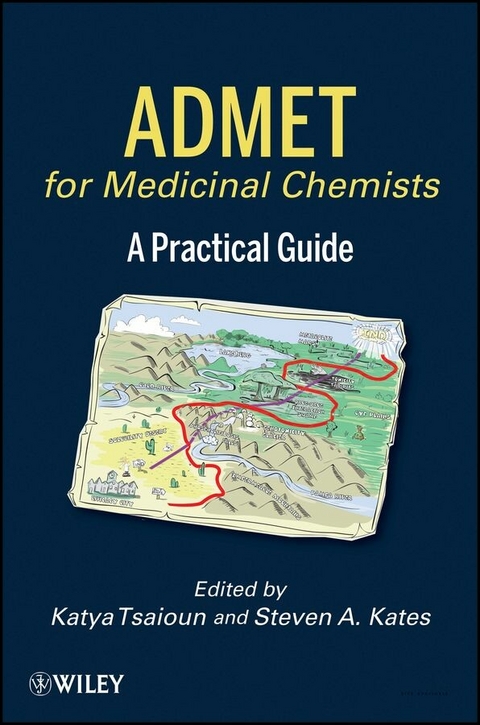
ADMET for Medicinal Chemists (eBook)
John Wiley & Sons (Verlag)
978-0-470-92281-1 (ISBN)
KATYA TSAIOUN, PhD, is Chief Scientific Officer of Cyprotex and, previously, president and founder Apredica, which was acquired by Cyprotex. Both companies specialize in the rapid preclinical in vitro assessment of the ADME-Tox (Absorption, Distribution, Metabolism, Elimination, and Toxicity) properties of small-molecule and peptide therapeutics.
STEVEN A. KATES, PhD is Vice President of Research and Development at Ischemix. He is a highly experienced chemist with over twenty years in R&D for both life science products and human therapeutics, and has advanced several compounds through drug development from early preclinical to early clinical development. He has more than 100 patents and publications, including one book.
This book guides medicinal chemists in how to implement early ADMET testing in their workflow in order to improve both the speed and efficiency of their efforts. Although many pharmaceutical companies have dedicated groups directly interfacing with drug discovery, the scientific principles and strategies are practiced in a variety of different ways. This book answers the need to regularize the drug discovery interface; it defines and reviews the field of ADME for medicinal chemists. In addition, the scientific principles and the tools utilized by ADME scientists in a discovery setting, as applied to medicinal chemistry and structure modification to improve drug-like properties of drug candidates, are examined.
KATYA TSAIOUN, PhD, is Chief Scientific Officer of Cyprotex and, previously, president and founder Apredica, which was acquired by Cyprotex. Both companies specialize in the rapid preclinical in vitro assessment of the ADME-Tox (Absorption, Distribution, Metabolism, Elimination, and Toxicity) properties of small-molecule and peptide therapeutics. STEVEN A. KATES, PhD is Vice President of Research and Development at Ischemix. He is a highly experienced chemist with over twenty years in R&D for both life science products and human therapeutics, and has advanced several compounds through drug development from early preclinical to early clinical development. He has more than 100 patents and publications, including one book.
Preface.
Contributors.
1 Introduction (Corinne Kay).
1.1 Introduction.
1.2 Voyage Through The Digestive System.
1.3 The Liver Metabolism.
1.4 The Kidneys.
1.5 Conclusions.
2 In Silico ADME/Tox Predictions (David Lagorce, Christelle Reynes, Anne-Claude Camproux, Maria A. Miteva, Olivier Sperandio, and Bruno O. Villoutreix).
2.1 Introduction.
2.2 Key Computer Methods for ADME/Tox Predictions.
2.3 Preparation of Compound Collections and Computer Programs, Challenging ADME/Tox Predictions and Statistical Methods.
2.4 ADME/Tox Predictions within Pharmaceutics Companies.
2.5 Challenging ADME/Tox Predictions.
2.6 Statistical Methods.
2.7 Conclusions.
3 Absorption and Physicochemical Properties of the NCE (Jon Selbo and Po-Chang Chiang).
3.1. Introduction.
3.2. Physicochemical Properties.
3.3. Stability.
3.4. Dissolution and Solubility.
3.5. Solid State.
4 ADME (Martin E. Dowty, Dean M. Messing, Yurong Lai, and Leonid (Leo) Kirkovsky).
4.1 Introduction.
4.2 Absorption.
4.3 Distribution.
4.4 Elimination.
4.5 Drug Interactions.
4.6 Strategies for Assessing ADME Properties.
4.7 Tool Summary for Assessing ADME Properties.
5 Pharmacokinetics for Medicinal Chemists (Leonid (Leo) Kirkovsky and Anup Zutshi).
5.1 Introduction.
5.2 ADME.
5.3 The Mathematics of Pharmacokinetics.
5.4 Drug Administration and PK Observations.
5.5 Human PK Projection.
5.6 PK Practices.
5.7 Engineering Molecules with Desired ADME Profile.
6 Cardiac Toxicity (Ralf Kettenhofen and Silke Schwengberg).
6.1 Introduction.
6.2 Ion Channel-Related Cardiac Toxicity.
6.3 Nonarrhythmic Cardiac Toxicity.
7 Genetic Toxicity: In Vitro Approaches for Medicinal Chemists (Richard M. Walmsley and David Elder).
7.1 Introduction.
7.2 Limitations in the Regulatory In Vitro Genotoxicity Tests.
7.3 Practical Issues for Genotoxicity Profiling.
7.4 Computational Approaches to Genotoxicity Assessment: The In Silico Methods.
7.5 Genotoxicity Assays for Screening.
7.6 The "Omics".
7.7 Using Data from In Vitro Profiling: Confirmatory Tests, Follow-Up Tests, and the Link to Safety Assessment and In Vivo Models.
7.8 What to Test, When, and How.
7.9 Changes to Regulatory Guidelines Can Influence Screening Strategy.
7.10 Summary.
8 Hepatic Toxicity (Jinghai James Xu and Keith Hoffmaster).
8.1 Introduction.
8.2 Mechanisms of DILI.
8.3 Assays and Test Systems to Measure Various Types of DILI.
8.4 Medicinal Chemistry Strategies to Minimize DILI.
8.5 Future Outlooks.
9 In Vivo Toxicological Considerations (John P. Devine, Jr).
9.1 Introduction.
9.2 Route of Administration.
9.3 Formulation Issues.
9.4 Compound Requirements.
9.5 Animal Models.
9.6 IND-Supporting Toxicology Studies.
9.7 Study Result Interpretation.
9.8 Genetic Toxicology Studies.
9.9 Conclusion.
10 Preclinical Candidate Nomination and Development (Nils Bergenhem).
10.1 Introduction.
10.2 Investigational New Drug Application and Clinical Development.
10.3 Strategic Goals for the Preclinical Development.
10.4 Selection of Preclinical Development Candidate.
10.5 CMC.
10.6 Preclinical Studies.
10.7 Conclusions.
11 Fragment-Based Drug Design: Considerations for Good ADME Properties (Haitao Ji).
11.1 Introduction.
11.2 Fragment-Based Screening.
11.3 Case Studies of Fragment-Based Screening for Better Bioavailability.
11.4 De Novo Design.
11.5 Case Studies of De Novo Design for Better Bioavailability.
11.6 Minimal Pharmacophoric Elements and Fragment Hopping.
11.7 Conclusions and Future Perspectives.
Acknowledgments.
References.
Index.
"The content of the book was overall revealing and if you wanted a
general text on ADMET (or ADME) together with a mix of toxicology
to complement other texts, then this book would probably be a good
addition to your collection." (The British Toxicology Society, 1
May 2011)
| Erscheint lt. Verlag | 15.2.2011 |
|---|---|
| Sprache | englisch |
| Themenwelt | Medizin / Pharmazie |
| Naturwissenschaften ► Chemie | |
| Technik | |
| Schlagworte | Biochemie u. Chemische Biologie • Biochemistry (Chemical Biology) • Chemie • Chemistry • Drug Discovery & Development • implement early ADMET testing, ADMET testing, guidelines for ADMET testing, drug discovery, scientific principles of ADMET. strategies for ADMET, testing in a scientific discovery setting, ADMET and medicinal chemistry • Medical Science • Medizin • Medizinische Chemie • Pharmacology & Pharmaceutical Medicine • Pharmakologie u. Pharmazeutische Medizin • Wirkstoffforschung u. -entwicklung |
| ISBN-10 | 0-470-92281-8 / 0470922818 |
| ISBN-13 | 978-0-470-92281-1 / 9780470922811 |
| Informationen gemäß Produktsicherheitsverordnung (GPSR) | |
| Haben Sie eine Frage zum Produkt? |
 EPUB (Adobe DRM)
Kopierschutz: Adobe-DRM
Adobe-DRM ist ein Kopierschutz, der das eBook vor Mißbrauch schützen soll. Dabei wird das eBook bereits beim Download auf Ihre persönliche Adobe-ID autorisiert. Lesen können Sie das eBook dann nur auf den Geräten, welche ebenfalls auf Ihre Adobe-ID registriert sind.
Details zum Adobe-DRM
Dateiformat: EPUB (Electronic Publication)
EPUB ist ein offener Standard für eBooks und eignet sich besonders zur Darstellung von Belletristik und Sachbüchern. Der Fließtext wird dynamisch an die Display- und Schriftgröße angepasst. Auch für mobile Lesegeräte ist EPUB daher gut geeignet.
Systemvoraussetzungen:
PC/Mac: Mit einem PC oder Mac können Sie dieses eBook lesen. Sie benötigen eine
eReader: Dieses eBook kann mit (fast) allen eBook-Readern gelesen werden. Mit dem amazon-Kindle ist es aber nicht kompatibel.
Smartphone/Tablet: Egal ob Apple oder Android, dieses eBook können Sie lesen. Sie benötigen eine
Geräteliste und zusätzliche Hinweise
Buying eBooks from abroad
For tax law reasons we can sell eBooks just within Germany and Switzerland. Regrettably we cannot fulfill eBook-orders from other countries.
aus dem Bereich