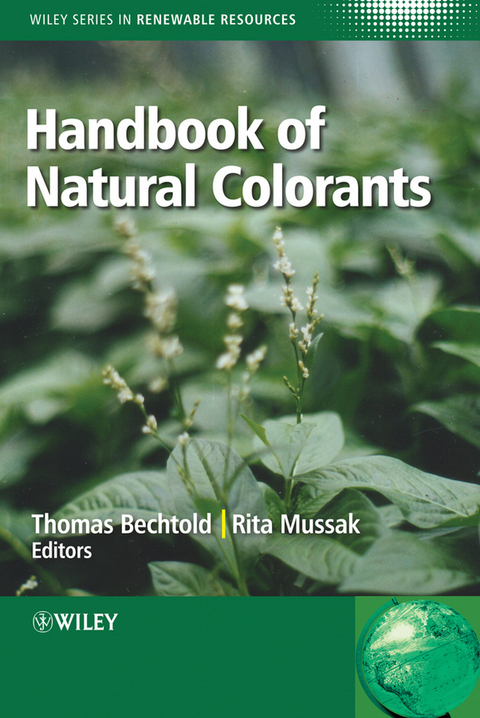
Handbook of Natural Colorants (eBook)
John Wiley & Sons (Verlag)
978-0-470-74496-3 (ISBN)
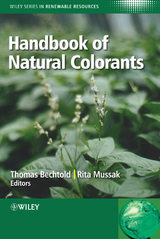
Written by scientists with specialised knowledge in the field, Handbook of Natural Colorants provides a unique source of information, summarising the present knowledge of natural colorants in depth. Supporting researchers in this emerging field of sustainable chemistry, it provides easy access to the theory and practice of natural colorants from different viewpoints, including agricultural, economic and legislative aspects.
Topics covered include:
- History of coloration technology
- Present position of natural colorants
- Regional plant source availability
- Specific application techniques
- Chemical properties that professional dyers and chemists have to consider
- Agricultural sourcing of dyes with an emphasis on renewable resources
- Discussions on energy and material balance issues arising from the sourcing of materials
- Production aspects of colorants, leading on to the key applications
- Environmental and economic aspects
Also included are the pros and cons of natural dyestuffs, presenting some promising results and evaluating the potential use of vegetable dyes as alternatives to chemical-based ones with a focus on green chemistry
Dr Thomas Bechtold is Head of the Institute for Textile Chemistry and Textile Physics at the Leopold-Franzens University of Innsbruck, Austria. His key research interests are: dyeing with vat, indigo and sulfur dyes; electrochemistry in textile processes; formulation of special detergents.
He has published over 70 papers in this research field in the last 20 years.
Dr Rita Mussak is based in the Department of Theoretical Chemistry at the Leopold-Franzens University of Innsbruck, Austria.
Concentration on renewable resources, sustainability and replacement of oil based products are driving forces to reassess the potential of natural resources including natural colorants. The growing consumer interest in purchasing green products, which exhibit an improved environmental profile, can be seen as the break-through force needed to reintroduce natural colorants into the modern markets. Written by scientists with specialised knowledge in the field, Handbook of Natural Colorants provides a unique source of information, summarising the present knowledge of natural colorants in depth. Supporting researchers in this emerging field of sustainable chemistry, it provides easy access to the theory and practice of natural colorants from different viewpoints, including agricultural, economic and legislative aspects. Topics covered include: History of coloration technology Present position of natural colorants Regional plant source availability Specific application techniques Chemical properties that professional dyers and chemists have to consider Agricultural sourcing of dyes with an emphasis on renewable resources Discussions on energy and material balance issues arising from the sourcing of materials Production aspects of colorants, leading on to the key applications Environmental and economic aspects Also included are the pros and cons of natural dyestuffs, presenting some promising results and evaluating the potential use of vegetable dyes as alternatives to chemical-based ones with a focus on green chemistry
Dr Thomas Bechtold is Head of the Institute for Textile Chemistry and Textile Physics at the Leopold-Franzens University of Innsbruck, Austria. His key research interests are: dyeing with vat, indigo and sulfur dyes; electrochemistry in textile processes; formulation of special detergents. He has published over 70 papers in this research field in the last 20 years. Dr Rita Mussak is based in the Department of Theoretical Chemistry at the Leopold-Franzens University of Innsbruck, Austria.
I. HISTORICAL ASPECTS.
1. History of Natural Dyes in the Ancient Mediterranean World (Maria J. Melo).
2. Colours in Civilisations of the World and Natural Colorants: History under Tension (Dominique Cardon).
3. History on Natural Dyes in North Africa "Egypt" (Harby Ezzeldeen Ahmed).
II. REGIONAL ASPECTS OF AVAILABILITY OF PLANT SOURCES.
4. Dye Plants in Europe (Andrea Biertümpfel & Günter Wurl).
5. Dyes in South America (Veridiana Vera de Rosso and Adriana Zerlotti Mercadante).
6. Dye Plants in Vietnam (Hoang Thi Linh).
III. COLORANT PRODUCTION AND PROPERTIES.
7. Indigo - Agricultural aspects (Philip John and Luciana Gabriella Angelini).
8. Indigo - Production (Philip John).
9. Anthocyanins, Nature's Glamorous Palette (Maria J. Melo, Fernando Pina, and Claude Andary).
10. Anthraquinones (Thomas Bechtold).
11. Dyes from Lichen and Mushrooms (Riikka Räisänen).
12. Tannins and tannin agents (Riita Julkunen-Tiitto, and Hely Häggman).
13. Carotenoids-Properties (U. G. Chandrika).
14. Carotenoids-Production (U. G. Chandrika).
15. Chlorophylls (Ursula Maria Lanfer Marquez and Daniela Borrmann).
IV. APPLICATION IN TECHNICAL USE AND CONSUMER PRODUCTS.
16. Flavonoids as Natural Pigments (M. Monica Guisti and Taylor C. Wallace).
17. Coloration of Wood (Martin Weigl).
18. Natural colorants in textiles (Rita Mussak).
19. Natural colorants in hair dyeing (Thomas Bechtold).
V. ENVIRONMENTAL.
20. Environmental Aspects and Sustainability (Erika Ganglberger).
21. Economic aspects of Natural dyes (Susanne Geissler).
Review copy sent 02/11/10: Chimie Nouvelle
| Erscheint lt. Verlag | 6.4.2009 |
|---|---|
| Reihe/Serie | Wiley Series in Renewable Resource |
| Wiley Series in Renewable Resources | Wiley Series in Renewable Resources |
| Sprache | englisch |
| Themenwelt | Naturwissenschaften ► Chemie |
| Technik | |
| Schlagworte | Based • breakthrough • Chemie • Chemistry • colorants • consumer • Environmental Profile • Farbstoff • Field • Food Science & Technology • force • Forces • Handbook • Industrial Chemistry • Lebensmittelforschung u. -technologie • Markets • Modern • NATURAL • Naturstoff • Oil • Organic Chemistry • Organische Chemie • Potential • Products • reintroduce • renewable • replacement • scientists • specialised knowledge • Technische u. Industrielle Chemie |
| ISBN-10 | 0-470-74496-0 / 0470744960 |
| ISBN-13 | 978-0-470-74496-3 / 9780470744963 |
| Informationen gemäß Produktsicherheitsverordnung (GPSR) | |
| Haben Sie eine Frage zum Produkt? |
 PDF (Adobe DRM)
Kopierschutz: Adobe-DRM
Adobe-DRM ist ein Kopierschutz, der das eBook vor Mißbrauch schützen soll. Dabei wird das eBook bereits beim Download auf Ihre persönliche Adobe-ID autorisiert. Lesen können Sie das eBook dann nur auf den Geräten, welche ebenfalls auf Ihre Adobe-ID registriert sind.
Details zum Adobe-DRM
Dateiformat: PDF (Portable Document Format)
Mit einem festen Seitenlayout eignet sich die PDF besonders für Fachbücher mit Spalten, Tabellen und Abbildungen. Eine PDF kann auf fast allen Geräten angezeigt werden, ist aber für kleine Displays (Smartphone, eReader) nur eingeschränkt geeignet.
Systemvoraussetzungen:
PC/Mac: Mit einem PC oder Mac können Sie dieses eBook lesen. Sie benötigen eine
eReader: Dieses eBook kann mit (fast) allen eBook-Readern gelesen werden. Mit dem amazon-Kindle ist es aber nicht kompatibel.
Smartphone/Tablet: Egal ob Apple oder Android, dieses eBook können Sie lesen. Sie benötigen eine
Geräteliste und zusätzliche Hinweise
Buying eBooks from abroad
For tax law reasons we can sell eBooks just within Germany and Switzerland. Regrettably we cannot fulfill eBook-orders from other countries.
aus dem Bereich