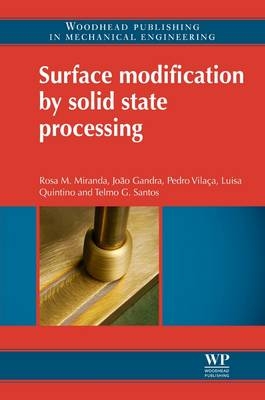
Surface Modification by Solid State Processing
Woodhead Publishing Ltd (Verlag)
978-0-85709-468-1 (ISBN)
- Titel ist leider vergriffen;
keine Neuauflage - Artikel merken
Surface Modification by Solid State Processing describes friction-based surfacing techniques for surface modification to improve resistance to corrosion and wear, also changing surface chemistry.
Surface conditions are increasingly demanding in industrial applications and surface modification can reduce manufacturing and maintenance costs, leading to improved component performance, reliability and lifetime. Friction-based technologies are promising solid state processing technologies, particularly for light alloys, in the manufacturing of composite surface and functionally graded materials
This title is divided into five chapters, and after an introduction the book covers friction surfacing; friction stir processing; surface reinforcements of light alloys; and characterization techniques based on eddy currents.
Rosa M. Miranda is Associate Professor with Habilitation in the Mechanical and Industrial Engineering Department, Faculdade de Ciências e Tecnologia, Universidade Nova de Lisboa, Portugal, and previously Assessor of the Research and Development Department at the Portuguese Welding and Quality institute, 1982-1999. Rosa is the author of more than 200 publications in Materials processing technologies, welding and materials science. Joao Pedro Gandra is a PhD student in mechanical engineering, researching friction surfacing. Pedro Vilaça is Assistant Professor at the Mechanical Engineering Department of the Lisbon Technical University, and author of more than 150 publications with particular expertise in friction stir welding and processing. Luisa Quintino is Associate Professor with Habilitation in Welding at the Mechanical Engineering Department of the Lisbon Technical University, and author of more than 250 publications, with particular expertise in welding. Previously Luisa was Vice President of IIW, and Chief Executive of the European Welding Federation. Telmo G. Santos is Assistant Professor at the Mechanical Engineering Department of Nova University, and author of several publications, with particular expertise in non destructive testing and friction stir welding and processing.
List of figures and tables
Figures
Tables
List of abbreviations
About the Editor and the Contributors
Introduction
1. Overview of coating technologies
Abstract:
1.1 Introduction
1.2 Surface coating technologies
1.3 Chemical and electrodeposition
1.4 Vacuum deposition
1.5 Arc welding
1.6 Thermal spraying
1.7 Cladding
1.8 Comparison between cladding processes
1.9 Conclusion
1.10 References
2. Friction surfacing
Abstract:
2.1 Introduction
2.2 Fundamentals
2.3 Main features for visual analysis characterization
2.4 Parameters
2.5 Metallurgical features of FS involving steels and aluminium alloy
2.6 Mechanical features
2.7 Friction surfacing in the scope of surfacing engineering
2.8 Advantages and limitations
2.9 Analytical establishment of performance analysis
2.10 Conventional and innovative applications
2.11 Challenges in modelling FSW
2.12 Conclusions
2.13 References
3. Friction stir processing
Abstract:
3.1 Introduction
3.2 Processed zone
3.3 Material flow
3.4 Typical defects in friction stir welding and processing
3.5 Property enhancement
3.6 Process parameters
3.7 Tool geometry
3.8 Multiple-pass friction stir processing
3.9 Conclusions
3.10 References
4. Surface reinforcements of light alloys
Abstract:
4.1 Introduction
4.2 Basics of the process
4.3 Methods of reinforcement
4.4 Reinforcement materials
4.5 Multiple-pass FSP
4.6 Surface hybrid composites
4.7 Magnesium alloys
4.8 Functionally graded materials
4.9 Conclusions
4.10 References
5. Characterization of FSP by electrical conductivity
Abstract:
5.1 Introduction
5.2 Fundamentals
5.3 Measurement approaches
5.4 Performance and applications
5.5 Conclusions
5.6 References
Index
| Verlagsort | Cambridge |
|---|---|
| Sprache | englisch |
| Maße | 156 x 234 mm |
| Gewicht | 470 g |
| Themenwelt | Technik ► Maschinenbau |
| ISBN-10 | 0-85709-468-8 / 0857094688 |
| ISBN-13 | 978-0-85709-468-1 / 9780857094681 |
| Zustand | Neuware |
| Informationen gemäß Produktsicherheitsverordnung (GPSR) | |
| Haben Sie eine Frage zum Produkt? |
aus dem Bereich