Zum Hauptinhalt springen
Nicht aus der Schweiz? Besuchen Sie lehmanns.de
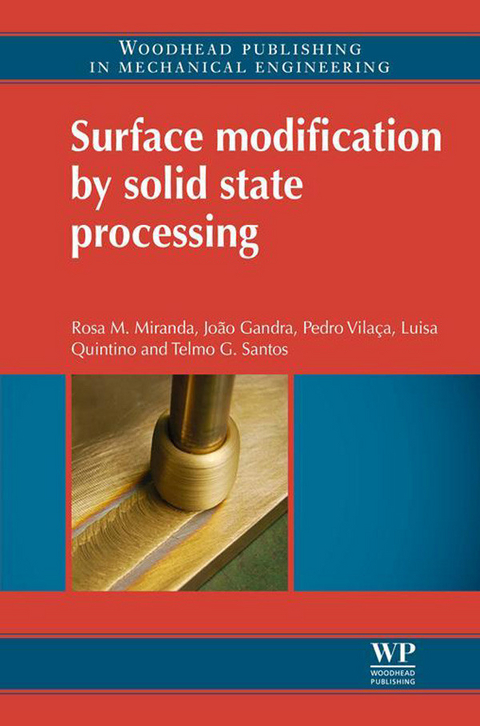
Surface Modification by Solid State Processing -  Joao Pedro Gandra,  Rosa M. Miranda,  Luisa Quintino,  Telmo G. Santos,  Pedro Vilaca

Surface Modification by Solid State Processing (eBook)

eBook Download: EPUB
2013 | 1. Auflage
210 Seiten
Elsevier Science (Verlag)
978-0-85709-469-8 (ISBN)
Systemvoraussetzungen
154,54 inkl. MwSt
(CHF 149,95)
Der eBook-Verkauf erfolgt durch die Lehmanns Media GmbH (Berlin) zum Preis in Euro inkl. MwSt.
  • Download sofort lieferbar
  • Zahlungsarten anzeigen
Surface Modification by Solid State Processing describes friction-based surfacing techniques for surface modification to improve resistance to corrosion and wear, also changing surface chemistry. Surface conditions are increasingly demanding in industrial applications and surface modification can reduce manufacturing and maintenance costs, leading to improved component performance, reliability and lifetime. Friction-based technologies are promising solid state processing technologies, particularly for light alloys, in the manufacturing of composite surface and functionally graded materials This title is divided into five chapters, and after an introduction the book covers friction surfacing; friction stir processing; surface reinforcements of light alloys; and characterization techniques based on eddy currents. - Describes friction-based surfacing techniques for surface modification to improve resistance to corrosion and wear, and change surface chemistry - Emphasizes industrial applications - Describes existing and emerging techniques

Rosa M. Miranda is Associate Professor with Habilitation in the Mechanical and Industrial Engineering Department, Faculdade de Ciˆncias e Tecnologia, Universidade Nova de Lisboa, Portugal, and previously Assessor of the Research and Development Department at the Portuguese Welding and Quality institute, 1982-1999. Rosa is the author of more than 200 publications in Materials processing technologies, welding and materials science.
Surface Modification by Solid State Processing describes friction-based surfacing techniques for surface modification to improve resistance to corrosion and wear, also changing surface chemistry. Surface conditions are increasingly demanding in industrial applications and surface modification can reduce manufacturing and maintenance costs, leading to improved component performance, reliability and lifetime. Friction-based technologies are promising solid state processing technologies, particularly for light alloys, in the manufacturing of composite surface and functionally graded materialsThis title is divided into five chapters, and after an introduction the book covers friction surfacing; friction stir processing; surface reinforcements of light alloys; and characterization techniques based on eddy currents. - Describes friction-based surfacing techniques for surface modification to improve resistance to corrosion and wear, and change surface chemistry- Emphasizes industrial applications- Describes existing and emerging techniques

List of figures and tables


Figures


1.1 Classification of surface engineering technologies    4

1.2 Examples of typical industrial applications of surface coatings. (a) Buildup of worn industrial gas turbine compressor blade platform. (b) Profile of hardfaced railways. (c) Buttering welds of materials with poor weldability. (d) Surface cladding for wear and corrosion resistance    6

1.3 Anodized aluminium    8

1.4 Electroplated screws    10

1.5 Example of physical vapour deposition application    11

1.6 Buildup application via submerged arc welding (SAW)    13

1.7 Example of thermal spraying application    15

1.8 Laser cladding process delivering powder via a coaxial nozzle that surrounds the laser beam    17

1.9 (a) Typical cladding arrangement before the detonation of the explosive. (b) Schematic drawing of the collision process. (c) Geometry of the steady-state collision    19

1.10 Typical wavy bond generated by explosion cladding    20

1.11 Illustration of FS process    20

2.1 Flash formation due to unconstrained ‘thirdbody region’ during FS of similar rod and plate materials. (a) Steel, (b) aluminium alloy, (c) NiAl–bronze    28

2.2 Fundamentals and main nomenclature of the FS process    29

2.3 Thermo-mechanics of FS. (a) Sectioned consumable, (b) process parameters, (c) thermomechanical transformations and speed profile    30

2.4 Schematic representation of true coating area after mechanical finishing and main dimensions nomenclature    33

2.5 Presentation for visual analysis of FS of coatings of AISI H13 consumable rod over substrate AISI 1020 produced under different FS parameters    33

2.6 Effect of axial forging force on coating cross section morphology and joining interface. FS of AISI 1020 rod deposited over an AISI 1020 plate    35

2.7 Effect of rotation speed on coating cross section morphology and joining interface. FS of AISI 1020 rod deposited over an AISI 1020 plate    36

2.8 Substrate presenting the thermo-mechanically affected zone    36

2.9 Effect of travel speed on coating cross section morphology and joining interface. FS of AISI 1020 rod deposited over an AISI 1020 plate    37

2.10 Effect of process parameters on FS of AISI 1020 rod deposited over an AISI 1020 plate: coating thickness, width, bonded width and underfill    38

2.11 Effect of process parameters on FS of AISI H13 rod deposited over an AISI 1020 plate: coating thickness, width, bonded width and underfill    38

2.12 FS process parameters and variables    39

2.13 Metallurgical and hardness features of AISI 1020 rod deposited over an AISI 1020 plate    42

2.14 Metallurgical and hardness features of AISI 1045 rod deposited over an AISI 1020 plate    43

2.15 Metallurgical and hardness features of AISI H13 rod deposited over an AISI 1020 plate    44

2.16 Metallurgical features of AA6082-T6 rod deposited over an AA2024-T3 plate    47

2.17 Evolution of FS (AISI 1020 rod over AISI 1020 plate) variables with time for a forcecontrolled deposition period. Plunge period of rod with feed rate control    48

2.18 Evolution of FS (AISI 1020 rod over AISI 1020 plate) variables with time for: (a) different rotational speeds, and (b) travel speeds    50

2.19 Classification of surface engineering technologies    53

2.20 Effect of process parameters on deposition rate (DR) and consumption rate (CR). FS of AISI H13 rod deposited over an AISI 1020 plate    57

2.21 Effect of FS process parameters on efficiency performance parameters. FS of AISI H13 rod deposited over an AISI 1020 plate    59

2.22 Effect of process parameters on FS power and specific energy consumption for three different coating materials    61

2.23 Examples of non-linear trajectories of FS applied to steel and aluminium    62

2.24 Surface finish by milling: FS of AA6082-T6 over AA7178-T6    63

2.25 Build-up by FS. (a) Successive deposition; (b) bulk produced from four overlapped passes; (c) detail of final thickness achieved; (d) milling of linear rail; (e) continuous cylindrical build-up of a 3D helicoidal trajectory    64

2.26 Joining interface of SiC reinforced AA6082-T6 coatings produced by FS over AA2024-T3 substrate    64

3.1 Schematic representation of friction stir processing    75

3.2 A typical cross section macrograph showing various microstructural zones in FSW AA2024-T351    76

3.3 Microstructure of thermo-mechanically affected zone in FSP AA 7022-T6    77

3.4 Merging between probe and the shoulderdriven material flow. FSP of 5083-H111    79

3.5 Typical defects in friction stir welding and processing: (a) flash on the advancing side, (b) cavity defect on the advancing side, (c) oxide alignment, (d) surface grooves, (e) processed surface depression, (f) ledge of bottom surface or weld root. Exclusive of FSW: (g) lack of penetration, (h) oxide alignment at weld root    81

3.6 Cross section detail of a flash on the advancing side    82

3.7 Channel defects on the advancing side in multiple-pass FSP    83

3.8 Hardness profiles along nugget region in the FSP of (a) AA 1100-H12 and (b) AA 5083-H111    85

3.9 Micro-hardness profile of nugget section in as-received AZ61 alloy    86

3.10 Variation of (a) elongation and (b) flow stress with initial strain rate for extruded and FSP Al-Mg-Sc alloys    87

3.11 Bending samples in the surface (SFSP) and volume friction stir processing (VFSP) of AA 7022-T6 and AA 5083-O    88

3.12 Plot of the applied force vs. displacement in the AA5083-O alloys with different treatments    89

3.13 Plot of the applied force vs. displacement in the AA7022-T6 alloys with different treatments    90

3.14 Comparison of results obtained for the maximum bending angle and the energy to fracture for both alloys with and without FSP    90

3.15 Longitudinal cross sectional views of fatiguefailed sample near to fracture tip: (a) as-cast (40 MPa) and (c) FSP (95 MPa). FSP processing of cast Mg–9Al–1Zn alloy    91

3.16 Interface between as-cast (left) and processed zone (right) for the FSP of cast Al–7Si–0.6 Mg alloy    92

3.17 Cause and effect diagram    95

3.18 Friction stir welding and processing tool geometry combinations. Patented iSTIRtool_v3 tool assembly system. (a) Pin and shoulder fastening (b–e) several tool geometry combinations    97

3.19 Probe geometry infl uence on microstructure pattern in the FSP of AA 1100-H12 and AA 5083-H111    98

3.20 Tool geometry and convention of overlapping nomenclature: (a) Tool design, (b) overlapping by the advancing side (AS), (c) overlapping by the retreating side (RS)    100

3.21 Surfaces produced by multi-pass overlapping by the AS (a) and by the RS (b)    100

3.22 Macrographs of cross sections in friction stir processed surfaces when overlapping by the AS (a) and by the RS (b)    101

3.23 Hardness profile of a multi-pass layer processed when overlapping by the AS    102

3.24 Hardness profile of a multi-pass layer processed when overlapping by the RS    103

4.1 Schematic representation of the grooves in A12-H composite production. (a) Overall view; (b) longitudinal...

Erscheint lt. Verlag 31.10.2013
Sprache englisch
Themenwelt Naturwissenschaften Chemie Physikalische Chemie
Naturwissenschaften Physik / Astronomie Festkörperphysik
Technik Maschinenbau
ISBN-10 0-85709-469-6 / 0857094696
ISBN-13 978-0-85709-469-8 / 9780857094698
Informationen gemäß Produktsicherheitsverordnung (GPSR)
Haben Sie eine Frage zum Produkt?
EPUBEPUB (Adobe DRM)

Kopierschutz: Adobe-DRM
Adobe-DRM ist ein Kopierschutz, der das eBook vor Mißbrauch schützen soll. Dabei wird das eBook bereits beim Download auf Ihre persönliche Adobe-ID autorisiert. Lesen können Sie das eBook dann nur auf den Geräten, welche ebenfalls auf Ihre Adobe-ID registriert sind.
Details zum Adobe-DRM

Dateiformat: EPUB (Electronic Publication)
EPUB ist ein offener Standard für eBooks und eignet sich besonders zur Darstellung von Belle­tristik und Sach­büchern. Der Fließ­text wird dynamisch an die Display- und Schrift­größe ange­passt. Auch für mobile Lese­geräte ist EPUB daher gut geeignet.

Systemvoraussetzungen:
PC/Mac: Mit einem PC oder Mac können Sie dieses eBook lesen. Sie benötigen eine Adobe-ID und die Software Adobe Digital Editions (kostenlos). Von der Benutzung der OverDrive Media Console raten wir Ihnen ab. Erfahrungsgemäß treten hier gehäuft Probleme mit dem Adobe DRM auf.
eReader: Dieses eBook kann mit (fast) allen eBook-Readern gelesen werden. Mit dem amazon-Kindle ist es aber nicht kompatibel.
Smartphone/Tablet: Egal ob Apple oder Android, dieses eBook können Sie lesen. Sie benötigen eine Adobe-ID sowie eine kostenlose App.
Geräteliste und zusätzliche Hinweise

Buying eBooks from abroad
For tax law reasons we can sell eBooks just within Germany and Switzerland. Regrettably we cannot fulfill eBook-orders from other countries.

Mehr entdecken
aus dem Bereich
Thermodynamik • Kinetik • Elektrochemie

von Sebastian Seiffert; Wolfgang Schärtl

eBook Download (2024)
De Gruyter (Verlag)
CHF 58,55
Quantenmechanik • Spektroskopie • Statistische Thermodynamik

von Sebastian Seiffert; Wolfgang Schärtl

eBook Download (2024)
De Gruyter (Verlag)
CHF 53,65