


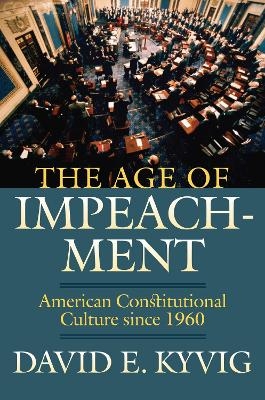
The Age of Impeachment
American Constitutional Culture Since 1960
Seiten
2008
University Press of Kansas (Verlag)
978-0-7006-1581-0 (ISBN)
University Press of Kansas (Verlag)
978-0-7006-1581-0 (ISBN)
A buzz word in public life, ""impeachment"" was anything but that before 1960. This work chronicles the rise of a culture of impeachment since 1960 - one that extends far beyond the infamous scandals surrounding Presidents Richard Nixon (Watergate) and Bill Clinton (Monica Lewinsky) and has dramatically altered the face of American politics.
In this magisterial new work, Bancroft Prize - winning historian David Kyvig chronicles the rise of a culture of impeachment since 1960 - one that extends far beyond the infamous scandals surrounding Presidents Richard Nixon (Watergate) and Bill Clinton (Monica Lewinsky) and has dramatically altered the face of American politics.A buzz word in today's public life, ""impeachment"" was anything but that before 1960. Since then it has been transformed from a historically little-known and little-used tool of last resort into a political weapon of choice. By examining the details and consequences of impeachment episodes involving three Supreme Court justices, a vice president, five federal judges, and four presidents, Kyvig explores this seismic shift in our constitutional culture and gauges its ongoing implications for American political life.Beginning with the John Birch Society's campaign against Chief Justice Earl Warren, impeachment efforts became far more frequent after 1960, with eight actually ending in resignation or removal. In describing these efforts, Kyvig recounts stories and subplots about key political actors and the controversies they inspired. He argues that judicial cases are as important as the better-known presidential ones and shows why those cases that did not proceed - against not only Warren, but also Abe Fortas, William O. Douglas, Spiro Agnew, Ronald Reagan, and George W. Bush - are as illuminating as those that did.Kyvig demonstrates that impeachment has been the bellwether of a changing - and increasingly toxic - political climate. Perhaps most important and ominous, the increasing threat of impeachment has encouraged presidents to hide potentially impeachable actions behind a thick veil of executive secrecy, while dramatically expanding executive power beyond the reach of either Congress or the courts.Combining political and legal history at their best, Kvyig also explores the cultural impact of journalist David Frost, editorial cartoonist Herblock, and filmmakers Alan Pakula, Robert Altman, and Oliver Stone. A gifted storyteller, he presents a cautionary tale that should be read by all who care about our national government and its ability to survive and thrive in perilous times.
In this magisterial new work, Bancroft Prize - winning historian David Kyvig chronicles the rise of a culture of impeachment since 1960 - one that extends far beyond the infamous scandals surrounding Presidents Richard Nixon (Watergate) and Bill Clinton (Monica Lewinsky) and has dramatically altered the face of American politics.A buzz word in today's public life, ""impeachment"" was anything but that before 1960. Since then it has been transformed from a historically little-known and little-used tool of last resort into a political weapon of choice. By examining the details and consequences of impeachment episodes involving three Supreme Court justices, a vice president, five federal judges, and four presidents, Kyvig explores this seismic shift in our constitutional culture and gauges its ongoing implications for American political life.Beginning with the John Birch Society's campaign against Chief Justice Earl Warren, impeachment efforts became far more frequent after 1960, with eight actually ending in resignation or removal. In describing these efforts, Kyvig recounts stories and subplots about key political actors and the controversies they inspired. He argues that judicial cases are as important as the better-known presidential ones and shows why those cases that did not proceed - against not only Warren, but also Abe Fortas, William O. Douglas, Spiro Agnew, Ronald Reagan, and George W. Bush - are as illuminating as those that did.Kyvig demonstrates that impeachment has been the bellwether of a changing - and increasingly toxic - political climate. Perhaps most important and ominous, the increasing threat of impeachment has encouraged presidents to hide potentially impeachable actions behind a thick veil of executive secrecy, while dramatically expanding executive power beyond the reach of either Congress or the courts.Combining political and legal history at their best, Kvyig also explores the cultural impact of journalist David Frost, editorial cartoonist Herblock, and filmmakers Alan Pakula, Robert Altman, and Oliver Stone. A gifted storyteller, he presents a cautionary tale that should be read by all who care about our national government and its ability to survive and thrive in perilous times.
David E. Kyvig is Distinguished Research Professor in the Department of History at Northern Illinois University and author or editor of ten other books, including Explicit and Authentic Acts: Amending the U.S. Constitution, 1776-1995, winner of the 1997 Bancroft Prize.
| Zusatzinfo | 19 illustrations |
|---|---|
| Verlagsort | Kansas |
| Sprache | englisch |
| Maße | 163 x 233 mm |
| Gewicht | 862 g |
| Themenwelt | Geschichte ► Allgemeine Geschichte ► Zeitgeschichte |
| Geisteswissenschaften ► Geschichte ► Regional- / Ländergeschichte | |
| Sozialwissenschaften ► Politik / Verwaltung | |
| ISBN-10 | 0-7006-1581-4 / 0700615814 |
| ISBN-13 | 978-0-7006-1581-0 / 9780700615810 |
| Zustand | Neuware |
| Informationen gemäß Produktsicherheitsverordnung (GPSR) | |
| Haben Sie eine Frage zum Produkt? |
Mehr entdecken
aus dem Bereich



aus dem Bereich
die großen Jahre der Soziologie 1949-1969
Buch | Hardcover (2025)
Klett-Cotta (Verlag)
CHF 39,20
eine Deutschlandreise im Jahr 1958
Buch | Hardcover (2024)
C.H.Beck (Verlag)
CHF 29,90


