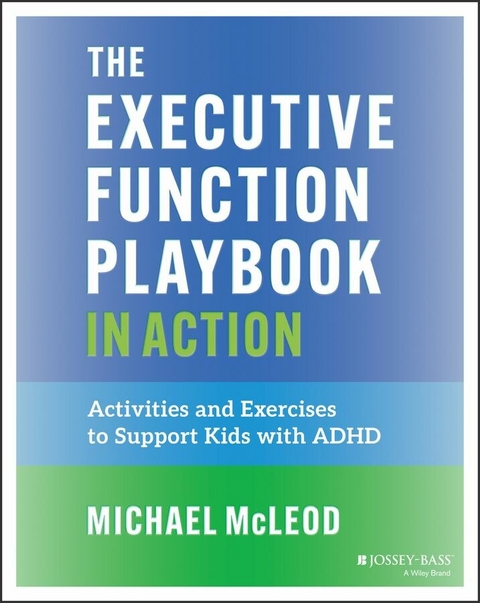
The Executive Function Playbook in Action (eBook)
324 Seiten
Jossey-Bass (Verlag)
978-1-394-36459-6 (ISBN)
An effective collection of worksheets, activities, tools, and resources for the parents and teachers of young people with ADHD
The Executive Function Playbook in Action: Activities and Strategies to Support Kids with ADHD is the ultimate hands-on guide for parents and educators working with students to improve their executive function skills. Instead of focusing exclusively on external strategies, this companion workbook to The Executive Function Playbook takes a groundbreaking approach that shows parents and practitioners how to help young people build self-regulation, self-motivation, and independence.
The resources contained in this workbook help parents and educators walk students through the steps they can take to improve their planning, organization, and time management abilities. They'll learn how to complete tasks independently and reduce their reliance on frequent external prompts and interventions to help them get things done.
The Executive Function Playbook in Action is focused on long-term success, helping anyone who works with young people with ADHD build on initial accomplishments to generate lasting improvements to executive function skills.
Inside the book:
- Step-by-step instructions for parents and professionals who need to plan lessons, group work, and individual student work
- Student assessment and self-assessment tools that highlight progress and identify specific areas for improvement
- Practical, evidence-based exercises covering self-awareness, self-regulation, self-motivation, self-evaluation, social executive function, screentime, and verbal and non-verbal working memory
- Chapters on authoritative parenting, college success, and strategies for common 'failure to launch' setbacks
Filled with practical resources for adults working with youth with ADHD, The Executive Function Playbook in Action is an invaluable collection of worksheets, activities, strategies, and walkthroughs designed to make a concrete difference in the lives of young people with ADHD and the people who work with and care for them.
MICHAEL MCLEOD, MA, CCC-SLP TSSLD, is the founder of GrowNOW ADHD, an organization that helps educators, counselors, and parents provide executive function coaching for kids and families. He's a keynote speaker and trainer who uses his unique GrowNOW Internal Skills Model to help young people living with ADHD build executive function capabilities and resiliency.
CHAPTER 1
The Foundational Skills: Understanding and Strengthening Nonverbal and Verbal Working Memory
Welcome to the first chapter of The Executive Function Playbook in Action. This chapter is devoted to the two most essential—but often invisible—building blocks of executive functioning: nonverbal working memory and verbal working memory. These are the internal skills that form the foundation for every other executive function your child will need to succeed academically, socially, and emotionally.
Many of the challenging behaviors we see in children with ADHD—impulsivity, forgetfulness, reactivity, difficulty following multistep directions—are not signs of defiance or laziness. They are signs that these internal systems are underdeveloped. Simply put, the child is missing the tools that allow them to stop, think, and reflect before they act.
In this chapter, we focus on giving those tools back.
Nonverbal working memory is the ability to visualize and mentally “replay” past experiences. It allows a child to picture what happened yesterday, imagine how someone felt, or anticipate what might happen next. When this skill is weak, the child struggles to learn from experience, repeats the same mistakes, and often seems stuck in the moment without the ability to pause or adjust.
Verbal working memory is the ability to use internal language to guide behavior. This is the inner voice that helps a child talk themselves through a task, remember the steps to a routine, or calm themselves during a moment of frustration. Without it, children often rely entirely on external prompts and reminders—and struggle to function independently.
The pages ahead are designed to strengthen these two foundational skills through structured reflection, visualization, and language-building exercises. They include prompts like:
- “What did I do yesterday, and how did it turn out?”
- “What will future me need from me right now?”
- “What can I say to myself when I’m starting to feel upset?”
These aren’t just worksheets—they’re tools to build internal systems.
You’ll also find pages that encourage the use of imagery, drawing, and storytelling to help children hold onto key emotional experiences, recall them when needed, and apply them in new situations. Over time, as these skills strengthen, you’ll see a child who is better able to pause, reflect, regulate, and self-direct.
Before children can manage time, plan assignments, or handle social challenges, they must be able to remember and talk themselves through what has already happened—and what needs to happen next. This chapter is where that journey begins.
Take your time with these pages. Revisit them as needed. And most importantly, complete them alongside your child. Your presence, modeling, and emotional regulation are just as foundational as the skills we’re building here.
Let’s begin laying the groundwork—one internal skill at a time.
Activity 1.1: Practicing the GrowNOW Predictions Review Model
Executive function skills strengthened: Nonverbal working memory, verbal working memory
OVERVIEW
One of the most significant cognitive challenges faced by children with ADHD is difficulty holding onto mental representations of time, outcomes, and internal experiences. This difficulty—known as working memory impairment—is a hallmark executive function deficit. In The Executive Function Playbook, we emphasize that without strong nonverbal working memory (mental imagery) and verbal working memory (self-talk), students struggle to plan ahead, regulate their emotions in the moment, and learn from experience.
The GrowNOW Predictions Review Model was developed to directly strengthen these internal cognitive systems through an evidence-based process. It is rooted in neurodevelopmental research showing that individuals with ADHD benefit most from guided mental rehearsal, explicit language strategies, and structured reflection before and after tasks. In short, they learn best through experience—but only when that experience is processed, previewed, and reviewed with support.
This page walks families through a step-by-step approach to improving future thinking (visualizing and talking to themselves through what’s ahead) and hindsight reflection (learning from what just happened). These are the very skills needed to break cycles of impulsivity, task avoidance, and time blindness—and to move toward independent goal-directed behavior.
INSTRUCTIONS FOR PARENT, TEACHER, CLINICIAN, AND CHILD (COMPLETE TOGETHER)
Use this worksheet before and after a task, activity, or part of the day (such as going to school, starting homework, playing a sport, or going to a new place). This can be done daily or used situationally to build a habit over time.
Step 1: Predictive Visualization (Mental Movie)
Before beginning the task, guide your child to close their eyes, put their head down, and make a mental movie of what the task or day ahead will look like.
Coach them to visualize:
- Where they’ll be
- What they’ll be doing
- How they think they will feel
- What challenges might come up
- What success will look like
This strengthens nonverbal working memory—the brain’s internal “camera” that helps children picture themselves in the future. It’s the same skill used by successful athletes, public speakers, and leaders who mentally rehearse before performance.
Step 2: Record the Predictions
Now have your child write (or dictate) the specific predictions they made during their visualization. These should be short, clear, and tied to internal experience, not just external outcomes.
Examples:
- “I’ll feel tired at the beginning but get more focused after 10 minutes.”
- “I’ll probably want to quit when it gets boring, but I’ll keep going.”
- “I think it will take 20 minutes to finish.”
- “I’ll feel proud when I turn it in.”
Step 3: Create a Self-Talk Script
Help your child create a verbal self-coaching statement—a short script they can say in their head during the task to stay focused and regulated. This builds verbal working memory, the internal voice used for planning, problem-solving, and motivation.
Examples:
- “Stay calm. You know how to do this. Just take it one step at a time.”
- “If I get distracted, I’ll just come back to the goal.”
- “I’ve done this before—I can do it again.”
- “Keep going until it’s done. Then I can relax.”
Encourage repetition of the same script in future tasks to build familiarity and internalization.
Step 4: Do the Task or Activity
Now your child does the task. You don’t need to guide them through this step—just allow them to apply what they’ve visualized and rehearsed. If they become dysregulated or frustrated, gently prompt them to return to their mental movie or self-talk script.
Step 5: Predictions vs. Reality—Review and Reflect
After completing the task, come back together and compare what was predicted vs. what actually happened. This builds insight, self-monitoring, and adaptive learning. Help your child identify:
- Where their predictions were accurate
- Where things went differently
- How they felt about the outcome
- What they’d do the same or differently next time
This final step strengthens hindsight—a crucial executive function skill that allows individuals to build adaptive strategies over time, rather than repeat the same mistakes or emotional reactions.
KEY MESSAGE
Working memory is not just about remembering facts—it’s about holding onto internal experiences long enough to plan, act, and reflect. The Predictions—Review Model gives children a structure to visualize the future, talk themselves through the moment, and learn from the past. Over time, this builds the internal architecture for independence, regulation, and resilience.
CLOSING THOUGHT
Kids with ADHD often live in the “now.” They act without thinking, and they forget what they’ve learned. This isn’t due to laziness or defiance—it’s neurological. But the brain can grow. With repetition and coaching, your child can develop the internal skills to become their own guide. This worksheet is not just a strategy—it’s a mirror that helps them see who they can become.
RESEARCH REFERENCE
Klingberg, T. (2010). Training and plasticity of working memory. Trends in Cognitive Sciences, 14(7), 317–324. https://doi.org/10.1016/j.tics.2010.05.002
Activity 1.2: The Brain Coach, Part 1
Executive function skills strengthened: Verbal working memory
OVERVIEW
One of the most powerful tools a child can develop for executive function growth is the ability to talk to themselves—on...
| Erscheint lt. Verlag | 5.1.2026 |
|---|---|
| Sprache | englisch |
| Themenwelt | Sozialwissenschaften ► Pädagogik ► Bildungstheorie |
| Schlagworte | adhd exercises • adhd workbook • adhd worksheets • youth adhd activities • youth adhd exercises • youth adhd handbook • youth adhd resources • youth adhd strategies • youth adhd student activities • youth adhd workbook • youth adhd worksheets |
| ISBN-10 | 1-394-36459-8 / 1394364598 |
| ISBN-13 | 978-1-394-36459-6 / 9781394364596 |
| Informationen gemäß Produktsicherheitsverordnung (GPSR) | |
| Haben Sie eine Frage zum Produkt? |
 EPUB (Adobe DRM)
Kopierschutz: Adobe-DRM
Adobe-DRM ist ein Kopierschutz, der das eBook vor Mißbrauch schützen soll. Dabei wird das eBook bereits beim Download auf Ihre persönliche Adobe-ID autorisiert. Lesen können Sie das eBook dann nur auf den Geräten, welche ebenfalls auf Ihre Adobe-ID registriert sind.
Details zum Adobe-DRM
Dateiformat: EPUB (Electronic Publication)
EPUB ist ein offener Standard für eBooks und eignet sich besonders zur Darstellung von Belletristik und Sachbüchern. Der Fließtext wird dynamisch an die Display- und Schriftgröße angepasst. Auch für mobile Lesegeräte ist EPUB daher gut geeignet.
Systemvoraussetzungen:
PC/Mac: Mit einem PC oder Mac können Sie dieses eBook lesen. Sie benötigen eine
eReader: Dieses eBook kann mit (fast) allen eBook-Readern gelesen werden. Mit dem amazon-Kindle ist es aber nicht kompatibel.
Smartphone/Tablet: Egal ob Apple oder Android, dieses eBook können Sie lesen. Sie benötigen eine
Geräteliste und zusätzliche Hinweise
Buying eBooks from abroad
For tax law reasons we can sell eBooks just within Germany and Switzerland. Regrettably we cannot fulfill eBook-orders from other countries.
aus dem Bereich