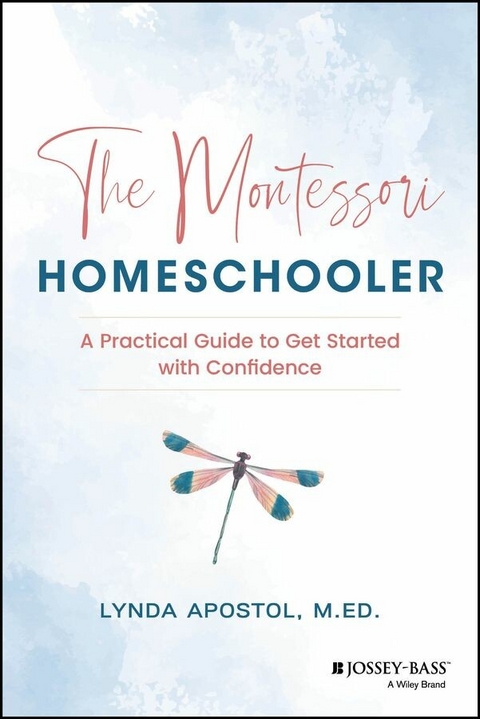
The Montessori Homeschooler (eBook)
257 Seiten
Jossey-Bass (Verlag)
978-1-394-28103-9 (ISBN)
What if Montessori wasn't just something you tried at home-but something you truly understood?
The Montessori Homeschooler is your practical, compassionate guide to implementing Montessori with confidence-without the overwhelm, second-guessing, or pressure to get it perfect. Designed for real families with real responsibilities, this book goes beyond shelf setup and Pinterest-perfect routines to help you build a home environment rooted in structure, respect, and deep trust in your child's natural development.
Whether you're just starting out, shifting from traditional school, or wondering if you're 'Montessori enough,' this step-by-step blueprint will show you how to:
- Structure your first day, week, and month with intention
- Create a calm, consistent rhythm that supports independence
- Set up your space and introduce Montessori lessons with clarity
- Navigate discipline and conflict with confidence
- Foster focus, responsibility, and self-direction-without coercion
Grounded in developmental science and filled with real-life case studies, The Montessori Homeschooler helps you become the prepared adult your child needs. This isn't a scripted curriculum. It's a mindset shift-and a roadmap to raising capable, curious humans through rhythm, relationship, and real-life learning.'
Lynda Apostol, M.Ed., is the founder and CEO of The Montessori Teacher, where she helps educators in alternative education settings gain clarity, sharpen their skillset and get organized to implement the Montessori Method with confidence. Lynda has worked in public, private, charter, and nontraditional school settings and has two Master's degrees in education.
1
Before You Begin: What Montessori Homeschooling Is and When It Starts
When to Homeschool: Understanding Montessori's Developmental Timing
One of the most common questions families ask is, “When should we start homeschooling?”
If you've spent any time in online communities or researching curriculum options, you've probably noticed that many approaches to homeschooling begin around kindergarten or first grade. Montessori is different.
In Montessori, homeschooling typically begins at age 3—not because we're pushing academics early, but because this is when a major shift occurs in your child's development. Around this age, your child enters the second half of what we call the first plane of development (ages 0–6). This is when they begin transitioning from unconscious absorption to conscious learning.
That's a big deal.
In the first 3 years of life, your child learns effortlessly through unconscious absorption. Their brain is like a sponge, soaking in language, movement, order, and relationships simply through experience. This is not the time for formal academics—but it is the time to lay the essential groundwork that academic learning depends on later.
Through practical life activities, sensory exploration, language-rich interactions (think narration, think-alouds, reading every night), family connection and the freedom to move and concentrate, your infant and toddler is developing the foundations of what Montessori calls the mathematical mind, the coordinated hand, and the ordered intellect. These aren't buzzwords—they're real, observable capacities that emerge through rich and respectful environments.
So while this book doesn't focus on Montessori at home in the 0–3 stage, it's important to acknowledge how vital those early years are. We are laying the foundation for a lifetime of learning—even if that learning doesn't look like “school.”
Homeschooling, or formal education and academic instruction, in the Montessori context begins in earnest at age three, when your child becomes developmentally ready for more intentional, structured guidance—but always in harmony with their natural rhythms and readiness. It's not school-at-home, and it's not early push-down academics. It's a child-led, adult-supported approach that respects the absorbent mind while offering carefully sequenced, hands-on learning experiences.
This is also the age when the Montessori materials start to shine. The sandpaper letters, number rods, sound games, and golden beads weren't designed for older children—they were created precisely for the sensitive periods that begin around age three. It's when the child is ready to move from absorbing the world around them to actively engaging with it in purposeful ways.
So if you're wondering why Montessori and why now, it's because Montessori aligns with your child's natural developmental timeline—not with arbitrary school start dates.
We begin homeschooling at age three not to get ahead, but to meet the child right where they are.
“Montessori doesn't begin with school—it begins with life. But formal homeschooling begins when your child is ready to consciously engage with learning—and that's around age three.”
What Is Montessori Homeschooling?
The following two terms are often used interchangeably by parents and educators alike—but they're not quite the same and it's important to understand this distinction:
- Montessori at home refers to applying Montessori principles to daily life and parenting—things like offering choices within limits, preparing a child-accessible environment, using respectful language, and encouraging independence in daily routines. This approach starts from birth and extends throughout childhood, regardless of whether formal homeschooling is taking place.
- Montessori homeschooling, by contrast, begins when the child is developmentally ready for conscious learning—typically around age three. It involves a more intentional educational rhythm, the use of Montessori materials and lesson sequences, and a home environment specifically prepared for academic engagement. It is not just parenting with Montessori values; it is guiding your child's education in alignment with the Montessori method.
In short:
- Montessori at home = Lifestyle and parenting philosophy
- Montessori homeschooling = Educational method and academic rhythm
Both are valuable. But this book focuses on the second: how to begin your journey to bringing authentic Montessori education into your home with clarity, confidence, and developmental integrity.
To support you in this journey, I explore the core Montessori values that guide this approach—principles like respect for the child, independence, freedom within limits, observation, and the prepared environment. These values shape not just what you do, but how and why you do it. You'll encounter them throughout this book, and if you're new to Montessori, you may want to refer to the glossary at the end for clear definitions and explanation of key terms.
The Core Values Behind Montessori
Montessori isn't just a set of materials or a sequence of lessons—it's a philosophy guided by deeply held values that shape how we see the child and how we support their development. These principles are what make Montessori truly transformative, and they're just as powerful at home as they are in a classroom.
Some of the key values you'll encounter throughout this book include:
- Respect for the child: Seeing the child as a whole, capable human being with agency, preferences, and potential, not an empty vessel to be filled.
- Independence: Trusting the child's capabilities and creating opportunities for the child to do things themselves, building confidence and real-world competence.
- Freedom within limits: Allowing meaningful choice and autonomy while maintaining boundaries that ensure safety, order, and respect for others.
- Prepared environment: Intentionally designing the child's space and curating the objects and materials within it to invite exploration, concentration, and meaningful work.
- Observation: Watching closely (without hovering) to learn, not to assess or control, so you can understand what the child needs, when they're ready, and how to support them effectively.
- Follow the child: Understanding the child's stages of development and their motivations for work to respond to their inner drive by working in collaboration with their natural rhythms, interests, and readiness to guide the learning process.
These values are more than concepts—they're practices. You'll see them woven into the structure of this book and tools I share and in the stories from real Montessori families.
If you're unfamiliar with the terminology, don't worry. There's a glossary at the end of the book with many of the key terms and concepts you'll encounter as you read. You don't need to memorize them up front—just know that support is there when you need it.
Why Families Choose to Homeschool
Homeschooling is a deeply personal decision, and families arrive at it for all kinds of reasons. Maybe you're here because you want more time with your child, or because you feel traditional schools aren't meeting their needs. Maybe you love the idea of tailoring education to your child's unique learning style. Or maybe you've just always felt called to something different.
For many families, homeschooling is about freedom—freedom to move at a child's pace, to explore topics deeply, to nurture creativity, and to spend quality time together as a family. Homeschooling is a vehicle that helps you create a learning environment that aligns with your values, rather than fitting into a one-size-fits-all system.
I remember when I first started considering homeschooling. I kept thinking, Can I really do this? Am I going to mess this up? The self-doubt was real. But when I took a step back and asked myself what I truly wanted for my child—joyful learning, curiosity, independence, meaningful experiences, belonging—I realized that no one was better equipped to provide that than me. If you're feeling that same hesitation, know this: homeschooling isn't about having all the answers, being a subject-matter expert, or being able to control the future. It's about presence, intention, self-discipline, and a willingness to learn alongside your child.
The Appeal of Montessori Homeschooling
Montessori offers something rare: a method that respects the whole child while providing a clear framework for academic development. It is both structured and flexible, grounded in developmental science yet adaptable to your home.
If you've seen Montessori mentioned online—in blog posts, parenting groups, or on social media—you may have noticed the focus on clean spaces, minimalist shelves, and curated wooden materials. Maybe you've wondered, Is this something I can actually do at home?
The answer is: yes. But not because you can replicate a classroom. Because...
| Erscheint lt. Verlag | 9.12.2025 |
|---|---|
| Sprache | englisch |
| Themenwelt | Sozialwissenschaften ► Pädagogik ► Bildungstheorie |
| Schlagworte | homeschooling book • homeschooling strategies • homeschooling techniques • Montessori at home • Montessori for homeschoolers • Montessori homeschooling • Montessori homeschooling methods • Montessori philosophy • new homeschoolers |
| ISBN-10 | 1-394-28103-X / 139428103X |
| ISBN-13 | 978-1-394-28103-9 / 9781394281039 |
| Informationen gemäß Produktsicherheitsverordnung (GPSR) | |
| Haben Sie eine Frage zum Produkt? |
 EPUB (Adobe DRM)
Kopierschutz: Adobe-DRM
Adobe-DRM ist ein Kopierschutz, der das eBook vor Mißbrauch schützen soll. Dabei wird das eBook bereits beim Download auf Ihre persönliche Adobe-ID autorisiert. Lesen können Sie das eBook dann nur auf den Geräten, welche ebenfalls auf Ihre Adobe-ID registriert sind.
Details zum Adobe-DRM
Dateiformat: EPUB (Electronic Publication)
EPUB ist ein offener Standard für eBooks und eignet sich besonders zur Darstellung von Belletristik und Sachbüchern. Der Fließtext wird dynamisch an die Display- und Schriftgröße angepasst. Auch für mobile Lesegeräte ist EPUB daher gut geeignet.
Systemvoraussetzungen:
PC/Mac: Mit einem PC oder Mac können Sie dieses eBook lesen. Sie benötigen eine
eReader: Dieses eBook kann mit (fast) allen eBook-Readern gelesen werden. Mit dem amazon-Kindle ist es aber nicht kompatibel.
Smartphone/Tablet: Egal ob Apple oder Android, dieses eBook können Sie lesen. Sie benötigen eine
Geräteliste und zusätzliche Hinweise
Buying eBooks from abroad
For tax law reasons we can sell eBooks just within Germany and Switzerland. Regrettably we cannot fulfill eBook-orders from other countries.
aus dem Bereich