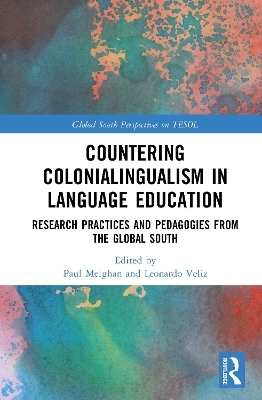
Countering Colonialingualism in Language Education
Routledge (Verlag)
978-1-041-10149-9 (ISBN)
- Noch nicht erschienen (ca. April 2026)
- Versandkostenfrei
- Auch auf Rechnung
- Artikel merken
The book defines colonialingualism as the privileging of dominant colonial languages, knowledges, and neoliberal valorizations of diversity, operating from ideology and policy to practice and outcomes. Spanning the epistemic and geographic Global South, chapters present case studies, narratives, pedagogical interventions, and curriculum and policy analyses. Together, they show how the system operates, informing a practical counter-practice toolkit for curriculum and assessment design, institutional change, and policy routes. The book recenters Global South and Indigenous epistemologies as sources of theory and method, advancing raciolinguistic perspectives and multilingual frameworks such as translanguaging and plurilingualism. Contributors mobilize Sumud and Ubuntu pedagogies, heteroglossic space-making, life-story and autoethnographic methods, place-based inquiry, and AI literacies to expose and counter the colonialingual ideologies sustaining native-speakerism, accentism, and linguistic racism within English language education and beyond.
Ultimately, the volume demonstrates how minoritized communities resist, reclaim, and revitalize their languages and knowledge systems, and how programs and policies can be redesigned in accountable, pluriversal ways. It will appeal to scholars, researchers, practitioners, and postgraduate students in applied linguistics, TESOL, and language education engaged with urgent issues of linguistic and epistemic justice and decolonization.
Paul Meighan is a Gael sociolinguist and ESL Professor at Sheridan College, Canada. He is the originator of the term Colonialingualism Leonardo Veliz is Associate Professor in Language and Literacy Education, University of New England, Australia
Global South Resistance to Colonialingualism: An Introduction
- Paul Meighan, Leonardo Veliz
PART I. Countering Colonialingualism: Theoretical Foundations, Methodological Shifts, and Pedagogical Reimaginings
1. Charting Actionable Pedagogical Directions for Decolonizing the Languages Curriculum by Adriana Díaz, Macarena Ortiz-Jiménez
2. “Is That Allowed?”: Raciolinguistic Entanglements and Transraciolinguistic Transgressions in EL(T) Spaces by Rashi Jain
3. Towards a Transepistemic Academe: A Critical Autoethnography of Lived Coloniality in Pakistani ELT and Academic Specialization in (Applied) Linguistics by Waqar Ali Shah
4. Dialogic Autoethnography as a Duet Performance of Countering Colonialingualism by Ufuk Keleş, Bedrettin Yazan
PART II. Countering Colonialingualism: Indigenous Knowledges, Language Revitalization, and Educational Reworlding
5. Illuminating African Epistemologies: Reclaiming Literacy Through Indigenous Knowledge Systems in Higher Education by Leketi Makalela, Gaokgakala Daniel Lemmenyane
6. Tackling Neo-colonialingualism: Revitalizing Australian Aboriginal Languages in the Classrooms by Sender Dovchin, Nakarra Michelle Martin, Rhonda Oliver
7. Life Stories of Indigenous Peoples: Challenging Coloniality and Colonialingualism by Yesenia Bautista Ortiz, Mario López-Gopar, Jamie L. Schissel, José Julio Morales Chávez
8. Countering Colonialingualism and Promoting Indigenous Language Revitalization in Higher Education by Stephen May, Peter Keegan, Mi Yung Park
9. Decolonial Struggles for Indigenous Multilingual Education by Prem Phyak, Tsewang Chuskit
PART III. Countering Colonialingualism: Transformative Practices, Policy Routes, and Transnational Community Praxis
10. Countering Colonialingualism with Intellectual Sovereignty of the South: English Language Education and Social Justice and Equity in Bangladesh by Shaila Sultana
11. Entanglements, Englishes, and Transraciolinguistic Becoming: Navigating Colonialingualism Across Borders by Patriann Smith, Dianne Wellington, Yetunde Alabede, Andrew Hunte, Taiwo Odungapo
12. Decolonizing Bilingual Education in Brasil for Countering Colonialingualism by Luciana C. de Oliveira, Fernanda C. Liberali, Michele Salles El Kadri, Antonieta Megale
13. Moving Beyond the Coloniality of English: Building Spaces of Otherwise by Muzna Awayed-Bishara
14. From Marginalization to Inclusion: Refugee Learners’ Struggles with English Dominance and Future Aspirations by Leonardo Veliz, Paul Meighan, Julian Chen
Toward a Transformative Framework for Decolonizing Language Education: An Afterword by Paul Meighan, Leonardo Veliz
| Erscheint lt. Verlag | 1.4.2026 |
|---|---|
| Reihe/Serie | Global South Perspectives on TESOL |
| Zusatzinfo | 3 Tables, black and white; 6 Line drawings, black and white; 13 Halftones, black and white; 19 Illustrations, black and white |
| Verlagsort | London |
| Sprache | englisch |
| Maße | 156 x 234 mm |
| Themenwelt | Geschichte ► Teilgebiete der Geschichte ► Wirtschaftsgeschichte |
| Geisteswissenschaften ► Sprach- / Literaturwissenschaft ► Sprachwissenschaft | |
| Sozialwissenschaften ► Pädagogik | |
| ISBN-10 | 1-041-10149-X / 104110149X |
| ISBN-13 | 978-1-041-10149-9 / 9781041101499 |
| Zustand | Neuware |
| Informationen gemäß Produktsicherheitsverordnung (GPSR) | |
| Haben Sie eine Frage zum Produkt? |
aus dem Bereich