


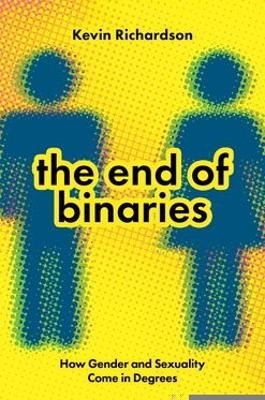
The End of Binaries
How Gender and Sexuality Come in Degrees
Seiten
2025
Oxford University Press Inc (Verlag)
978-0-19-781222-8 (ISBN)
Oxford University Press Inc (Verlag)
978-0-19-781222-8 (ISBN)
The End of Binaries articulates a philosophical alternative to binary ways of thinking about gender and sexuality. It proposes a spatial theory of gender and sexuality, where a person's gender or sexuality should be understood as a location within a multidimensional space.
We live in a world in which the boundaries of gender and sexual orientation are increasingly being contested. Gender categories like man and woman cannot do justice to non-binary, genderqueer, and trans people. Common categories of sexual orientation, like heterosexual and homosexual, are unhelpful for understanding a new generation of people whose sexual identities do not neatly fit within those categories. These various social binaries-man/woman, heterosexual/homosexual--are now a fraught way to understand social identity.
At the same time as there is resistance to these binaries, there are also those who reinforce and protect them. Across the United States and other countries, there has been a wave of legislation targeting perceived threats to the gender binary system. Books with trans characters are being removed from the shelves of public libraries. There is a surge of legislation prohibiting trans women from using women's restrooms. There is legislation that challenges the legality of drag performances. All of these efforts are attempts to preserve the dominant gender and sexuality binaries.
The End of Binaries articulates a philosophical alternative to these binary ways of thinking about gender and sexuality. It proposes a spatial theory of gender and sexuality, where a person's gender or sexuality should be understood as a location within a multidimensional space. Just as the boundaries of countries divide up geographical territories, social boundaries divide up regions of gender and sexuality space. And just as each person has an exact location represented by a GPS coordinate, each person has a gender and sexual location that represents their distinctive way of being gendered or sexually oriented. The spatial approach to gender and sexuality fundamentally understands gender and sexuality as complex, diverse, and continuous. The spatial framework is a more accurate (and more just) way to understand the diversity of gender and sexuality.
We live in a world in which the boundaries of gender and sexual orientation are increasingly being contested. Gender categories like man and woman cannot do justice to non-binary, genderqueer, and trans people. Common categories of sexual orientation, like heterosexual and homosexual, are unhelpful for understanding a new generation of people whose sexual identities do not neatly fit within those categories. These various social binaries-man/woman, heterosexual/homosexual--are now a fraught way to understand social identity.
At the same time as there is resistance to these binaries, there are also those who reinforce and protect them. Across the United States and other countries, there has been a wave of legislation targeting perceived threats to the gender binary system. Books with trans characters are being removed from the shelves of public libraries. There is a surge of legislation prohibiting trans women from using women's restrooms. There is legislation that challenges the legality of drag performances. All of these efforts are attempts to preserve the dominant gender and sexuality binaries.
The End of Binaries articulates a philosophical alternative to these binary ways of thinking about gender and sexuality. It proposes a spatial theory of gender and sexuality, where a person's gender or sexuality should be understood as a location within a multidimensional space. Just as the boundaries of countries divide up geographical territories, social boundaries divide up regions of gender and sexuality space. And just as each person has an exact location represented by a GPS coordinate, each person has a gender and sexual location that represents their distinctive way of being gendered or sexually oriented. The spatial approach to gender and sexuality fundamentally understands gender and sexuality as complex, diverse, and continuous. The spatial framework is a more accurate (and more just) way to understand the diversity of gender and sexuality.
Kevin Richardson is Associate Professor of Philosophy at Duke University. He is also secondary faculty in Duke's Department of Gender, Sexuality, and Feminist Studies. His current research focuses on philosophical questions concerning gender, sexuality, and race, and he has also published papers on truth, explanation, and vagueness. His papers have been published in journals such as Journal of Philosophy, Philosophy and Phenomenological Research and Ergo, among others.
| Erscheinungsdatum | 30.12.2025 |
|---|---|
| Verlagsort | New York |
| Sprache | englisch |
| Maße | 156 x 21 mm |
| Gewicht | 512 g |
| Themenwelt | Geisteswissenschaften ► Philosophie |
| Sozialwissenschaften ► Soziologie ► Gender Studies | |
| ISBN-10 | 0-19-781222-8 / 0197812228 |
| ISBN-13 | 978-0-19-781222-8 / 9780197812228 |
| Zustand | Neuware |
| Informationen gemäß Produktsicherheitsverordnung (GPSR) | |
| Haben Sie eine Frage zum Produkt? |
Mehr entdecken
aus dem Bereich



aus dem Bereich
Buch | Hardcover (2026)
Springer Fachmedien Wiesbaden GmbH (Verlag)
CHF 139,95
eine Geschichte des IfS aus feministischer Perspektive
Buch | Softcover (2025)
Bertz und Fischer (Verlag)
CHF 25,20


