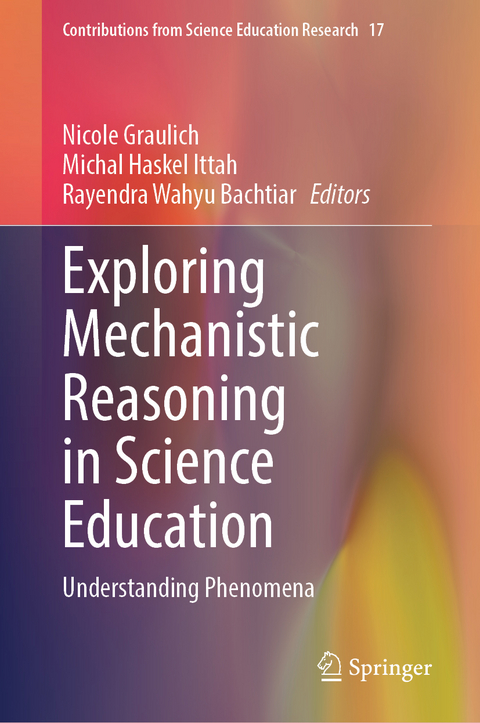
Exploring Mechanistic Reasoning in Science Education
Springer International Publishing (Verlag)
978-3-032-10245-4 (ISBN)
- Noch nicht erschienen - erscheint am 14.02.2026
- Versandkostenfrei
- Auch auf Rechnung
- Artikel merken
This edited volume provides a comprehensive exploration of the diverse dimensions of mechanistic reasoning within science education; inviting to understand its significance, development, and practical applications across diverse scientific disciplines. Through its four sections it covers mechanistic reasoning though diverse lenses such as research studies; instructional strategies; the nature of explanations; and its overall impact on scientific literacy. It combines theoretical discussions with empirical evidence and practical applications, offering a multifaceted perspective on mechanistic reasoning.
This book is an important contribution to science educators working on mechanistic reasoning and related fields such as explanations, system thinking, modeling and argumentation. Additionally, it's practical recommendations regarding approaches for evaluating and promoting mechanistic reasoning make this a volume of interest for curriculum designers and teachers.
Nicole Graulich is a professor of chemistry education at the Justus-Liebig University Giessen, Germany. Her research focuses on learning chemistry at the tertiary level with a focus on mechanistic reasoning and leveraging new technologies for adaptive learning.
Michal Haskel-Ittah is a senior scientist at the Department of Science Teaching, the Weizmann Institute of Science, Israel. Her research focuses on causal understanding and mechanistic reasoning in the context of teaching and learning biology.
Rayendra Wahyu Bachtiar is an assistant professor in the Department of Physics Education at the University of Jember, Indonesia. His research focuses on understanding how technology can support students in developing mechanistic reasoning in physics.
I. Preface.- II. Introduction to the sections.- Part 1. Capturing reasoning about mechanisms - analyzing and evaluating mechanistic reasoning.- Chapter 1. Leveraging machine learning to investigate organic chemistry students mechanistic reasoning across a corpus of writing-to-learn assignment responses.- Chapter 2. Students teleological reasoning: An explanatory escape.- Chapter 3. Reasoning about Alternatives: Contrasting students mechanistic reasoning for chemical reactions of varying plausibility.- Chapter 4. Towards a wide understanding of mechanisms across science domains: Implications for Science Education.- Part 2. Promoting mechanistic reasoning - implications for supporting mechanistic reasoning.- Chapter 1. Facilitating Mechanistic Reasoning with Gesture: A study of Two Students sense-making of heat transfer.- Chapter 2. Design principles for developing and analyzing formative assessments to support mechanistic reasoning.- Chapter 3. Explicating black boxes in the biology classroom for promoting mechanistic reasoning.- Chapter 4. Promoting students mechanistic reasoning in physics through constructing stop-motion animations: what to consider?.- Part 3. Processes of constructing mechanistic explanations.- Chapter 1. On the productivity of mechanistic reasoning in elementary science classroom.- Chapter 2. The nature of Mechanistic Reasoning in Chemistry.- Chapter 3. Modality Matters: Exploring and Identifying Mechanistic Reasoning in Computational Modeling in Science Education.- Part 4. Contribution of mechanistic reasoning to scientific literacy.- Chapter 1. Mechanistic Reasoning In-School vs. Mechanistic Reasoning In-Life.- Chapter 2. Mechanistic literacy across functional health-related daily life decisions.
| Erscheinungsdatum | 29.11.2025 |
|---|---|
| Reihe/Serie | Contributions from Science Education Research |
| Zusatzinfo | VIII, 263 p. 73 illus., 55 illus. in color. |
| Verlagsort | Cham |
| Sprache | englisch |
| Maße | 155 x 235 mm |
| Themenwelt | Sozialwissenschaften ► Pädagogik ► Erwachsenenbildung |
| Schlagworte | biology education • causal reasoning • chemistry education • Complex Thinking • Contribution of mechanistic reasoning to scientific literacy • Leveraging machine learning • Mechanistic explanations • Mechanistic models • Mechanistic reasoning • Physics education • Primary to high-school education • Processes of constructing mechanistic explanations • Promoting mechanistic reasoning • Reasoning about mechanisms • science education • Scientific Literacy • scientific phenomena • Students' teleological reasoning • Students’ teleological reasoning |
| ISBN-10 | 3-032-10245-6 / 3032102456 |
| ISBN-13 | 978-3-032-10245-4 / 9783032102454 |
| Zustand | Neuware |
| Informationen gemäß Produktsicherheitsverordnung (GPSR) | |
| Haben Sie eine Frage zum Produkt? |
aus dem Bereich