


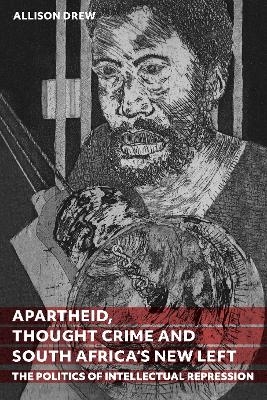
Apartheid, Thought Crime and South Africa’s New Left
The Politics of Intellectual Repression
Seiten
2026
James Currey (Verlag)
978-1-84701-484-9 (ISBN)
James Currey (Verlag)
978-1-84701-484-9 (ISBN)
- Noch nicht erschienen (ca. März 2026)
- Versandkostenfrei
- Auch auf Rechnung
- Artikel merken
Of all the groups charged in the early 1960s under apartheid security laws in South Africa, the National Liberation Front was the only one whose members did not engage in violence. Yet six months after its launch, its founding members were arrested and then sentenced to between five and ten years in prison. Why?
A Cape Peninsula offshoot of the Non-European Unity Movement, the NLF was explicitly socialist and part of the long 1960s New Left. Although the NLF challenged South Africa's racial and capitalist orders, it has scarcely appeared in the liberation movement historiography. This book recovers the NLF's lost history, tracing its perspectives on colonialism, apartheid, political education and guerrilla struggle. The book examines the NLF in its international and national contexts, exploring its relationships with both the transnational New Left and the South African left, and evaluating the conditions producing and then smashing South Africa's New Left.
Debates about apartheid focus on race, political economy, and state and institutions. But apartheid also strove to control thought through unequal education and censorship. While bringing the NLF's critique of racial capitalism to life, the book also uncovers the NLF's unique educational approach and the state's attempt to contain its thinking.
A Cape Peninsula offshoot of the Non-European Unity Movement, the NLF was explicitly socialist and part of the long 1960s New Left. Although the NLF challenged South Africa's racial and capitalist orders, it has scarcely appeared in the liberation movement historiography. This book recovers the NLF's lost history, tracing its perspectives on colonialism, apartheid, political education and guerrilla struggle. The book examines the NLF in its international and national contexts, exploring its relationships with both the transnational New Left and the South African left, and evaluating the conditions producing and then smashing South Africa's New Left.
Debates about apartheid focus on race, political economy, and state and institutions. But apartheid also strove to control thought through unequal education and censorship. While bringing the NLF's critique of racial capitalism to life, the book also uncovers the NLF's unique educational approach and the state's attempt to contain its thinking.
ALLISON DREW is Professor Emerita at the University of York, UK and Distinguished Visiting Professor at the University of Johannesburg Centre for Education Rights and Transformation.
List of Illustrations
Preface and acknowledgements
Abbreviations
The Accused
Introduction: Intellectual repression and thought crime in apartheid South Africa
1: South Africa's 1960s New Left
2: Gender and education in the NLF
3: The NLF and the South West Africa question
4: Things Fall Apart
5: The Trial
6: The Verdict
Conclusion
Bibliography
Index
| Erscheint lt. Verlag | 3.3.2026 |
|---|---|
| Zusatzinfo | 1 map and 6 b/w illus. |
| Verlagsort | Oxford |
| Sprache | englisch |
| Maße | 156 x 234 mm |
| Themenwelt | Geisteswissenschaften ► Geschichte ► Regional- / Ländergeschichte |
| Geschichte ► Teilgebiete der Geschichte ► Wirtschaftsgeschichte | |
| Sozialwissenschaften ► Politik / Verwaltung | |
| ISBN-10 | 1-84701-484-4 / 1847014844 |
| ISBN-13 | 978-1-84701-484-9 / 9781847014849 |
| Zustand | Neuware |
| Informationen gemäß Produktsicherheitsverordnung (GPSR) | |
| Haben Sie eine Frage zum Produkt? |
Mehr entdecken
aus dem Bereich

aus dem Bereich
wie Tech-Konzerne und Großmächte die Welt unter sich aufteilen
Buch | Hardcover (2025)
C.H.Beck (Verlag)
CHF 39,20


