


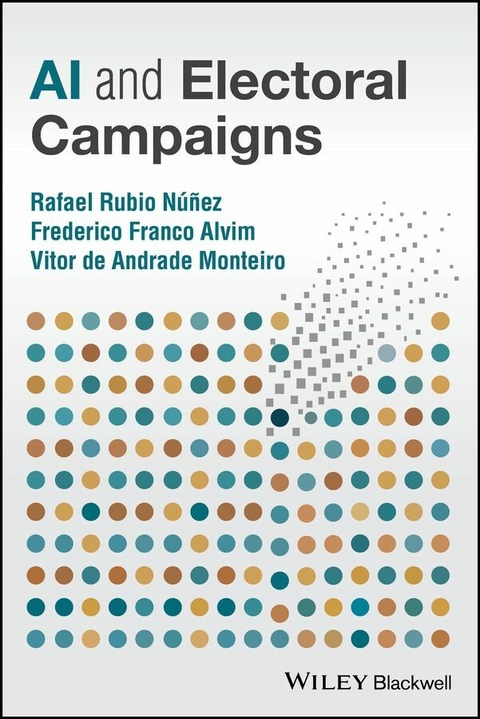
Offers a groundbreaking analysis of how artificial intelligence is reshaping the dynamics of political communication and electoral competition
AI and Electoral Campaigns delivers a timely, in-depth exploration of how artificial intelligence is disrupting the foundational processes of electoral democracy. As AI technologies increasingly shape political communication, this much-needed book equips readers to identify and critically assess the emerging threats to transparency, fairness, and legitimacy in democratic elections. Drawing on real-world cases from across the globe-including Argentina, India, the U.S., and Slovakia-the authors present an empirically grounded taxonomy of AI-related threats, including deepfakes, firehosing, cognitive hacking, astroturfing, and psychographic microtargeting.
AI and Electoral Campaigns fills a critical gap in the literature by addressing not only the political and communicative dimensions of AI's role in elections, but also its legal and ethical implications. The authors propose a clear framework to evaluate the impact of AI through principles-based analysis and present comparative insights into the regulatory responses emerging in diverse jurisdictions. With a structured approach that spans historical context, threat classification, ethical considerations, and legal strategies, the book focuses on the systemic challenges AI poses to electoral integrity.
A foundational guide for navigating the next phase of democratic resilience in the digital age, AI and Electoral Campaigns:
- Offers a global analysis of the new vulnerabilities and systemic risks AI introduces to democratic processes
- Features technical, legal, and practical insights from experts with frontline electoral policy experience
- Addresses the role of electoral management bodies (EMBs) in countering AI-driven disinformation
- Includes an in-depth review of current legislative and regulatory responses from different jurisdictions
- Highlights underexplored 'cyberpathologies' in political discourse shaped by AI technologies
AI and Electoral Campaigns is essential reading for postgraduate and advanced undergraduate students enrolled in courses such as Political Communication, Media Law, AI and Society, and Electoral Law. It is suitable for degree programs in Political Science, Communication Studies, Law, and Public Policy, and also serves as a key reference for electoral officials, policy makers, and legal practitioners.
RAFAEL RUBIO NÚÑEZ is Professor of Constitutional Law at the Complutense University of Madrid. A leading expert in electoral and parliamentary law, he advises international organizations on transparency, digital governance, and electoral integrity and has published extensively on political participation and freedom of expression.
FREDERICO FRANCO ALVIM is a legal expert in electoral law and disinformation, with advisory experience at Brazil's Superior Electoral Court. He has published on electoral justice, media integrity, and democratic resilience. He is a founding member of the Brazilian Academy of Electoral and Political Law.
VITOR DE ANDRADE MONTEIRO is a PhD candidate in Constitutional Law at the Complutense University of Madrid. He is a specialist in procedural and electoral law, with published work focusing on digital democracy and comparative constitutional analysis.
Offers a groundbreaking analysis of how artificial intelligence is reshaping the dynamics of political communication and electoral competition AI and Electoral Campaigns delivers a timely, in-depth exploration of how artificial intelligence is disrupting the foundational processes of electoral democracy. As AI technologies increasingly shape political communication, this much-needed book equips readers to identify and critically assess the emerging threats to transparency, fairness, and legitimacy in democratic elections. Drawing on real-world cases from across the globe including Argentina, India, the U.S., and Slovakia the authors present an empirically grounded taxonomy of AI-related threats, including deepfakes, firehosing, cognitive hacking, astroturfing, and psychographic microtargeting. AI and Electoral Campaigns fills a critical gap in the literature by addressing not only the political and communicative dimensions of AI's role in elections, but also its legal and ethical implications. The authors propose a clear framework to evaluate the impact of AI through principles-based analysis and present comparative insights into the regulatory responses emerging in diverse jurisdictions. With a structured approach that spans historical context, threat classification, ethical considerations, and legal strategies, the book focuses on the systemic challenges AI poses to electoral integrity. A foundational guide for navigating the next phase of democratic resilience in the digital age, AI and Electoral Campaigns: Offers a global analysis of the new vulnerabilities and systemic risks AI introduces to democratic processes Features technical, legal, and practical insights from experts with frontline electoral policy experience Addresses the role of electoral management bodies (EMBs) in countering AI-driven disinformation Includes an in-depth review of current legislative and regulatory responses from different jurisdictions Highlights underexplored cyberpathologies in political discourse shaped by AI technologies AI and Electoral Campaigns is essential reading for postgraduate and advanced undergraduate students enrolled in courses such as Political Communication, Media Law, AI and Society, and Electoral Law. It is suitable for degree programs in Political Science, Communication Studies, Law, and Public Policy, and also serves as a key reference for electoral officials, policy makers, and legal practitioners.
Introduction
Technological acceleration, the rise of social networks, data mining, and the automation of creative processes in different formats all lead to a progressive virtualization of reality, to the “digitalization of public conversations” (INNERARITY; COLOMINA 2020, p. 11). Within the realm of the symbolic conflicts that dominate politics at this point in the twenty‐first century, these phenomena have had an intense impact on the behavior of organizations, political parties, candidates, and activists, transforming not only politics but also society more broadly through the accelerated “dehumanization” of sensitive social tasks and processes.1
Electoral campaigns, originally based on direct interpersonal contacts (in the nineteenth and early twentieth centuries), on mass media as the intermediary (from the mid‐twentieth to the early twentieth centuries), and on the multi‐platform modality characteristic of digitalization (present day), have retained human behavior as their main source of action, despite transformations in the sociotechnical media. In this context, the quest for votes was based on strategies conceived and executed with the logistical support of the techniques available at any given moment, giving a competitive advantage to those whose strategic technical innovation surpassed that of their opponents. For example, the emergence of information technology from Ronald Reagan's first election campaign in 1980 onwards gave rise to a series of phenomena in the political arena, such as web pages (2000), meetups (2004), social networks (2008), micro‐segmentation (2012), and data‐driven campaigns in 2016, whose use rapidly became the norm.
However, the advance of artificial intelligence (AI) heralds the start of a new and inevitable transformation in the dynamics of electoral contests. In this context, the modernization and consequent expansion of communication possibilities, from the production to the dissemination phase, makes it possible to collect data on voter behavior and use this to create personalized messages as well as facilitate the dissemination of automated messages with an enormous potential to artificially manipulate public debate. In addition, the use of AI has the capacity to exert a negative influence both on the information market and on the climate of social relations, even going so far as to create apparently real “facts” embedded in ultrarealistic representations of people and events, which are conceived with a degree of sophistication that increasingly surpasses the savoir‐faire of the average hoaxer,2 and which use persuasion techniques that were “unthinkable in the past” and damage our collective ability to understand reality (SCHICK, 2020, p. 30).
Furthermore, these technologies provide political parties and candidates with opportunities to gain a better understanding of reality, develop sophisticated strategies, and optimize their communication with voters. On the other hand, they also enable an increase in the institutional capacities of electoral bodies, for example, in the fields of improving relations with society, the logistical organization of processes, the updating of electoral registers, voter identification, the detection of disinformation through social listening and network monitoring, and the construction of communication strategies to disseminate content, using “counter‐discourse” as a “combat tactic” (PRADO, 2022, p. 51).
The undeniable role of AI in the organization of current electoral processes raises concerns (VENICE COMMISSION, 2022; MONTILLA MARTOS, 2023; ROBINS-EARLY, 2023; WORLD ECONOMIC FORUM, 2024),3 as the recent experience of elections in countries such as Slovakia, Pakistan, India, Mexico, the United States, and Argentina4 has shown. In general, these cases were characterized by a recurrent use of generative tools in the production of advertising but also by the employment of these techniques in the industrial‐scale production of high‐yield content of a harmful or disinformative nature, such as the audio and video deepfakes that have flooded social media platforms and messaging applications (MEAKER, 2023; RAMÍREZ, 2023) or memes that use humor as a pretext for the manufacture of certain stereotypes on digital networks (BURROUGHS, 2023, p. 199). Such content is distributed on a massive scale through automated sending or the creation of fake profiles, in many cases as a result of the selective programming of different types of bots.5
Without succumbing to a catastrophism that could condition our response, it is clear that AI poses technical and social challenges that, in turn, demand the adoption of specific precautions and attitudes on the part of legislative (GARRIGA; RUIZ-INCERTIS; MAGALLÓN ROSA, 2024; VAN DER LINDEN, 2024), administrative, and jurisdictional bodies that participate in the organization of elections in the broadest possible sense. This need is further confirmed by the decisive role played by the opaque and biased algorithms that power recommendation systems (FISHER, 2022, p. 117; MOROZOV, 2018, p. 39; SANTINI; SALLES; MATTOS, 2023, p. 7); fuel identity bubbles; and favor the creation and dissemination of negative campaigns (MIHAILIDIS, 2023), hate speech (GUARATY, 2023, p. 09), fallacy mechanisms (CARRATALÁ; IRANZO-CABRERA; LÓPEZ-GARCÍA, 2023, p. 16), and practices designed to alter the popular will (RAMONET, 2022, p. 33; PÉREZ-CURIEL; RIVAS-DE-ROCA; GARCÍA-GORDILLO, 2023, p. 38). Moreover, the emergence of a polarized and radicalized public sphere (PRADO, 2023, p. 96) associated with the banalization of authoritarianism (LEVITSKY; ZIBLATT, 2023, p. 56) ushers in an era of “high‐risk elections” (DE LEO, 2023),6 which is further compounded by the overexploitation of personal information for the purposes of blackmail, influence, agitation, and propaganda (LUQUIN CALVO, 2023, p. 57; REBOLLO DELGADO, 2023, p. 28) in addition to the absence of effective and comprehensive special regulation.
Given these circumstances, this work aims to discuss the impact of the increasing role of AI tools in political–electoral communication from a political–legal perspective, in particular with regards to the supposed “special protection” (SÁNCHEZ MUÑOZ, 2020, p. 133) warranted by the integrity of the electoral system in the face of the new pathologies present in the era of digitalized elections. It is not a question of assessing the advisability or otherwise of using these technologies (given that the horse has already bolted the stable) but of carrying out a risk analysis as a preventive tool which identifies threats that have the potential to affect the execution of a process, in this case the electoral process, and which allows for a more effective management of contingencies, should these occur. In this sense, the authors propose a discussion centered on the risk paradigm, that is, on the contingencies or negative externalities that might result from the malicious use of AI tools but with the hope that the general sense of alert will not be interpreted as a sign of alarmist determinism. The risks that will be analyzed have different dimensions and impacts, many of which will hopefully fail to materialize. Others, moreover, can be neutralized by the pertinent institutions, provided that these are alert to the array of positive uses of the very tools that will be discussed.
While not claiming to offer simplistic answers that are more damaging to the democratic system than the legal good that these seek to defend, the knowledge produced by the capabilities and effects of using these technologies during elections renders it essential to consider possible answers. This is especially relevant given the context in which politics is above all a battle fought via communication, political disputes are driven by data (JUNEJA; MCBRIDE, 2023), and in which social media platforms act both as authentic “key institutions” (BALKIN, 2021, p. 71) of the “new public square” (INNERARITY; COLOMINA, 2020, p. 12) and as the new controllers of these communications processes7 (BALAGUER CALLEJÓN, 2023, p. 25; BUCCI, 2023, p. 113; KISSINGER; SCHMIDT; HUTTENLOCHER, 2022, p. 90), potentially leading to an almost unconscious shift in views on the part of voters (HELBIN et al., 2017; ORTEGA, 2023), thereby acting as veritable “weapons” in the struggle for collective persuasion (VAN DER LINDEN, 2023, p. 133).
BIBLIOGRAPHY
- Alvim, Frederico Franco; Monteiro, Vitor de Andrade; Rubio Núñez, Rafael. Inteligência artificial para eleições (mais) livres, justas e eficientes. Rio de Janeiro: Lumen Juris, 2025.
- Balaguer Callejón, Francisco. La...
| Erscheint lt. Verlag | 22.9.2025 |
|---|---|
| Sprache | englisch |
| Themenwelt | Sozialwissenschaften ► Kommunikation / Medien |
| Sozialwissenschaften ► Politik / Verwaltung | |
| Sozialwissenschaften ► Soziologie | |
| Schlagworte | AI digital democracy • AI election disinformation • AI election law • AI electoral campaign regulation • AI electoral campaigns • AI electoral integrity • AI ethics • AI political communication • AI political disinformation • artificial intelligence elections |
| ISBN-13 | 9781394311798 / 9781394311798 |
| Informationen gemäß Produktsicherheitsverordnung (GPSR) | |
| Haben Sie eine Frage zum Produkt? |
 EPUB (Adobe DRM)
Kopierschutz: Adobe-DRM
Adobe-DRM ist ein Kopierschutz, der das eBook vor Mißbrauch schützen soll. Dabei wird das eBook bereits beim Download auf Ihre persönliche Adobe-ID autorisiert. Lesen können Sie das eBook dann nur auf den Geräten, welche ebenfalls auf Ihre Adobe-ID registriert sind.
Details zum Adobe-DRM
Dateiformat: EPUB (Electronic Publication)
EPUB ist ein offener Standard für eBooks und eignet sich besonders zur Darstellung von Belletristik und Sachbüchern. Der Fließtext wird dynamisch an die Display- und Schriftgröße angepasst. Auch für mobile Lesegeräte ist EPUB daher gut geeignet.
Systemvoraussetzungen:
PC/Mac: Mit einem PC oder Mac können Sie dieses eBook lesen. Sie benötigen eine
eReader: Dieses eBook kann mit (fast) allen eBook-Readern gelesen werden. Mit dem amazon-Kindle ist es aber nicht kompatibel.
Smartphone/Tablet: Egal ob Apple oder Android, dieses eBook können Sie lesen. Sie benötigen eine
Geräteliste und zusätzliche Hinweise
Buying eBooks from abroad
For tax law reasons we can sell eBooks just within Germany and Switzerland. Regrettably we cannot fulfill eBook-orders from other countries.
aus dem Bereich


