


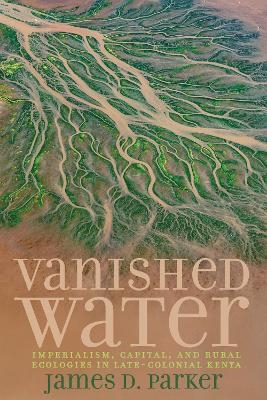
Vanished Water
Imperialism, Capital, and Rural Ecologies in Late-Colonial Kenya
Seiten
2026
University of Virginia Press (Verlag)
978-0-8139-5484-4 (ISBN)
University of Virginia Press (Verlag)
978-0-8139-5484-4 (ISBN)
- Noch nicht erschienen (ca. April 2026)
- Versandkostenfrei
- Auch auf Rechnung
- Artikel merken
The trickle-down effects of empire on the environment
Vanished Water examines the ecological and social consequences of British imperial rule—and its inherently extractive aims—on water development in late-colonial Kenya. Examining the arid northern and eastern parts of the country between 1938 and the mid-1960s, James Parker demonstrates how the British colonial state manipulated scant water supplies to drive cash crop production, rerouting critical resources away from the pastoral and riverine communities who relied on them for their existence. In doing so, the state sought to force these communities away from their traditional subsistence economies and into the capitalist economy, a move that fundamentally altered relationships to the land and between ethnic groups themselves. Vanished Water describes how these nefarious programs devastated rural communities, while also showing how they were resisted and manipulated and how Kenyans adapted to these life-altering changes imposed on them from the outside. These developments, as Parker shows, echo into the present, continuing to test the resiliency of arid communities now dealing with climate change.
Vanished Water examines the ecological and social consequences of British imperial rule—and its inherently extractive aims—on water development in late-colonial Kenya. Examining the arid northern and eastern parts of the country between 1938 and the mid-1960s, James Parker demonstrates how the British colonial state manipulated scant water supplies to drive cash crop production, rerouting critical resources away from the pastoral and riverine communities who relied on them for their existence. In doing so, the state sought to force these communities away from their traditional subsistence economies and into the capitalist economy, a move that fundamentally altered relationships to the land and between ethnic groups themselves. Vanished Water describes how these nefarious programs devastated rural communities, while also showing how they were resisted and manipulated and how Kenyans adapted to these life-altering changes imposed on them from the outside. These developments, as Parker shows, echo into the present, continuing to test the resiliency of arid communities now dealing with climate change.
James D. Parker is an Assistant Teaching Professor and Honors Faculty Fellow at Arizona State University.
| Erscheint lt. Verlag | 16.4.2026 |
|---|---|
| Reihe/Serie | Carter G. Woodson Institute Series |
| Zusatzinfo | 4 maps, 2 tables |
| Verlagsort | Charlottesville |
| Sprache | englisch |
| Maße | 152 x 229 mm |
| Themenwelt | Geisteswissenschaften ► Geschichte ► Regional- / Ländergeschichte |
| Geschichte ► Teilgebiete der Geschichte ► Wirtschaftsgeschichte | |
| Sozialwissenschaften ► Politik / Verwaltung | |
| ISBN-10 | 0-8139-5484-3 / 0813954843 |
| ISBN-13 | 978-0-8139-5484-4 / 9780813954844 |
| Zustand | Neuware |
| Informationen gemäß Produktsicherheitsverordnung (GPSR) | |
| Haben Sie eine Frage zum Produkt? |
Mehr entdecken
aus dem Bereich


aus dem Bereich
wie Tech-Konzerne und Großmächte die Welt unter sich aufteilen
Buch | Hardcover (2025)
C.H.Beck (Verlag)
CHF 39,20
Aufstieg und Fall der Deutschland AG
Buch | Hardcover (2025)
Suhrkamp (Verlag)
CHF 41,95


