


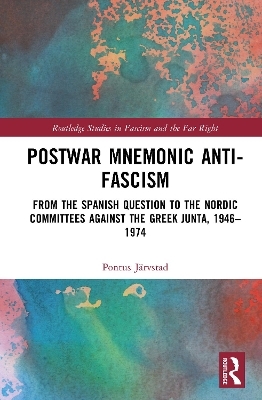
Postwar Mnemonic Anti-Fascism
From the Spanish Question to the Nordic Committees against the Greek Junta, 1946–1974
Seiten
2025
Routledge (Verlag)
978-1-041-12690-4 (ISBN)
Routledge (Verlag)
978-1-041-12690-4 (ISBN)
This book deals with the transnational activities and political agitation of a Nordic social movement that was created to fight the junta which seized power in a military coup in Greece in 1967.
This book deals with the transnational activities and political agitation of a Nordic social movement that was created to fight the junta, which seized power in a military coup in Greece in 1967. The main focus is on the anti-fascist aspects of the opposition movement. It is shown that the individual committees, which were created in all the Nordic countries, framed their acts of resisting the military regime as a continuation of past resistance against fascism. Thus, despite the centrality of the ideological clash between two empires—the Soviet Union and the United States—Nordic politicians and activists also transcended political dogmas during the Cold War. While spanning a broad political spectrum, the Norwegian, Swedish, and Danish Committees, in particular, were dominated by social democratic members. It is shown, however, that despite close links with social democratic governments, these anti-fascist activists were prepared to go beyond legal means as part of their covert efforts to unite the Greek democratic opposition, calling for the assassination of Junta members and for engaging in direct resistance activities in Greece. This book argues that the Nordic Committees on Spain and Greece formed a collective anti-fascist identity. By labeling these regimes as fascist, the activists sought to resume the historical struggle against fascism in a post-war setting. This transnational social movement garnered support for its cause by summoning memories of this past, especially of the Spanish Civil War and the Nazi occupation of Denmark and Norway. The military coup in Greece was seen as an “event of critical juncture,” which unsettled the existing democratic order, and which raised the specter of fascism in Europe. This book will be of interest to scholars of anti-fascism, social movements, memory studies, and the far right.
This book deals with the transnational activities and political agitation of a Nordic social movement that was created to fight the junta, which seized power in a military coup in Greece in 1967. The main focus is on the anti-fascist aspects of the opposition movement. It is shown that the individual committees, which were created in all the Nordic countries, framed their acts of resisting the military regime as a continuation of past resistance against fascism. Thus, despite the centrality of the ideological clash between two empires—the Soviet Union and the United States—Nordic politicians and activists also transcended political dogmas during the Cold War. While spanning a broad political spectrum, the Norwegian, Swedish, and Danish Committees, in particular, were dominated by social democratic members. It is shown, however, that despite close links with social democratic governments, these anti-fascist activists were prepared to go beyond legal means as part of their covert efforts to unite the Greek democratic opposition, calling for the assassination of Junta members and for engaging in direct resistance activities in Greece. This book argues that the Nordic Committees on Spain and Greece formed a collective anti-fascist identity. By labeling these regimes as fascist, the activists sought to resume the historical struggle against fascism in a post-war setting. This transnational social movement garnered support for its cause by summoning memories of this past, especially of the Spanish Civil War and the Nazi occupation of Denmark and Norway. The military coup in Greece was seen as an “event of critical juncture,” which unsettled the existing democratic order, and which raised the specter of fascism in Europe. This book will be of interest to scholars of anti-fascism, social movements, memory studies, and the far right.
Pontus Järvstad is a postdoctoral fellow in the Department of Humanities, University of Iceland.
1. Introduction 2. Postwar Anti-Fascist Sentiments in the Nordic Countries 3. Anti-Fascism as a Praxis: The Nordic Committees for Democracy in Greece 4. Conclusion
| Erscheinungsdatum | 05.12.2025 |
|---|---|
| Reihe/Serie | Routledge Studies in Fascism and the Far Right |
| Verlagsort | London |
| Sprache | englisch |
| Maße | 156 x 234 mm |
| Gewicht | 570 g |
| Themenwelt | Geschichte ► Allgemeine Geschichte ► Zeitgeschichte |
| Geisteswissenschaften ► Geschichte ► Regional- / Ländergeschichte | |
| Sozialwissenschaften ► Politik / Verwaltung ► Politische Systeme | |
| Sozialwissenschaften ► Politik / Verwaltung ► Politische Theorie | |
| ISBN-10 | 1-041-12690-5 / 1041126905 |
| ISBN-13 | 978-1-041-12690-4 / 9781041126904 |
| Zustand | Neuware |
| Informationen gemäß Produktsicherheitsverordnung (GPSR) | |
| Haben Sie eine Frage zum Produkt? |
Mehr entdecken
aus dem Bereich



aus dem Bereich
die großen Jahre der Soziologie 1949-1969
Buch | Hardcover (2025)
Klett-Cotta (Verlag)
CHF 39,20
eine Deutschlandreise im Jahr 1958
Buch | Hardcover (2024)
C.H.Beck (Verlag)
CHF 29,90


