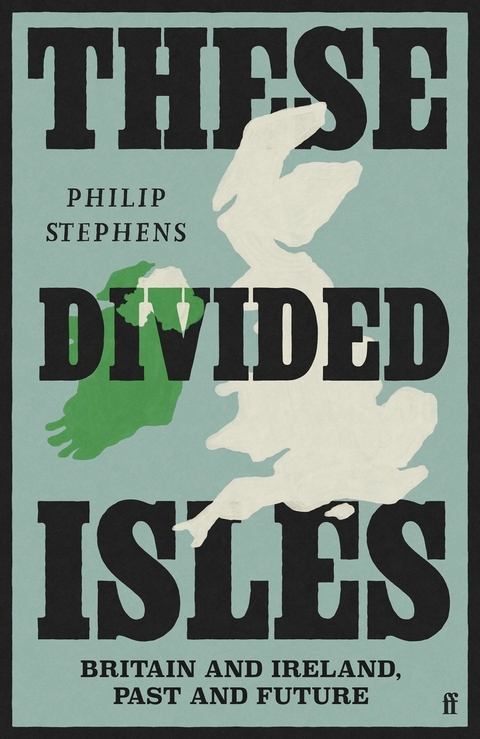
These Divided Isles (eBook)
480 Seiten
Faber & Faber (Verlag)
978-0-571-38150-0 (ISBN)
Philip Stephens is an award-winning journalist and contributing editor at the Financial Times, where he was previously director of the Editorial Board and chief political commentator. Throughout his career, he has had unique access to foreign policymakers in Britain and around the world. Stephens has won the David Watt Prize for Outstanding Political Journalism; the Political Studies Association's Journalist of the Year; and Political Journalist of the Year in the Press Awards. He is the author of Politics and the Pound, Tony Blair: The Making of a World Leader and Britain Alone: The Path from Suez to Brexit. He is British and Irish, brought up in London but with roots in County Mayo.
A vital history from the award-winning Financial Times journalist Philip Stephens on the dramatic century since the Anglo-Irish Treaty and partition. Ireland and Britain's relationship is as intertwined as it has so often been violent and traumatic. In These Divided Isles the award-winning author and journalist Philip Stephens tells the vital, riveting history that focuses on the dramatic century since the Anglo-Irish Treaty and on the unfinished business of partition, revealing how the past has shaped the present and will inform the future of both nations. Telling the story from both sides of the Irish Sea and cutting through the layers of grievance and prejudice, Philips explores the emotional intimacy and enmity of a relationship shaped by close familial ties and clashing national identities. It's a story written by big political leaders - David Lloyd George, Michael Collins, Winston Churchill and Eamon de Valera - and the millions of Irish emigrants who crossed from Ireland to Britain to begin new lives. Today demography, Brexit and political logic have brought the possibility of Irish unity into view. Grounded in decades of personal contact and interviews with key policymakers across Britain and Europe, Stephens maps this complex relationship and asks how Ireland might deploy its history to inform its future rather than hold it in place.
There was a theatrical quality to the ultimatum issued by David Lloyd George. The new parliament in Belfast was to reconvene the following day. A Royal Navy frigate, the prime minister told his interlocutors, was standing by to take news of the outcome of their deliberations to the unionist government. After months of arguing, the choice the prime minister presented to the republican negotiators in Downing Street was between accepting the accord before them or bearing responsibility for the ‘terrible war’ Britain would otherwise unleash within days to crush their rebellion. At a little after 2 a.m. on 6 December 1921, the Sinn Féin delegation of Arthur Griffith, Michael Collins, Eamonn Duggan, George Gavan Duffy and Robert Barton signed the articles of agreement for a treaty between Britain and Ireland. The war that had begun nearly three years earlier when Volunteers of the Irish Republican Army had launched a lethal attack on the police in Soloheadbeg, County Tipperary, was over.
When the Downing Street conference had first met in October, the prime minister’s officials had set a wide table between the two delegations. They were fearful of embarrassment should one of the attending British ministers refuse to extend a hand to the leaders of what they regarded as a lawless insurrection. Now, the seven-strong British side – counting among them Austen Chamberlain and Winston Churchill – walked around to clasp hands with the leaders of a new Irish state. Lloyd George had almost certainly been bluffing. He had indeed promised to send an update on the progress of the talks to the Ulster leader James Craig. He had played his hand skilfully – even to the point of drafting a statement explaining the breakdown of the talks. The Irish side, this said, had presented to the British ‘proposals which would break the empire in pieces, dislocate society in all its self-governing nations and cancel forever the hope of national unity in Ireland itself’.1 But there was no immutable deadline. Rather, Lloyd George considered he had exhausted his political room for compromise. The ultimatum was a last throw.
The rock-strewn path to the treaty and the partition of Ireland was marked out with blood, prejudice, political opportunism and deception, culminating in the armed uprising that began in Limerick. Peace had taken its time. The Tory statesman Benjamin Disraeli had defined the challenge in 1844, during a speech to the House of Commons on the eve of the Great Famine:
A dense population, in extreme distress, inhabit an island where there is an Established Church, which is not their Church, and a territorial aristocracy, the richest of whom live in foreign capitals. Thus you have a starving population, an absentee aristocracy, and an alien Church; and in addition the weakest executive in the world. That is the Irish Question.
The Liberal statesman William Gladstone had tried to offer an answer with his proposals during the 1880s for Home Rule. His premiership had been broken by the endeavour.
The promise of the treaty was to set both nations free – the twenty-six counties of the Free State from seven centuries of violent repression; and the British from the disruptive intrusion into the affairs of the empire that came with ruling a nation that did not want them. Partition, its authors hoped, would draw a line not just across Ireland but under a conflict Britain had come to understand it could not win. The new Northern Ireland’s place in the United Kingdom would be unique: separated but attached, Irish but still British. For Michael Collins, the military commander of the IRA Volunteers whose war had brought Lloyd George’s coalition government to the negotiating table, the treaty was an imperfect outcome, but one that put Ireland on the path to the freedom it craved. Lloyd George’s adviser Philip Kerr caught the British mood when he remarked that the agreement would achieve two vital objectives: ‘It would take Ulster out of the Irish question which it has blocked for a generation and it would take Ireland out of English party controversies.’2 For the following half-century, Kerr might have argued he had been right. But then, as Northern Ireland fell to violent conflict, it was revealed as a truce rather than a peace.
For Irish nationalism, the loss of most of Ulster was proof of immutable English perfidy. The very existence of Northern Ireland (unionists would have preferred to call it Ulster) was a baleful reminder of the legacy of colonisation. But then for Lloyd George’s government, partition was not so much a principled plan as another chapter in the narrative of political expediency that guided British policy towards Ireland. It was shaped by English politics rather than Irish geography. The bargain fell far short of the republicans’ aspirations for an independent, sovereign and united Ireland because a British prime minister considered that Dominion status within the empire for the twenty-six counties was as much as he could offer the revolutionaries without forcing a confrontation with Craig’s unionists and provoking the collapse of his own coalition government. If Collins would characterise the treaty as a stepping stone to full nationhood, for Britain’s ruling class it was counted as a blessed release.
The Government of Ireland Act that had been passed into law by Herbert Asquith’s Liberal government seven years earlier had for a moment seemed to map a political accommodation between London and Dublin. Asquith had succeeded where Gladstone had failed in piloting through the Westminster parliament an arrangement to reconcile Irish demands for self-government with the British imperative that Ireland remain within the family of the empire. In truth, the plan for a new Dublin parliament that kept Ireland firmly within the bounds of the empire was always set to fail. As so often in the history of Anglo-Irish relations, the terms of the proposed settlement were crafted without reference to political realities in Ireland. What might have met the demands of the celebrated Irish nationalist Charles Stewart Parnell during the 1880s had been overtaken by events. As it turned out, the onset of war with the Kaiser in 1914 ensured the attempt to implement Asquith’s plan would be suspended for the duration of hostilities with Germany. But anyway it was out of time. Falling short of the aspirations of nationalism, it was also anathema to a Protestant population in the north-east that had circled the wagons of implacable unionism against any accommodation with the Catholic south. John Redmond, the leader of the constitutional nationalists in the Irish Parliamentary Party (IPP), had acquiesced in Asquith’s plan, albeit with great reluctance. Edward Carson, the fiery Dublin-born lawyer who dominated the unionist politics of the north during the decade after 1910, had railed against the act as ‘a sentence of death with a stay of execution’.
Lloyd George’s peace treaty was nothing if not true to the organising impulse of British, or more accurately English, attitudes to Ireland: the balance of interests and votes at Westminster took precedence over the force or the justice of any of the arguments heard in Ireland itself. Gladstone’s attempts to deliver a measure of self-government had foundered in the face of Conservative hostility and divisions in his own party between Home Rulers and self-proclaimed Liberal unionists who shared Tory fears that concessions to Irish nationalism would strike at Britain’s global standing. In 1895 Gladstone’s departure saw the Liberals swept from office by Lord Salisbury’s Conservatives. Parnell’s IPP, which for a decade had contrived to set the agenda of politics at Westminster, fractured. Disgraced by public disclosure of an affair with the married Kitty O’Shea, Parnell died prematurely in 1891. Robbed of its charismatic leader, the party fell into internal squabbles.
For a handful of Conservatives, opposition to Irish Home Rule reflected family background, typically infused with visceral disdain for the native Irish. Andrew Bonar Law, who led the party’s battle against Asquith’s Home Rule bill, hailed from a staunchly unionist family. He belonged to those who shared the opinion of the writer and historian James Anthony Froude that the fault in Ireland lay in the deeply flawed character of the Irish people: ‘a race which seemed incurable’, as Froude put it. Others in the party were driven by a broader but deep-seated anti-Catholic prejudice. What pulled the various factions together was the wider fear, shared by Liberal Party unionists and heightened by the Boer rebellion in southern Africa, that concessions to Irish nationalism would signal weakness. The loss of Ireland, they concluded, would risk the unravelling of Britain’s great empire. What clinched the argument was cynical electoral calculation. ‘Ulster will fight, and Ulster will be right’: Randolph Churchill’s notorious unionist rallying cry against Irish nationalism in 1886 had owed nothing to political principle. The purpose was to destabilise Gladstone. So it was with Tory backing for Carson’s insurrection against Asquith’s plan thirty years later. Leading a party that had been divided by arguments about imperial trade preferences and protectionism, Bonar Law saw a way to cement at once his own position and force the...
| Erscheint lt. Verlag | 26.8.2025 |
|---|---|
| Sprache | englisch |
| Themenwelt | Geisteswissenschaften ► Geschichte ► Regional- / Ländergeschichte |
| Sozialwissenschaften ► Politik / Verwaltung ► Europäische / Internationale Politik | |
| ISBN-10 | 0-571-38150-2 / 0571381502 |
| ISBN-13 | 978-0-571-38150-0 / 9780571381500 |
| Informationen gemäß Produktsicherheitsverordnung (GPSR) | |
| Haben Sie eine Frage zum Produkt? |
 EPUB (Adobe DRM)
Kopierschutz: Adobe-DRM
Adobe-DRM ist ein Kopierschutz, der das eBook vor Mißbrauch schützen soll. Dabei wird das eBook bereits beim Download auf Ihre persönliche Adobe-ID autorisiert. Lesen können Sie das eBook dann nur auf den Geräten, welche ebenfalls auf Ihre Adobe-ID registriert sind.
Details zum Adobe-DRM
Dateiformat: EPUB (Electronic Publication)
EPUB ist ein offener Standard für eBooks und eignet sich besonders zur Darstellung von Belletristik und Sachbüchern. Der Fließtext wird dynamisch an die Display- und Schriftgröße angepasst. Auch für mobile Lesegeräte ist EPUB daher gut geeignet.
Systemvoraussetzungen:
PC/Mac: Mit einem PC oder Mac können Sie dieses eBook lesen. Sie benötigen eine
eReader: Dieses eBook kann mit (fast) allen eBook-Readern gelesen werden. Mit dem amazon-Kindle ist es aber nicht kompatibel.
Smartphone/Tablet: Egal ob Apple oder Android, dieses eBook können Sie lesen. Sie benötigen eine
Geräteliste und zusätzliche Hinweise
Buying eBooks from abroad
For tax law reasons we can sell eBooks just within Germany and Switzerland. Regrettably we cannot fulfill eBook-orders from other countries.
aus dem Bereich