


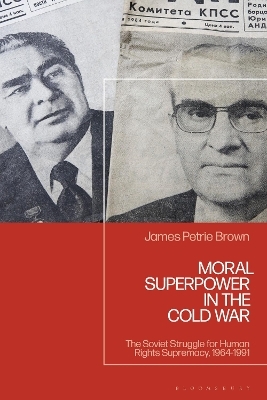
Moral Superpower in the Cold War
The Soviet Struggle for Human Rights Supremacy, 1964-1991
Seiten
2026
Bloomsbury Academic (Verlag)
978-1-350-54187-0 (ISBN)
Bloomsbury Academic (Verlag)
978-1-350-54187-0 (ISBN)
- Noch nicht erschienen (ca. Juni 2026)
- Versandkostenfrei
- Auch auf Rechnung
- Artikel merken
A study of the integral role played by human rights in Cold War international relations and the USSR’s attempt to transform its global image to become a moral superpower.
This book explores how the Cold War’s ideological conflict was played out through competition over human rights values.
As the West feared that the Soviet Union might ‘win’ the Cold war, it shows how they sought to aggressively outflank the USSR on human rights, while the Soviet Union simultaneously attempted to establish itself as a moral superpower, superior to the West.
Examining how the Soviet leadership sought to respond to the West’s amplification of prominent Soviet dissidents and global condemnation of their human rights abuses, they in turn depicted left-wing activists in the UK and the US as on par with famous Soviet dissidents in their press. Highlighting the extensive Soviet campaign to build global support for its image as a human rights’ defender, it shows how they claimed support for striking trade unionists, protesting students, Native American rights activists and radical ant-racist groups, primarily in the UK and the US, to push a narrative of the inherent instability of capitalism in the two leading capitalist states.
Exhibiting this ideological struggle and uncertainty between East and West in new ways, Moral Superpower in the Cold War helps us to understand why the conflict took the trajectory that it did, and how it was experienced by those who lived through it.
This book explores how the Cold War’s ideological conflict was played out through competition over human rights values.
As the West feared that the Soviet Union might ‘win’ the Cold war, it shows how they sought to aggressively outflank the USSR on human rights, while the Soviet Union simultaneously attempted to establish itself as a moral superpower, superior to the West.
Examining how the Soviet leadership sought to respond to the West’s amplification of prominent Soviet dissidents and global condemnation of their human rights abuses, they in turn depicted left-wing activists in the UK and the US as on par with famous Soviet dissidents in their press. Highlighting the extensive Soviet campaign to build global support for its image as a human rights’ defender, it shows how they claimed support for striking trade unionists, protesting students, Native American rights activists and radical ant-racist groups, primarily in the UK and the US, to push a narrative of the inherent instability of capitalism in the two leading capitalist states.
Exhibiting this ideological struggle and uncertainty between East and West in new ways, Moral Superpower in the Cold War helps us to understand why the conflict took the trajectory that it did, and how it was experienced by those who lived through it.
James Petrie Brown is an independent historian of the Cold War, Communism and Human Rights based in the UK. He received his PhD on Cold War human rights discourse from Northumbria University, UK.
1. The Breakthrough of Dissent and its Transnational Reception
2. The New Left, Race and Radicalism, 1968-72
3. The Human Rights Revolution, 1972-79
4. The Soviet Press and British and American Trade Unions, 1979-85
5. The ‘End of History’ and Transnational Dissident-Promoting Coalitions, 1985-present
Epilogue: From glasnost to gibridnaya voyna
| Erscheint lt. Verlag | 11.6.2026 |
|---|---|
| Zusatzinfo | 10 bw illus |
| Verlagsort | London |
| Sprache | englisch |
| Maße | 156 x 234 mm |
| Themenwelt | Geschichte ► Allgemeine Geschichte ► Zeitgeschichte |
| Sozialwissenschaften ► Politik / Verwaltung | |
| ISBN-10 | 1-350-54187-7 / 1350541877 |
| ISBN-13 | 978-1-350-54187-0 / 9781350541870 |
| Zustand | Neuware |
| Informationen gemäß Produktsicherheitsverordnung (GPSR) | |
| Haben Sie eine Frage zum Produkt? |
Mehr entdecken
aus dem Bereich



aus dem Bereich
die großen Jahre der Soziologie 1949-1969
Buch | Hardcover (2025)
Klett-Cotta (Verlag)
CHF 39,20
von den Versprechen der Neunziger zu den Krisen der Gegenwart
Buch | Hardcover (2025)
Aufbau (Verlag)
CHF 36,40


