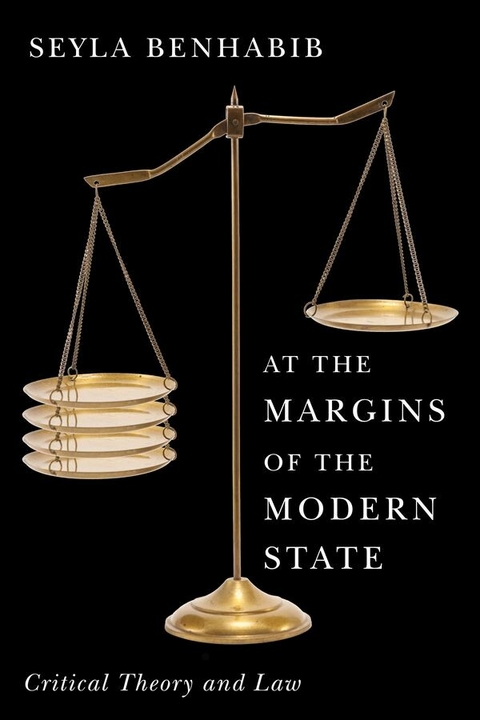
At the Margins of the Modern State (eBook)
221 Seiten
Polity (Verlag)
978-1-5095-6875-8 (ISBN)
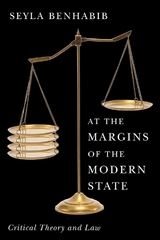
Facile expressions such as 'Eurocentrism' and 'demise of the West and the rise of the rest' miss the real challenge in this situation: how to extend moral, legal and political universalism to address the experiences of the multitude of humanity for whom western modernity has brought not only equality but also subordination, not only emancipation but also domination. Benhabib argues that rethinking this universalist project and participating in world-building together can be achieved by reconstructing and retrieving the best insights of critical social theory in the Frankfurt tradition and the liberal Kantianism of Rawls and Dworkin. In that spirit, this volume addresses state and popular sovereignty, Third World approaches to International Law, the 1951 Refugee Convention, and climate change legislation, while focusing on the changing fortunes of the European Union and cosmopolitanism. Benhabib engages with postcolonial thinkers and argues that, although validity claims and relations of domination and inequality are often intermixed, it is possible to reconstruct the insights of international law to serve a more inclusive universalism and world-building.
This vibrant defense of human rights and universal norms in an age of political skepticism and extremism will appeal to a wide readership and will be of particular interest to students and scholars in political theory, critical theory and law.
Seyla Benhabib is Eugene Meyer Professor of Political Science and Philosophy, Emerita at Yale University and Senior Research Scholar at Columbia Law School.
The international order of the post-WW II period is in disarray. The sounds of war can be heard all around us, from Ukraine to Gaza, from Darfur to the Congo, and there is growing skepticism towards human rights and democracy, the rule of law and peace among peoples.Facile expressions such as Eurocentrism and demise of the West and the rise of the rest miss the real challenge in this situation: how to extend moral, legal and political universalism to address the experiences of the multitude of humanity for whom western modernity has brought not only equality but also subordination, not only emancipation but also domination. Benhabib argues that rethinking this universalist project and participating in world-building together can be achieved by reconstructing and retrieving the best insights of critical social theory in the Frankfurt tradition and the liberal Kantianism of Rawls and Dworkin. In that spirit, this volume addresses state and popular sovereignty, Third World approaches to International Law, the 1951 Refugee Convention, and climate change legislation, while focusing on the changing fortunes of the European Union and cosmopolitanism. Benhabib engages with postcolonial thinkers and argues that, although validity claims and relations of domination and inequality are often intermixed, it is possible to reconstruct the insights of international law to serve a more inclusive universalism and world-building. This vibrant defense of human rights and universal norms in an age of political skepticism and extremism will appeal to a wide readership and will be of particular interest to students and scholars in political theory, critical theory and law.
| Erscheint lt. Verlag | 15.7.2025 |
|---|---|
| Sprache | englisch |
| Themenwelt | Geisteswissenschaften |
| Sozialwissenschaften ► Politik / Verwaltung ► Politische Theorie | |
| Schlagworte | 1951 Refugee Convention • Adorno Prize • Adorno Prize 2024 • are human rights a fig leaf for Western power? • are human rights universal? • Arendt • Can cosmopolitanism be reconciled with climate change? • Cosmopolitanism • Critical theory • Dworkin • Extremism • extremism book • Frankfurt School • Gaza • Habermas • Hannah Arendt • Hegel • hermeneutics of suspicion • how can we defend universal values in a sceptical age? • how to make the world a better place • Human Rights • Inequality • Kant • Law • law and human rights book • Postcolonialism • Rawls • Ricoeur • Seyla Benhabib • Ukraine • Violence • war • who won this year’s Adorno Prize? |
| ISBN-10 | 1-5095-6875-1 / 1509568751 |
| ISBN-13 | 978-1-5095-6875-8 / 9781509568758 |
| Informationen gemäß Produktsicherheitsverordnung (GPSR) | |
| Haben Sie eine Frage zum Produkt? |
 PDF (Adobe DRM)
Kopierschutz: Adobe-DRM
Adobe-DRM ist ein Kopierschutz, der das eBook vor Mißbrauch schützen soll. Dabei wird das eBook bereits beim Download auf Ihre persönliche Adobe-ID autorisiert. Lesen können Sie das eBook dann nur auf den Geräten, welche ebenfalls auf Ihre Adobe-ID registriert sind.
Details zum Adobe-DRM
Dateiformat: PDF (Portable Document Format)
Mit einem festen Seitenlayout eignet sich die PDF besonders für Fachbücher mit Spalten, Tabellen und Abbildungen. Eine PDF kann auf fast allen Geräten angezeigt werden, ist aber für kleine Displays (Smartphone, eReader) nur eingeschränkt geeignet.
Systemvoraussetzungen:
PC/Mac: Mit einem PC oder Mac können Sie dieses eBook lesen. Sie benötigen eine
eReader: Dieses eBook kann mit (fast) allen eBook-Readern gelesen werden. Mit dem amazon-Kindle ist es aber nicht kompatibel.
Smartphone/Tablet: Egal ob Apple oder Android, dieses eBook können Sie lesen. Sie benötigen eine
Geräteliste und zusätzliche Hinweise
Buying eBooks from abroad
For tax law reasons we can sell eBooks just within Germany and Switzerland. Regrettably we cannot fulfill eBook-orders from other countries.
aus dem Bereich