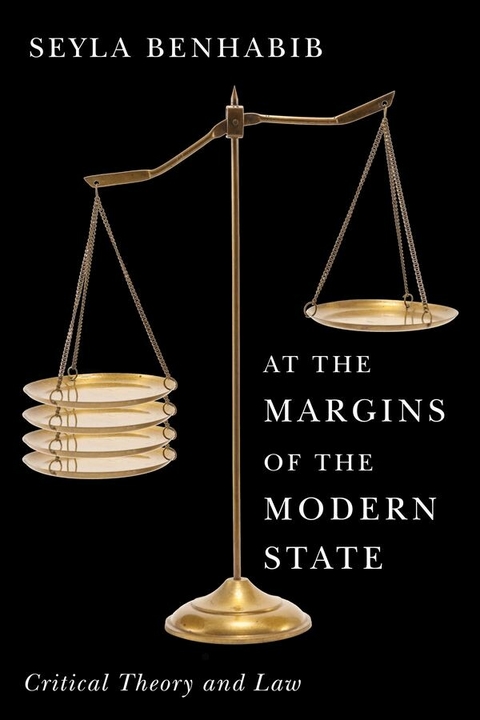
At the Margins of the Modern State (eBook)
343 Seiten
Polity (Verlag)
978-1-5095-6359-3 (ISBN)
Facile expressions such as 'Eurocentrism' and 'demise of the West and the rise of the rest' miss the real challenge in this situation: how to extend moral, legal and political universalism to address the experiences of the multitude of humanity for whom western modernity has brought not only equality but also subordination, not only emancipation but also domination. Benhabib argues that rethinking this universalist project and participating in world-building together can be achieved by reconstructing and retrieving the best insights of critical social theory in the Frankfurt tradition and the liberal Kantianism of Rawls and Dworkin. In that spirit, this volume addresses state and popular sovereignty, Third World approaches to International Law, the 1951 Refugee Convention, and climate change legislation, while focusing on the changing fortunes of the European Union and cosmopolitanism. Benhabib engages with postcolonial thinkers and argues that, although validity claims and relations of domination and inequality are often intermixed, it is possible to reconstruct the insights of international law to serve a more inclusive universalism and world-building.
This vibrant defense of human rights and universal norms in an age of political skepticism and extremism will appeal to a wide readership and will be of particular interest to students and scholars in political theory, critical theory and law.
Seyla Benhabib is Eugene Meyer Professor of Political Science and Philosophy, Emerita at Yale University and Senior Research Scholar at Columbia Law School.
The international order of the post-WW II period is in disarray. The sounds of war can be heard all around us, from Ukraine to Gaza, from Darfur to the Congo, and there is growing skepticism towards human rights and democracy, the rule of law and peace among peoples.Facile expressions such as Eurocentrism and demise of the West and the rise of the rest miss the real challenge in this situation: how to extend moral, legal and political universalism to address the experiences of the multitude of humanity for whom western modernity has brought not only equality but also subordination, not only emancipation but also domination. Benhabib argues that rethinking this universalist project and participating in world-building together can be achieved by reconstructing and retrieving the best insights of critical social theory in the Frankfurt tradition and the liberal Kantianism of Rawls and Dworkin. In that spirit, this volume addresses state and popular sovereignty, Third World approaches to International Law, the 1951 Refugee Convention, and climate change legislation, while focusing on the changing fortunes of the European Union and cosmopolitanism. Benhabib engages with postcolonial thinkers and argues that, although validity claims and relations of domination and inequality are often intermixed, it is possible to reconstruct the insights of international law to serve a more inclusive universalism and world-building. This vibrant defense of human rights and universal norms in an age of political skepticism and extremism will appeal to a wide readership and will be of particular interest to students and scholars in political theory, critical theory and law.
1
THE SPECTER OF POPULAR SOVEREIGNTY IN HABERMAS’S BETWEEN FACTS AND NORMS
Contemporary political thought and its discontents
If John Rawls’s A Theory of Justice of 1971 gave us the most extensive and still unsurpassed ideal theory of post-World War II constitutional liberal democracies, two decades later Jürgen Habermas’s Between Facts and Norms: Contributions to a Discourse Theory of Law and Democracy (1996 [1992])1 provided the most comprehensive theorization of such democracies as they evolved into the administrative state based on the legitimacy of the rule of law. Habermas’s method is not that of ideal theory but of rational reconstruction. Like Hegel in his 1821 Philosophy of Right, who sought to lay bare the normative logic of the institutions of the modern state – abstract right, legality, morality, the family, the market, and the state – Habermas, too, seeks to uncover the normative logic of the institutions of advanced liberal democracies.2
While Hegelian reconstruction, although dissecting the inadequacies of certain spheres and institutions, nonetheless sublates these into a larger conceptual whole in which these inadequacies are neutralized, Habermas insists on the interplay between validity and facticity or between the claim to rationality of existing institutions and their failure to live up to the normative demands of communicative reason. As he explains in the opening pages of BFN:
Tossed to and fro between facticity and validity, political and legal theory today are disintegrating into camps that hardly have anything more to say to one another. The tension between normative approaches, which are constantly in danger of losing contact with social reality, and objectivistic approaches, which screen out all normative aspects, can be taken as a caveat against fixating on one disciplinary point of view. (BFN: 6)
By contrast, Habermas’s goal is to “be open to different methodological standpoints” (BFN: 6). The phrase “being open to” ought to be read carefully. Habermas does not mean that these different methodological perspectives can be reconciled, or aufgehoben, in a Hegelian sense. The tension between the standpoint of the theoretical observer of democratic and legal institutions and that of the participant in them, the tension between the perspectives of judges, politicians, and legislators and those of the defendant, the citizen, and the client, and above all, the systems-theoretic versus discourse-theoretic perspectives on law and democracy must be articulated and each given their due.
Among competing theoretical approaches to the law, the dominant one for Habermas in this work is the systems-theoretic approach of Niklas Luhmann. Neither the Critical Legal Studies Movement, which had gained ascendance in the US academy during the 1990s, nor Michel Foucault’s theory of power, which was fundamentally a critique of the disciplinary apparatus of the modern state – called “l’état provident,” or, more pejoratively, “the nanny state” in the French context – are given much consideration. The challenge Habermas sets for himself is to show that despite the considerable gains of viewing law as autopoietic, that is, as a self-generating and self-regulating system, as systems-theory does, if the perspective of normative validity disappears and law is viewed as a system of referentially self-validating norms and statutes alone, it becomes a medium of power for the exercise of administrative control over passively complying citizens and loses its democratic legitimation function. Yet the question of how to do justice to the self-referential complexity of modern legal systems normatively without repeating the naivety of natural law theories is a challenging one.
Niklas Luhmann had argued that the political system is neither at the center nor at the apex of the modern state but is just one more subsystem among others.3 Can this be made compatible with the expectation that a democratic people ought to be able to govern itself according to certain principles and values? Or should we bid farewell to this ideal of demos-kratia as a romantic vision, or maybe as a fata morgana, which Hannah Arendt had once described the council system to be, that is, a form of government which appears in certain periods of history only to disappear again, as if it were a mirage like the ones seen by sailors at sea?4
The systematic achievement of Between Facts and Norm was holding together opposites which have since fallen apart. Habermas attempted to show that human rights and sovereignty, liberalism and republicanism, democracy and social complexity, deliberative politics and administrative power were false antitheses and that a discourse theory of law and democracy would show how they could fit together, albeit not without tensions and contradictions.
Three decades after its first publication, far from being reconcilable, these pairs of theoretical opposites have become antagonisms at the center of the crises of contemporary constitutional democracies. Liberalism and republicanism have gone their separate ways: liberalism has been reduced by its opponents to a mouthpiece for the economic hegemony of a global economic elite, while republicanism has been reappropriated by left- or right-wing populists. Within the European Union, the critique of Brussels bureaucracy and technocracy, the outcry against the democratic deficit, and the hostility toward migrants, asylees, and refugees are shared by the Italian populists as well as the French left. In Italy, the Brothers of Italy Party of Giorgia Meloni, with roots in Italian fascism, has come to power, while in France, Jean-Louis Mélenchon has revived the memory of France’s struggle against Hitler with the evocative slogan of “la France insoumise” (indomitable France or non-subservient France). With the elections to the European Parliament in the summer of 2024, the European right has surged in many erstwhile social democratic countries like Sweden, the Netherlands, Belgium, and Germany. Whether populism is a permanent temptation within democracy itself, as Jan Werner-Müller and Nadia Urbinati have argued,5 or it is a destruction of democracy, as Yasha Mounk sees it,6 it is clear that very few believe that liberalism and democracy can be held together anymore.
The liberal-communitarian debate of the late 1980s has also resurfaced forty years later, but this time the players are not progressive critics of individualistic liberal rights theories, such as Charles Taylor or Michael Sandel had been.7 Nor are they critics of liberal redistributionism, such as Amartya Sen or G. A. Cohen.8 The culture wars of the intervening decades, particularly in the United States, have led to a new literature on the death of liberalism,9 and in some legal circles it has produced a revival of a “common goods constitutionalism,” tinged by Catholic virtue teaching.10 Whether constitutional democracy can survive the death of liberalism or whether virtue teaching can be reconciled with a constitutional democracy, based on the irreducible diversity of visions of the theological, moral, and aesthetic good, are questions left unanswered or ignored through significant silences.
Mainstream liberal-democratic theorists who still want to hold on to the project of liberal democracy, such as Steven Levitsky and Daniel Ziblatt in How Democracies Die?, examine the malfunction of democratic institutions in the wake of the failure of the elites, the fragmentation and polarization of the media, and the disappearance of democratic norms of comity.11 But they provide little by way of reforming or reconstructing institutions, focusing instead on attitudinal and value changes among the elite.
If the above brief sketch of contemporary trends is accurate, can rereading Between Facts and Norms more than three decades later and in hindsight provide us with some guidance? To answer this question, I want to highlight the two most original aspects of Habermas’s discourse theory of law and democracy: first, the centrality of civil society and the public sphere in mediating between citizens’ deliberation and administrative power, thus nourishing the “sluices of communicative power” (BFN: 150 ff.); second, the thesis of the equiprimordiality of rights and popular sovereignty. During debates in the 1990s, the concept of civil society had been revived by East European dissidents in their critique of totalitarianism in order to emphasize the significance of free spaces of deliberation and association among citizens beyond the control of the autocratic state.12 Together with the public sphere, which he saw to be central to civil society, Habermas placed both concepts at the heart of a normative theory of advanced democracies.
Since then, the transformation of the public sphere with the rise of digital media and the spread of the World Wide Web have posed difficult challenges to Habermas’s discourse theory of democracy. In his recent book A New Structural Transformation of the Public Sphere and Deliberative Politics,13 he reckons with the fragmentation and privatization of the public sphere, and the ensuing polarization this causes among content consumers who now only flock to media which confirm their biases and prejudices. Habermas is concerned that, “[j]ust as printing made...
| Erscheint lt. Verlag | 20.3.2025 |
|---|---|
| Sprache | englisch |
| Themenwelt | Geisteswissenschaften |
| Sozialwissenschaften ► Politik / Verwaltung ► Politische Theorie | |
| Schlagworte | 1951 Refugee Convention • Adorno Prize • Adorno Prize 2024 • are human rights a fig leaf for Western power? • are human rights universal? • Arendt • Can cosmopolitanism be reconciled with climate change? • Cosmopolitanism • Critical theory • Dworkin • Extremism • extremism book • Frankfurt School • Gaza • Habermas • Hannah Arendt • Hegel • hermeneutics of suspicion • how can we defend universal values in a sceptical age? • how to make the world a better place • Human Rights • Inequality • Kant • Law • law and human rights book • Postcolonialism • Rawls • Ricoeur • Seyla Benhabib • Ukraine • Violence • war • who won this year’s Adorno Prize? |
| ISBN-10 | 1-5095-6359-8 / 1509563598 |
| ISBN-13 | 978-1-5095-6359-3 / 9781509563593 |
| Informationen gemäß Produktsicherheitsverordnung (GPSR) | |
| Haben Sie eine Frage zum Produkt? |
 EPUB (Adobe DRM)
Kopierschutz: Adobe-DRM
Adobe-DRM ist ein Kopierschutz, der das eBook vor Mißbrauch schützen soll. Dabei wird das eBook bereits beim Download auf Ihre persönliche Adobe-ID autorisiert. Lesen können Sie das eBook dann nur auf den Geräten, welche ebenfalls auf Ihre Adobe-ID registriert sind.
Details zum Adobe-DRM
Dateiformat: EPUB (Electronic Publication)
EPUB ist ein offener Standard für eBooks und eignet sich besonders zur Darstellung von Belletristik und Sachbüchern. Der Fließtext wird dynamisch an die Display- und Schriftgröße angepasst. Auch für mobile Lesegeräte ist EPUB daher gut geeignet.
Systemvoraussetzungen:
PC/Mac: Mit einem PC oder Mac können Sie dieses eBook lesen. Sie benötigen eine
eReader: Dieses eBook kann mit (fast) allen eBook-Readern gelesen werden. Mit dem amazon-Kindle ist es aber nicht kompatibel.
Smartphone/Tablet: Egal ob Apple oder Android, dieses eBook können Sie lesen. Sie benötigen eine
Geräteliste und zusätzliche Hinweise
Buying eBooks from abroad
For tax law reasons we can sell eBooks just within Germany and Switzerland. Regrettably we cannot fulfill eBook-orders from other countries.
aus dem Bereich