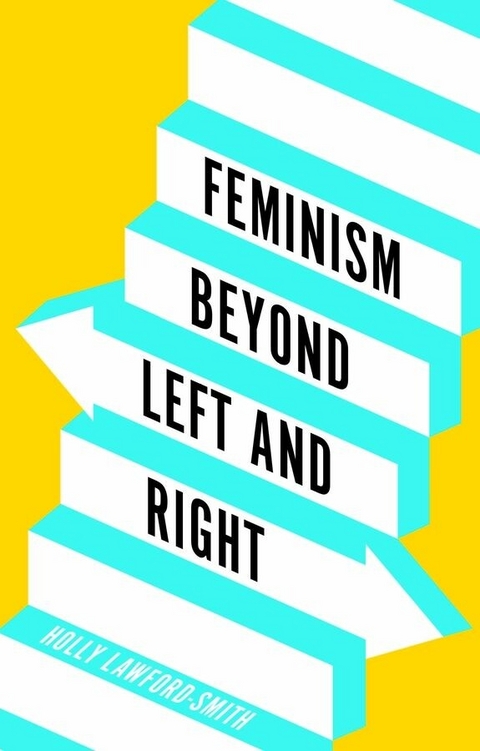
Feminism Beyond Left and Right (eBook)
177 Seiten
Polity Press (Verlag)
978-1-5095-6481-1 (ISBN)
There's nothing a philosopher loves more than an unquestioned assumption, and in this book political philosopher Holly Lawford-Smith systematically dismantles the assumption that feminism is an exclusively left-wing project. Once dismantled, the path is clear to a new set of questions. Who counts as a feminist in the first place? If women from anywhere on the political spectrum can be feminists, who is it that feminists should-or shouldn't-be working with? And what can be said, more generally, about the ethics of alliances and coalitions?
In Feminism Beyond Left and Right Lawford-Smith makes the case for non-partisan feminism, feminism outside the constraints of the left-right political spectrum, a feminism for and about all women as women.
Holly Lawford-Smith is Associate Professor in Political Philosophy at the University of Melbourne.
An unquestioned assumption of contemporary politics is that the left owns minority groups, in the sense that the left, exclusively, champions the interests of minorities and is for that reason owed the allegiance of minorities. This, in turn, gives rise to the sense of dissonance created by right-wing dissenters the black social conservative, the gay ultra-nationalist, the female libertarian, the poor pro-capitalist. This same dissonance exists for women and feminism, creating a default assumption that a feminist is a left-wing woman. We don t make a distinction between left-wing feminists and feminists; we don t need to.There s nothing a philosopher loves more than an unquestioned assumption, and in this book political philosopher Holly Lawford-Smith systematically dismantles the assumption that feminism is an exclusively left-wing project. Once dismantled, the path is clear to a new set of questions. Who counts as a feminist in the first place? If women from anywhere on the political spectrum can be feminists, who is it that feminists should or shouldn't be working with? And what can be said, more generally, about the ethics of alliances and coalitions?In Feminism Beyond Left and Right Lawford-Smith makes the case for non-partisan feminism, feminism outside the constraints of the left-right political spectrum, a feminism for and about all women as women.
Preface
This book, really, is an intervention on the frequent dust-ups inside feminism that happen whenever there is what a leftist might perceive as a ‘right-wing threat’, and to the claims routinely made in the course of those flare-ups. Let me give you a couple of examples.
In January 2019, three radical feminists and a de-transitioner (a person who previously identified as transgender) spoke on a panel titled ‘The Inequality of the Equality Act: Concerns from the Left’.1 Some British feminists flew to the United States to attend the event and support the speakers. Both the speakers and the British women were subsequently denounced for ‘allying with the right’. Why? Because the venue for the event was the conservative think tank, the Heritage Foundation. Never mind that the event was initiated by Katherine Cave, founder of the non-partisan organization the Kelsey Coalition, or that Cave had been searching for speakers and a venue for four years. As Julia Beck, one of the panellists, said in an interview with Meghan Murphy for Feminist Current:
Cave spent four years searching for anyone willing to speak publicly about how ‘gender identity’ impacts children and their parents. She asked every left-leaning think tank she could find, but they either flatly refused with accusations of ‘transphobia’, or simply did not reply. Eventually, Cave and WoLF2 worked together to plan a panel of left-leaning people to speak at the Heritage Foundation…. At the beginning of 2019, no other platform with half as much political influence as Heritage even dared to challenge the status quo, and that remains the case today.3
Beck’s description suggests that the Heritage Foundation was a last-resort venue for women desperate to start a conversation about a topic they considered politically urgent. The backlash against those women suggests it would have been better for them to not have the event at all if they could not find a left-wing venue to host it.
Here’s a more recent example — or, really, pair of examples — from my own patch of the forest. On 24 March 2024, a woman named Sabrinna Valisce declared on X (formerly Twitter) that ‘Radical feminism is anti-Nazi, anti-neo-Nazi, anti-fascist & against totalitarianism & the far right. It is left wing & pro-choice. It stands for women & girls & the protection of children. We dont [sic] work with people who want the mass murder of Jews or the eugenics of homosexuals.’4
Setting aside the ‘it is left wing and pro-choice’ part for now, why would Valisce feel the need to make such an obvious statement? Valisce is a radical feminist, a position informed by her experience as a sex trade survivor,5 and, most importantly for our purposes, an administrator for an online community of radical feminists from both Australia and New Zealand. A couple of days earlier, she had expelled the organizers of a Melbourne Women Will Speak rally from the online community, and posted to the group that:
Women’s Action Group and [Women] Will Speak sadly must be banned from Aussie and Kiwi Radfems. Racism, Homophobia, Nazism and neo-Nazi ideology is wholly incompatible with both Radical Feminism and any branch of Women’s Rights. Admin has been sent video footage and photo’s [sic] of a known neo-Nazi attending as an invited helper of the event this Saturday. We will NOT be endorsing or quietly capitulating to this tie with us. We reject these ties in their entirety and without hesitation.6
This storm in a very tiny teacup was just the latest in a string of skirmishes over who feminists should work with, centring in particular on alleged links to neo-Nazis. The year before, in the same month, the rather larger storm over the counterprotest by members of the National Socialist Network (a white supremacist group)7 to a protest by socialists and trans activists of a Let Women Speak rally led to the expulsion of Victorian MP Moira Deeming from the parliamentary party room of the Liberal Party.8 The problem, apparently, was the fact that Deeming co-hosted the rally, itself a feminist free speech event, with a British feminist accused of having associations with the far right.9 (These ‘associations’ included, for example, appearing together in a photograph.) The fallout over the event resulted in three separate defamation lawsuits by feminist women, including Deeming, against the leader of the Victorian Liberal Party, John Pesutto.10 In the 2024 iteration, the organizers of a Women Will Speak rally had been caught off guard by the size and noise of the protest against their event, and they made the decision to accept the offer of a better speaker from a man who had come to support the rally.11 In return, he had asked to open and close the rally — although he made only brief, generic comments.12 Soon after the event, he was alleged to be a neo-Nazi, and the women attending the rally and associated with its movement were, for the second year in a row, defending themselves from angry accusations of ‘working with fascists’.13
One final example. In June 2024, as I was writing this Preface, a black British woman was being dogpiled on X for sharing a photo of herself wearing a British flag and tweeting ‘you can [be] brown and still support your country’.14 She had attended a protest against two-tier policing, but because the organizer of the protests was Tommy Robinson — a controversial figure in the United Kingdom known for opposition to immigration — opponents had apparently decided that expressions of patriotism by attendees were really white nationalism. (The woman then posted about the vitriol she had received and said that she was leaving the feminist movement as a result.)15
While ‘working with’ was stretched to conceptual implausibility in meaning ‘standing in geographical proximity to’ at the 2023 Let Women Speak rally, perhaps there is an understanding of ‘working with’ as ‘sharing a platform with’ that can be invoked for the 2024 Women Will Speak event, even though that is not what is normally meant when we talk about groups working together politically. Helen Joyce mentioned this understanding in a debate with Julie Bindel in 2022, provocatively titled ‘Should TERFs Unite with the Right?’, asking whether ‘unite’ was meant to mean working together, sharing a platform or something else — and whether these things were meant to be equally objectionable.16
The general claim that tends to be made during these flareups is that feminists should not work with the right (ally with the right, get in bed with the right, etc.). That the left owns minority groups — in the sense that the left, exclusively, champions the interests of minorities and is for that reason owed the allegiance of minorities — appears to be an unquestioned assumption of our current political life. This, in turn, gives rise to the sense of dissonance created by individuals who are both members of minority groups and have right-wing views: the black social conservative; the gay ultra-nationalist; the female libertarian; the impoverished enthusiast for capitalism. This same dissonance exists for women and feminism, creating a default assumption that a feminist is a left-wing woman. We don’t make a distinction between left-wing feminists and feminists; it is assumed that we don’t need to.
Do we need to, though? The claim that feminists should not work with the right is my target in this book. In the course of assessing this apparently narrow claim, we are taken to bigger questions about what it actually means to do feminist politics and the relation of feminism to the left—right political spectrum. To assess the plausibility of the claim that feminists should not work with the right, we’ll need to talk about who feminists are, what the left and the right are, what reasons there are for why we shouldn’t work with others, what reasons women have actually given (if any) for not working with the right, and what a feminism outside of the constraints of the political spectrum might look like — and whether that feminism would be preferable to a feminism exclusive to the left.
Let’s get on with it.
Notes
- 1. https://www.heritage.org/event/the-inequality-the-equality-act-concerns-the-left and see discussion at Murphy 2019a.
- 2. WoLF is an acronym for Women’s Liberation Front, a radical feminist organization of which three of the panellists were members.
- 3. Murphy 2019a.
- 4. @SabrinnaValisce, 24 March, 11.22 pm (PDT), online at https://x.com/SabrinnaValisce/status/1772147063758659973?s=20. Similarly, Jane Clare Jones, a British feminist with more than 60,000 followers on X, tweeted sarcastically in response to a defence of one of the organizers ‘The only people who care about fascists are ideologically purist bitchy feminists who probably deserve a good kicking for caring about fascists’, @janeclarejones 24 March 2024, 3.23 pm (PT); https://x.com/janeclarejones/status/1772026437421109362?s=20. This phrase ‘ideologically purist … feminists’ was a reference back to infighting in the previous year, where Jones and some of her ideological allies...
| Erscheint lt. Verlag | 14.7.2025 |
|---|---|
| Sprache | englisch |
| Themenwelt | Sozialwissenschaften ► Soziologie ► Gender Studies |
| Schlagworte | does the Left support women • Feminism • feminist activism • feminist conflict • gender-critical • Holly Lawford-Smith new book • Judith Butler • left • left-wing misogyny • Let Women Speak • LGBTQ • liberal feminism • neglecting women • politically homeless • political objectives that benefit women • putting women first • radical feminism • right • right-wing misogyny • Second-Wave Feminism • should feminisms work with the Right • social justice movement • strategic activism • TERF • trans debates • what role do emotions play in political activism • women won’t wheesht |
| ISBN-10 | 1-5095-6481-0 / 1509564810 |
| ISBN-13 | 978-1-5095-6481-1 / 9781509564811 |
| Informationen gemäß Produktsicherheitsverordnung (GPSR) | |
| Haben Sie eine Frage zum Produkt? |
 EPUB (Adobe DRM)
Kopierschutz: Adobe-DRM
Adobe-DRM ist ein Kopierschutz, der das eBook vor Mißbrauch schützen soll. Dabei wird das eBook bereits beim Download auf Ihre persönliche Adobe-ID autorisiert. Lesen können Sie das eBook dann nur auf den Geräten, welche ebenfalls auf Ihre Adobe-ID registriert sind.
Details zum Adobe-DRM
Dateiformat: EPUB (Electronic Publication)
EPUB ist ein offener Standard für eBooks und eignet sich besonders zur Darstellung von Belletristik und Sachbüchern. Der Fließtext wird dynamisch an die Display- und Schriftgröße angepasst. Auch für mobile Lesegeräte ist EPUB daher gut geeignet.
Systemvoraussetzungen:
PC/Mac: Mit einem PC oder Mac können Sie dieses eBook lesen. Sie benötigen eine
eReader: Dieses eBook kann mit (fast) allen eBook-Readern gelesen werden. Mit dem amazon-Kindle ist es aber nicht kompatibel.
Smartphone/Tablet: Egal ob Apple oder Android, dieses eBook können Sie lesen. Sie benötigen eine
Geräteliste und zusätzliche Hinweise
Buying eBooks from abroad
For tax law reasons we can sell eBooks just within Germany and Switzerland. Regrettably we cannot fulfill eBook-orders from other countries.
aus dem Bereich