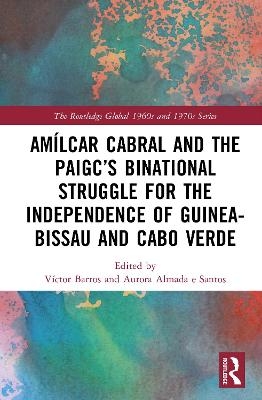
Amílcar Cabral and the PAIGC’s Binational Struggle for the Independence of Guinea-Bissau and Cabo Verde
Routledge (Verlag)
978-1-032-06981-4 (ISBN)
The struggle for independence of Guinea-Bissau and Cabo Verde was shaped by a multiplicity of interactions and connections. Because of the intimate association between the African Party for the Independence of Guinea and Cabo Verde (PAIGC – Partido Africano da Independência da Guiné e Cabo Verde) and Amílcar Cabral’s leadership, the existing scholarship has been discussing the fight led by the liberation movement and its Secretary-General’s role within a single analytical framework.
While much has been written, most studies fail to break the many historiographical silences still existing around the subject. Amílcar Cabral and the PAIGC’s Binational Struggle for the Independence of Guinea-Bissau and Cabo Verde intends to evince a multiplicity of analytical itineraries through which Cabral’s figure can contribute to understand the rise to statehood of both territories and the construction of memory of the anti-colonial struggle.
Víctor Barros is Researcher at the Institute of Contemporary History, NOVA School of Social Sciences and Humanities and the Associate Laboratory for Research and Innovation in Heritage, Arts, Sustainability and Territory (IHC – NOVA FCSH/IN2PAST). His main research interest is Portuguese colonialism, decolonsation, transnational networks of anticolonial solidarity and the construction of memory of the Portuguese empire in Africa. Aurora Almada e Santos is Researcher at the Institute of Contemporary History, NOVA School of Sciences and Humanities and the Associate Laboratory for Research and Innovation in Heritage, Arts, Sustainability and Territory (IHC – NOVA FCSH/IN2PAST). Her main research interest is Portuguese decolonisation, namely the transnational dimension of the struggle for the independence of the Portuguese African colonies.
Acknowledgements
List of Contributors
Foreward - P. Khalil Saucier
Introduction
Amílcar Cabral and the PAIGC’s Binational Struggle for the Independence of Guinea-Bissau and Cabo Verde – Víctor Barros and Aurora Almada e Santos
Anticolonial Thought
Chapter 1
Placing the West Before a Tribunal: Strategies of Critique in African Anticolonial Discourse – Branwen Gruffydd Jones
Chapter 2
Amílcar Cabral, the Just War, and the Right of Oppressed Peoples to Solidarity and Happiness – Julião Soares Sousa
Current Readings
Chapter 3
Amílcar Cabral as an Engaged and Dialectical Political Ecologist: Relating Land, Production and Circulation, 1946–1961 – Aharon deGrassi
Chapter 4
On Amílcar Cabral’s Humanism – Olúfẹ́mi Táíwò
Networks of Solidarity
Chapter 5
Non-Governmental Organisations Support for Amílcar Cabral and the PAIGC in the United States – Zachary C. Peterson
Chapter 6
Splendour and Fall of a Revolutionary: Amílcar Cabral and the Italian Reception of his Thinking in the 1960s and 1970s – Vincenzo Russo
Chapter 7
The United Nations Visiting Missions to Guinea and Cabo Verde: 1972 and 1975 – Aurora Almada e Santos
Postcolonial Memory and Legacies
Chapter 8
Amílcar Cabral: Memory and Legacy in the Language Policy of Guinea-Bissau’s Education System – Rui da Silva, Miguel Filipe Silva and Rui Jorge Semedo
Chapter 9
Amílcar Cabral: An African Leader Forged by Propaganda Films – Paulo Cunha and Catarina Laranjeiro
Chapter 10
Commemorating Amílcar Cabral as a Nation’s Founding Father and a Global Revolutionary: Binational Memory, Local Designs, Transnational Dimensions – Víctor Barros
| Erscheinungsdatum | 19.11.2025 |
|---|---|
| Reihe/Serie | The Routledge Global 1960s and 1970s Series |
| Zusatzinfo | 3 Halftones, black and white; 3 Illustrations, black and white |
| Verlagsort | London |
| Sprache | englisch |
| Maße | 156 x 234 mm |
| Gewicht | 760 g |
| Themenwelt | Geschichte ► Allgemeine Geschichte ► Zeitgeschichte |
| Geisteswissenschaften ► Geschichte ► Regional- / Ländergeschichte | |
| Geschichte ► Teilgebiete der Geschichte ► Wirtschaftsgeschichte | |
| Sozialwissenschaften ► Politik / Verwaltung | |
| ISBN-10 | 1-032-06981-3 / 1032069813 |
| ISBN-13 | 978-1-032-06981-4 / 9781032069814 |
| Zustand | Neuware |
| Informationen gemäß Produktsicherheitsverordnung (GPSR) | |
| Haben Sie eine Frage zum Produkt? |
aus dem Bereich