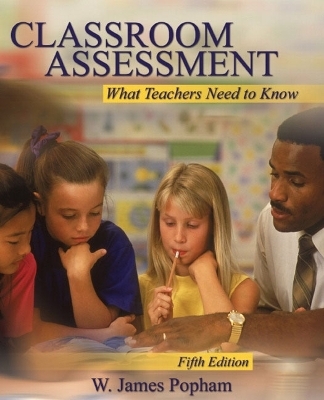
Classroom Assessment
Pearson (Verlag)
978-0-205-51075-7 (ISBN)
- Titel erscheint in neuer Auflage
- Artikel merken
Written with style and whimsey, this text focuses on what classroom teachers really need to know about assessment rather than looking at a collection of measurement esoterica. This well-written book is grounded in the reality of teaching today to show real-world teachers who want to use assessment in their classrooms the latest tools necessary to teach more effectively. The fifth edition of Classroom Assessment addresses the range of assessments that teachers are likely to use in their classrooms. With expanded coverage of problems related to measurement of special education children, a new student website with online activities, and an improved instructor’s manual, this book continues to be a cutting edge and indispensable resource not only for instructors, but also pre and in-service teachers.
W. James Popham has spent the bulk of his educational career as a teacher. His first teaching assignment, for example, was in a small eastern Oregon high school where he taught English and social studies while serving as yearbook advisor, class sponsor, and unpaid tennis coach. That recompense meshed ideally with the quality of his coaching. Most of Dr. Popham's teaching career took place at UCLA where, for nearly 30 years, he taught courses in instructional methods for prospective teachers as well as courses in evaluation and measurement for graduate students. At UCLA he won several distinguished teaching awards. In January 2000, he was recognized by UCLA Today as one of UCLA’s top 20 professors of the 20th century. (He notes that the 20th century was a full-length century, unlike the current abbreviated one.) In 1992, he took early retirement from UCLA upon learning that emeritus professors received free parking. Because at UCLA he was acutely aware of the perishability of professors who failed to publish, he spent his non-teaching hours affixing words to paper. The result: over 25 books, 200 journal articles, 50 research reports, and 175 papers presented before research societies. Although not noted in his official vita, while at UCLA he also authored 1,426 grocery lists. His most recent books are Classroom Assessment: What Teachers Need to Know, 4th Ed. (2005) and Assessment for Educational Leaders (2006), Allyn & Bacon; The Truth About Testing: An Educator’s Call to Action (2001) and Test Better, Teach Better: the Instructional Role of Assessment (2003), ASCD; America’s “Failing” Schools: How Parents and Teachers Can Cope with No Child Left Behind (2005) and Mastering Assessment: A Self-Service System for Educators (2006), RoutledgeFalmer. He encourages purchase of these books because he regards their semi-annual royalties as psychologically reassuring. In 1978, Dr. Popham was elected to the presidency of the American Educational Research Association (AERA). He was also the founding editor ofEducational Evaluation and Policy Analysis, a quarterly journal published by AERA. He has attended each year's AERA meeting since his first in 1958. He is inordinately compulsive. In 1968, Dr. Popham established IOX Assessment Associates, an R&D group that formerly created statewide student achievement tests for a dozen states. He has personally passed all of those tests, largely because of his unlimited access to the tests’ answer keys. In 2002 the National Council on Measurement in Education presented him with its Award for Career Contributions to Educational Measurement. In 2006 he was awarded a Certificate of Recognition by the National Association of Test Directors. Dr. Popham’s complete 42-page, single-spaced vita can be requested. It is really dull reading.
<>To The Reader
1 Why Do Teachers Need to Know about Assessment Federal Laws Rule
Assessment versus Testing
Why Should Teachers Know about Assessment? Yesteryear’s Answers
Why Should Teachers Know about Assessment? Today’s Answers
· Decision Time: Pressure from “Higher Ups”
What Do Classroom Teachers Really Need to Know about Assessment?
· But What Does This Have to Do with Teaching?
· Parent Talk
A Three-Chapter Preview
Chapter Summary
Self-Check
Pondertime
Self-Check Key
Additional Stuff
Nonprint Stuff
Cyber Stuff
2 Reliability of Assessment
Stability Reliability
· Decision Time: Quibbling over Quizzes
Alternate-Form Reliability
Internal Consistency Reliability
Three Coins in the Reliability Fountain
· Parent Talk
The Standard Error of Measurement
· But What Does This Have to Do with Teaching?
What Do Classroom Teachers Really Need to Know about Reliability?
Chapter Summary
Self Check
Pondertime
Self-Check Key
Endnotes
Additional Stuff
Cyber Stuff
3 Validity
A Quest for Defensible Inferences
· Decision Time: Group-Influenced Grading
Validity Evidence
Content-Related Evidence of Validity
Criterion-Related Evidence of Validity
· Parent Talk
Construct-Related Evidence of Validity
Sanctioned and Unsanctioned Forms of Validity Evidence
The Relationship between Reliability and Validity
What Do Classroom Teachers Really Need to Know about Validity?
· But What Does This Have to Do with Teaching?
Chapter Summary
Self Check
Pondertime
Self-Check Key
Additional Stuff
Nonprint Stuff
Cyber Stuff
4 Absence-of-Bias
The Nature of Assessment Bias
· Decision Time: Choose Your Language, Children!
Disparate Impact and Assessment Bias
Judgmental Approaches
Empirical Approaches
Bias Detection in the Classroom
· Parent Talk
Assessing Students with Disabilities and English Language Learners
What Do Classroom Teachers Really Need to Know about Absence-of-Bias?
· But What Does This Have to Do with Teaching?
Chapter Summary
Self-Check
Pondertime
Self-Check Key
Additional Stuff
Cyber Stuff
5 Deciding What to Assess and How to Assess It
What to Assess
· Decision Time: On Demand Assessment
How to Assess It
· Parent Talk
· But What Does This Have to Do with Teaching?
What Do Classroom Teachers Really Need to Know about What to Assess and How to Assess It?
Chapter Summary
Self-Check
Pondertime
Self-Check Key
Additional Stuff
Nonprint Stuff
Cyber Stuff
6 Selected-Response Tests
Ten (Divided by Two) Item-Writing Commandments
Binary-Choice Items
Multiple Binary-Choice Items
Multiple-Choice Items
· Decision Time: Multiple-Guess Test Items?
Matching Items
· Parent Talk
What Do Classroom Teachers Really Need to Know about Selected-Response Tests?
· But What Does This Have to Do with Teaching?
Chapter Summary
Self-Check
Pondertime
Self-Check Key
Additional Stuff
Nonprint Stuff
Cyber Stuff
7 Constructed-Response Tests
Short-Answer Items
Essay Items: Development
· Decision Time: Forests or Trees?
Essay Items: Scoring Students’ Responses
· Parent Talk
· But What Does This Have to Do with Teaching?
What Do Classroom Teachers Really Need to Know about Constructed-Response Tests?
Chapter Summary
Self-Check
Pondertime
Self-Check Key
Additional Stuff
Nonprint Stuff
Cyber Stuff
8 Performance Assessment
What Is a Performance Test?
Identifying Suitable Tasks for Performance Assessment
· Decision Time: Grow, Plants, Grow!
Identifying Scoring Criteria
An Illustrative Performance-Test Task
Rubrics: The Wretched and the Rapturous
Ratings and Observations
Sources of Error in Scoring Student Performances
· But What Does This Have to Do with Teaching?
What Do Classroom Teachers Really Need to Know about Performance Assessment?
· Parent Talk
Chapter Summary
Self-Check
Pondertime
Self-Check Key
Additional Stuff
Cyber Stuff
9 Portfolio Assessment
Classroom Portfolio Assessment versus Large-Scale Portfolio Assessment
· Decision Time: Does Self-Evaluation Equal Self-Grading?
Key Ingredients in Classroom Portfolio Assessment
The Pros and Cons of Portfolio Assessment
· But What Does This Have to Do with Teaching?
What Do Classroom Teachers Really Need to Know about Portfolio Assessment?
· Parent Talk
Chapter Summary
Self-Check
Pondertime
Self-Check Key
Additional Stuff
Nonprint Stuff
Cyber Stuff
10 Affective Assessment
Why Assess Affect?
· Decision Time: Where Went Wonder?
The Other Side of the Argument
Which Affective Variables Should Be Assessed?
How Should Affect Be Assessed in Classrooms?
Self-Report Assessment
· Parent Talk
What Kind of Inferences Are at Stake in Affective Assessment?
· But What Does This Have to Do with Teaching?
What Do Classroom Teachers Really Need to Know about Affective Assessment?
Chapter Summary
Self-Check
Pondertime
Self-Check Key
Additional Stuff
Nonprint Stuff
11 Improving Teacher-Developed Assessments
Judgmentally Based Improvement Procedures
Empirically Based Improvement Procedures
· Parent Talk
· Decision Time: To Catch a Culprit: Teacher or Test
Item Analysis for Criterion-Referenced Measurement
· But What Does This Have to Do with Teaching?
What Do Classroom Teachers Really Need to Know about Improving Their Assessments?
Chapter Summary
Self-Check
Pondertime
Self-Check Key
Additional Stuff
Nonprint Stuff
12 Instructionally Oriented Assessment
Instructional Decisions and Assessment Results
Planning Instruction to Achieve Assessment-Exemplified Curricular Aims
· Decision Time: At What Cost Score-Boosting?
· Parent Talk
What Do Classroom Teachers Really Need to Know about Instructionally Oriented Assessment?
· But What Does This Have to Do with Teaching?
Chapter Summary
Self-Check
Pondertime
Self-Check Key
Additional Stuff
Nonprint Stuff
Cyber Stuff
13 Making Sense Out of Standardized Test Scores
Standardized Tests
· Decision Time: Which Test to Believe
Group-Focused Test Interpretation
Individual Student Test Interpretation
· But What Does This Have to Do with Teaching?
· Parent Talk
The SAT and ACT: Three-Letter, High-Import Exams
What Do Classroom Teachers Really Need to Know about Interpreting Standardized Test Scores?
Chapter Summary
Self-Check
Pondertime
Self-Check Key
Additional Stuff
Nonprint Stuff
Cyber Stuff
14 Appropriate and Inappropriate Test-Preparation Practices
High-Stakes Assessment Arrives
Assessment Results as Inference Illuminators
· Decision Time: Was It Really Wrong?
Two Evaluative Guidelines
Five Test-Preparation Practices
Applying the Two Guidelines
· Parent Talk
What about “Teaching to the Test”?
· But What Does This Have to Do with Teaching?
What Do Classroom Teachers Really Need to Know about Test-Preparation Practices?
Chapter Summary
Self-Check
Pondertime
Self-Check Key
Additional Stuff
Nonprint Stuff
Cyber Stuff
15 Evaluating Teaching and Grading Students
Distinction Drawing
Evaluation of Teaching and the Use of Assessment Data
An Alternative Data-Gathering Design
What’s In a Name?
What’s a Teacher to Do?
Assessment-Based Grading
· Decision Time: Should Level-of-Effort Be Rewarded?
· Parent Talk
· But What Does This Have to Do with Teaching?
What Do Classroom Teachers Really Need to Know about Assessment-Based Evaluation of Teaching and Grading of Students?
Chapter Summary
Self-Check
Pondertime
Self-Check Key
Additional Stuff
Nonprint Stuff
Cyber Stuff
Glossary
Index
| Erscheint lt. Verlag | 17.5.2007 |
|---|---|
| Sprache | englisch |
| Gewicht | 590 g |
| Themenwelt | Sozialwissenschaften ► Pädagogik ► Berufspädagogik |
| ISBN-10 | 0-205-51075-2 / 0205510752 |
| ISBN-13 | 978-0-205-51075-7 / 9780205510757 |
| Zustand | Neuware |
| Informationen gemäß Produktsicherheitsverordnung (GPSR) | |
| Haben Sie eine Frage zum Produkt? |
aus dem Bereich