


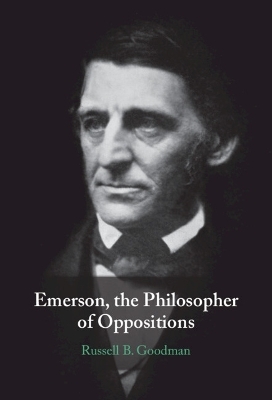
Emerson, the Philosopher of Oppositions
Seiten
2026
Cambridge University Press (Verlag)
978-1-009-60455-0 (ISBN)
Cambridge University Press (Verlag)
978-1-009-60455-0 (ISBN)
- Noch nicht erschienen (ca. Januar 2026)
- Versandkostenfrei
- Auch auf Rechnung
- Artikel merken
Goodman shows how Emerson's essays embody sets of oppositions or 'contrary tendencies,' and argues that we miss the living nature of Emerson's philosophy if we fail to register the motions within his essays and the ways in which he dramatizes instability, spontaneity, and inconsistency within them.
Ralph Waldo Emerson developed a metaphysics of process, an epistemology of moods, and an 'existentialist' ethics of self-improvement, drawing on sources including Neoplatonism, Kantianism, Hinduism, and the skepticism of Montaigne. In this book, Russell B. Goodman demonstrates how Emerson's essays embody oppositions – one and many, fixed and flowing, nominalism and realism – and argues, in tracing Emerson's main positions, that we miss the living nature of his philosophy unless we take account of the motions and patterns of his essays and the ways in which instability, spontaneity, and inconsistency are dramatized within them. Goodman presents Emerson as a philosopher in conversation with Plato, Kant, Nietzsche, William James, Wittgenstein, and Cavell. He finds a variety of skepticisms in Emerson's work – about friendship, language, freedom, and the world's existence – but also an acknowledgement of skepticism as a 'wise' form of life.
Ralph Waldo Emerson developed a metaphysics of process, an epistemology of moods, and an 'existentialist' ethics of self-improvement, drawing on sources including Neoplatonism, Kantianism, Hinduism, and the skepticism of Montaigne. In this book, Russell B. Goodman demonstrates how Emerson's essays embody oppositions – one and many, fixed and flowing, nominalism and realism – and argues, in tracing Emerson's main positions, that we miss the living nature of his philosophy unless we take account of the motions and patterns of his essays and the ways in which instability, spontaneity, and inconsistency are dramatized within them. Goodman presents Emerson as a philosopher in conversation with Plato, Kant, Nietzsche, William James, Wittgenstein, and Cavell. He finds a variety of skepticisms in Emerson's work – about friendship, language, freedom, and the world's existence – but also an acknowledgement of skepticism as a 'wise' form of life.
Russell B. Goodman is Regents Professor of Philosophy Emeritus at the University of New Mexico, Albuquerque. He is the author of American Philosophy and the Romantic Tradition (Cambridge, 1990); Wittgenstein and William James (Cambridge, 2002); and American Philosophy before Pragmatism (Oxford, 2015).
Introduction; 1. Emerson's philosophical style; 2. Varieties of skepticism in Emerson's thought; 3. Emerson and skepticism: a reading of 'Friendship'; 4. Paths of coherence through Emerson's philosophy: the case of 'nominalist and realist'; 5. Emerson, Montaigne, skepticism; 6. Reading 'Manners'; 7. Emerson's 'experience' and Plato's republic; 8. On 'The Poet'; 9. Emerson's natures; 10. Emerson and Hinduism; Afterword; Bibliography.
| Erscheint lt. Verlag | 31.1.2026 |
|---|---|
| Zusatzinfo | Worked examples or Exercises |
| Verlagsort | Cambridge |
| Sprache | englisch |
| Themenwelt | Literatur ► Essays / Feuilleton |
| Geisteswissenschaften ► Philosophie ► Metaphysik / Ontologie | |
| Sozialwissenschaften | |
| ISBN-10 | 1-009-60455-4 / 1009604554 |
| ISBN-13 | 978-1-009-60455-0 / 9781009604550 |
| Zustand | Neuware |
| Informationen gemäß Produktsicherheitsverordnung (GPSR) | |
| Haben Sie eine Frage zum Produkt? |
Mehr entdecken
aus dem Bereich



aus dem Bereich
eine philosophische Reise
Buch | Softcover (2024)
Goldmann (Verlag)
CHF 21,90


