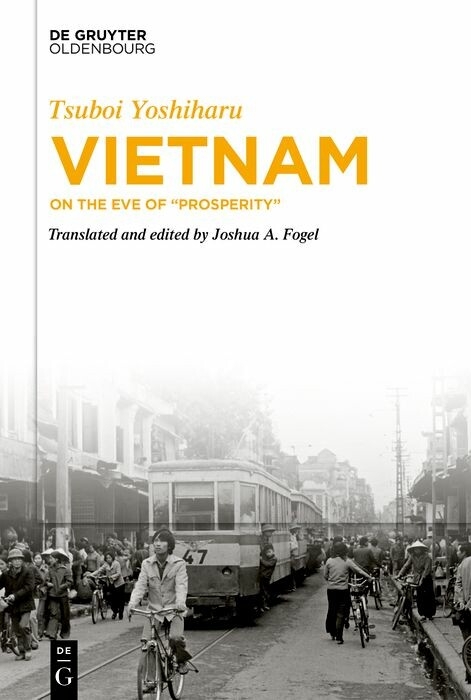
Vietnam (eBook)
193 Seiten
De Gruyter (Verlag)
978-3-11-221264-6 (ISBN)
Despite its difficult history in the wake of wars with the United States and China, Vietnam has not only survived, but it is developing well. The relationship between the Communist Party and civil society remains to be ironed out smoothly, but the d?i m?i policy of reforms made important strides in this realm.
This book surveys the entire history of Vietnam with a focus on its relationship with China to the North. It not only looks at the many border conflicts but also at ongoing trade between the two lands. While it does note social and cultural influences from China, it does not see Vietnam as a lesser cousin of sorts. It assesses just what makes Vietnam distinctive past and present. It stresses as well that Vietnam is a multi-ethnic society with numerous peoples, customs, and languages.
Tsuboi takes pains to examine how Vietnam is dealing with the extraordinary scars of war to which it has been victim, but it goes beyond victimization to emphasize its present economic development (stresses and strains).
Most characteristic of this book for a Western audience is its discussion and assessment of Japan's role in contemporary Vietnam and Japanese-Vietnamese relations. It is written in a style accessible to all audiences.
Chapter 2 Neighbors to the South and West: Champa, Cambodia, Laos
Numerous Ethnic Groups
It is by no means the case that Vietnam forged its own distinctive ethnic character through interactions solely with China. In fact, Vietnam itself is a multi-ethnic country within which some fifty-four nationalities co-exist. Among them, the overwhelming majority is occupied by the Kinh people (represented in Chinese by the graph 京 meaning ‘capital’; they fashion themselves ‘residents of the capital’ and take a superior view of themselves vis-à-vis other peoples), reaching as much as 90% of the population; in a narrow sense, they stand in for the entire Vietnamese people.
Fifty-three other ethnicities occupy the remaining 10%. For a detailed look at the representative ethnicities, by language groupings, see Chart 1.
Chart 1:Language Groups in Vietnam (population figures, 1984).
| I. | Austroasiatic language family |
| 1. Việt–Mường languages: Kinh 54,800,000; Mường 700,000; Thổ 24,000; Chứt 3,000 |
| 2. Mon-Khmer languages: Khmer 720,000; Bahnar 100,000; Sedang (Xê Đăng or Xơ Đăng) 73,000; Kohor 70,000; H’re 67,000; Mnong (Mơ-nông) 46,000; Stieng (Xtiêng) 40,000; Bru-Vân Kieu 33,000; Cơ Tu (Katu) 27,000; Giẻ Triêng 16,000; Mạ 20,000; Khơ Mú 23,ooo; Chor 17,000; Tà Ôi 20,000; Chơ Ro 7,000; Xinh Mun 9,000; Mảng 2,400; Brâu 300; Ơ Đu 100; Rơ Măm (Rmam) 150; Kháng 2,000 |
| 3. Tài languages: Tày 900,000; Thái 770,000; Nùng 560,000; Sán Chay 77,000; Giáy 28,000; Lao 7,000; Lự 3,000; Bộ Y 1,300 |
| 4. Hmong-Dao languages: Hmong 410,000; Dao 340,000; Pathen 2,000 |
| 5. Mixed languages: La Chí 6,000; La Ha 2,000; Cờ Lao 1,200; Pu Péo 250 |
| II. | Austronesian language family |
| 1. Malayo-Polynesian languages: Gia Rai 184,000; Êđê (Edeh) 140,000; Chăm 75,000; Raglai 58,000; Chu Ru (Churu, Chru) 8,000 |
| III. | Sino-Tibetan languages |
| 1. Sinic languages: Hoa 930,000; Ngái 1,500; Sán Dìu 66,000 |
| 2. Tibeto-Burman languages: Hà Nhì 9,000; La Hủ 4,000; Phù Lá 5,000; Lô Lô (Lolo) 2,000; Coóng 800; Sila 400 |
(Source: Furuta Motoo 古田元夫, Betonamujin kyōsanshugisha no minzoku seisaku shi, kakumei no naka no esunishiti ベトナム人共産主義者の民族政策史: 革命の中のエスニシティ (History of the Vietnamese Communists’ ethnicity policy, ethnicity in revolution) (Tokyo: Ōtsuki shoten, 1991), pp. 34–35.)
In past studies, when speaking about the Vietnamese ethnic group, scholars were referring to “Vietnamese” in a narrow sense, meaning the Kinh. The other ethnic minority peoples were outside the field of vision. In other words, an equality was established among the Kinh ethnicity, the Vietnamese people, and the country of Vietnam.
There were historical reasons for this—namely, in the long history of resistance against China, to establish their own identity they first had to create the myth that the Kinh equaled the Vietnamese people. As rulers, as we saw in Chapter 1, the Kinh called themselves the “Southern Sinic Empire” and looked down on both the domestic ethnic minorities and neighboring peoples as barbarians.
After beconing a socialist state, during the harsh fighting of the Vietnam War, in fact the other ethnic groups, centered around the Kinh who constituted the overwhelming majority among all ethnic groups, came together to fight for “national independence,” but to boost the sense of identity of an “ethnicity” and enhance patriotic passions, they deliberately avoided exposing internal differences, and there was no need to do so at the time.
As soon as the war was over, though, the issue of ethnic Chinese residents was revealed in the form of the boat people, and after that the war with neighboring Cambodia erupted. And, the problem of the “many ethnic groups” both neighboring and domestic (out of sight and out of mind until then) burst out into the open in one fell swoop.
In recent research addressing this situation, there has been a strong trend to try to deal with the people of Vietnam as “all of the peoples residing within the nation of Vietnam” in this wider framework, and thus the history of the Vietnamese people as “the history of the interactions among the fellow peoples who dwell not only within the nation of Vietnam but within the vicinity.”
In this chapter, while making maximal use of the results of recent research, I will be looking at the Chăm, the Khmer (Cambodian), and the Lao (Laotian) peoples who have had an immense impact on the formation of the “history of the Vietnamese people” in a broad sense. As can be seen in Chart 1, these three peoples even today reside as minority nationalities within the country of Vietnam. From the second to the fifteenth centuries, however, the Chăm people had established their own “kingdom of Champa” centered on the region of Đà Nẵng in the central region of contemporary Vietnam. At its height it overwhelmed the Vietnamese people in a narrow sense. From the fifteenth century, it went into decline, though even today in the central and southern parts of the country, it has left a significant mark, particularly in the cultural realm.
From the ninth to the thirteenth century, the Khmer people established the Angkor dynasty covering vast territory straddling contemporary southern Vietnam, Cambodia, northeastern Thailand, and Laos. The immensity of the power and prestige of the Angkor dynasty in its day is symbolized not only by the ancient capitals represented by Angkor Wat and Angkor Thom, but also by the majestic appearance of the Khmer remains at Vat Phou in Laos and Muong Thanh in northeastern Thailand. The Khmer people are the main ethnic group in the present state of Cambodia.
In the fourteenth century, the Lao people established the Lan Xang (Lancang) dynasty covering extensive territory, and they remain today the main ethnic group in the makeup of the People’s Republic of Laos.
Thus, there coexists on the Indochinese Peninsula including Vietnam numerous and varied ethnic groups dubbed “the treasure house of peoples.” As a region for research topics in the fields of ethnology and anthropology, it is an object of keen desire, and research concerning many different ethnicities have been published. Due to constraints of space, I cannot discuss these ethnic minorities here, but let me just add two points.
First, the great majority of minority ethnicities are known as “mountain peoples” because they reside in mountainous terrain. The Kinh, standing for the “Vietnamese” in a narrow sense, are flatland people who reside in the lowlands; they have established a kind of “compartmentalized” relationship with the mountain peoples. As long as they suffer no natural disasters like famines or floods, the mountain folk do not descend into the flatlands. And, by the same token, the lowland people do not go into the jungles where numerous endemic tropical diseases, like malaria, run rampant.
Lowland merchants would periodically bring large earthenware pots filled with salt and rainwater which mountain people much needed. And, aromatic wood such as aloes and aloeswood, timber such as Indian sandalwood, ivory, and rhinoceros horns (nowadays, the Asian rhinoceros has become extinct in Vietnam, although they did exist through the nineteenth century) were gathered by mountain people and traded for precious items with the people in the flatlands. By the same token, when mountain peoples needed daily necessities, such as clothing and medicines, they brought to market rattan-made items such as chairs, textiles, honey, and opium to sell. In this way, there were interactions between mountain and lowland peoples via trade in the past. Nowadays, the various kinds of commercial products and harvested items have changed, and there are numerous sites where trade in kind has changed to business transactions using currency as an intermediary. Despite this, peaceful interactions have basically continued.
Second is the issue of the border. On the Indochinese peninsula, consciousness of national borders as a line dividing national sovereignties only came about from the middle years of the nineteenth century when the Western powers invaded the region and established colonial rule there. Prior to that,...
| Erscheint lt. Verlag | 15.8.2025 |
|---|---|
| Zusatzinfo | 1 b/w ill., 4 b/w tbl. |
| Sprache | englisch |
| Themenwelt | Geisteswissenschaften ► Geschichte ► Regional- / Ländergeschichte |
| Sozialwissenschaften ► Politik / Verwaltung | |
| Schlagworte | đổi mới • Southeast Asia • Südostasien • Vietnam |
| ISBN-10 | 3-11-221264-9 / 3112212649 |
| ISBN-13 | 978-3-11-221264-6 / 9783112212646 |
| Informationen gemäß Produktsicherheitsverordnung (GPSR) | |
| Haben Sie eine Frage zum Produkt? |
 EPUB (Wasserzeichen)
Größe: 1,4 MB
DRM: Digitales Wasserzeichen
Dieses eBook enthält ein digitales Wasserzeichen und ist damit für Sie personalisiert. Bei einer missbräuchlichen Weitergabe des eBooks an Dritte ist eine Rückverfolgung an die Quelle möglich.
Dateiformat: EPUB (Electronic Publication)
EPUB ist ein offener Standard für eBooks und eignet sich besonders zur Darstellung von Belletristik und Sachbüchern. Der Fließtext wird dynamisch an die Display- und Schriftgröße angepasst. Auch für mobile Lesegeräte ist EPUB daher gut geeignet.
Systemvoraussetzungen:
PC/Mac: Mit einem PC oder Mac können Sie dieses eBook lesen. Sie benötigen dafür die kostenlose Software Adobe Digital Editions.
eReader: Dieses eBook kann mit (fast) allen eBook-Readern gelesen werden. Mit dem amazon-Kindle ist es aber nicht kompatibel.
Smartphone/Tablet: Egal ob Apple oder Android, dieses eBook können Sie lesen. Sie benötigen dafür eine kostenlose App.
Geräteliste und zusätzliche Hinweise
Buying eBooks from abroad
For tax law reasons we can sell eBooks just within Germany and Switzerland. Regrettably we cannot fulfill eBook-orders from other countries.
aus dem Bereich