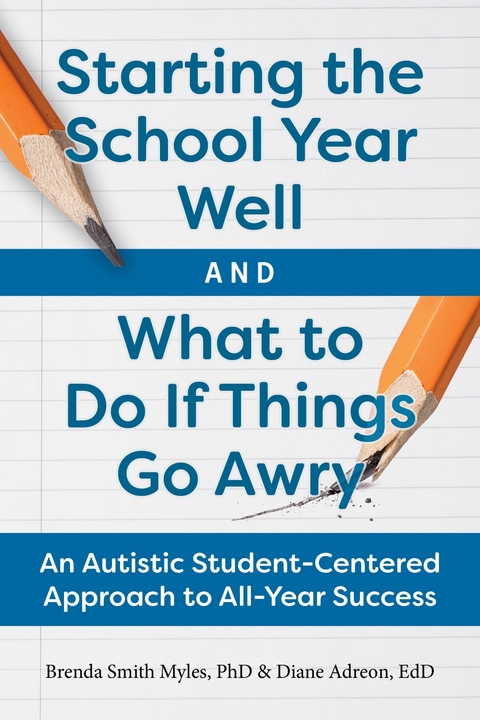
Starting the School Year Well And What To Do If Things Go Awry (eBook)
170 Seiten
Future Horizons (Verlag)
978-1-963367-26-3 (ISBN)

Most students thrive on consistency and it's especially important for autistic students. Without it, teachers can expect them to experience higher levels of anxiety and more meltdowns. Because of their neurology, autistic students learn best when they know exactly what they are going to do, when they are going to do it, and with whom they will do it.
Despite knowledge and well-intended efforts, educational systems often create a lack of predictability for students when they transition from year to year. Teachers certainly try. They've read last year's IEP, took part in creating a new one, and have read all the information in the student's file. But they still don't know
details, such as what the student's mini schedule looks like and what prompts are needed to support social interaction. Until now.
Starting the School Year Well provides a simple way for teachers to learn from past educators through the completion of three simple-to-use instruments:
• Transition Checklist
• Comprehensive Autism Planning System
• Learner Snapshot
These tools allow educators to immediately implement effective strategies instead of spending time engaged in trial-and-error instruction. These instruments create a smoother transition that enhances learning. Also included is an extensive approach to behavior challenges that results in real change! If behavior challenges occur, use this student-and-teacher-friendly approach to teach new behaviors and
provide support.
By eliminating guesswork as you get to know a student at the beginning of the year, you can get right to work teaching them new skills that match how they learn.
Chapter 2
Comprehensive Autism
Planning System
The Comprehensive Autism Planning System (CAPS) provides an overview of a student’s daily schedule by time and activity as well as the supports the student needs during each period. CAPS is often referred to as the “practical” IEP—it simply details what supports the student needs, when they are needed, and what they look like. For example, the CAPS allows the math teacher, at a glance, to identify how to create a successful learning environment for the autistic student.
Description
The CAPS is designed so that the supports and interventions can be easily implemented across each environment. Thus, the CAPS allows professionals and parents to answer the all-important question for autistic students: What supports does the student need for each activity?
Following the development of the student’s IEP, all educational professionals who work with the student create the CAPS. Each teacher then keeps the student’s CAPS at ready access—on their electronic device (e.g., computer), on their desk, or in a notebook.
The CAPS consists of a list of a student’s daily tasks and activities, the times they occur, and a thorough delineation of the supports needed to support success. In addition, it includes space for making notations about data collection and how skills are to be generalized to other settings.
Time
This section indicates the clock time when each activity that the student engages in throughout the day takes place.
Activity
This includes activities throughout the day in which the student requires support. Academic periods (e.g., reading, math), nonacademic times (e.g., recess, lunch), and transitions between classes are all considered activities.
Skills to Teach
This area may include IEP goals, the Common Core, and/or general skills that lead to school success. Skills may also be identified by parents or the student. These skills can serve as the basis for measuring response to intervention (RTI) or annual yearly progress (AYP).
Structure/Modifications
Structure/modifications encompass a wide variety of supports that may include restructuring the environment, changing academic requirements, and teaching new skills.
Reinforcement
Student access to specific types of reinforcement as well as reinforcement schedules is listed under this section. While other sections of the CAPS may be left blank because the student does not need additional support, the reinforcement section should never be left blank. All students need reinforcement. Reinforcement helps ensure that the skill demonstrated by the student occurs again.
Sensory/Regulation
Supports that help the student remain focused, calm, and comfortable in their environment are placed on the CAPS under the Sensory/Regulation category. They are often identified by an occupational therapist, special educator, Board Certified Behavior Analyst (BCBA), and others who understand the sensory systems and the many facets of regulation.
Communication/Social Skills
Specific communication goals or activities as well as corresponding supports are delineated here. Goals or activities may include (a) requesting help, (b) taking turns in conversation, or (c) protesting appropriately. Social goals may include learning to share space, share focus, and share enjoyment (Taylor et al. 2024).
Data Collection
This includes gathering information on behavior(s) to be documented during a specific activity. Typically, this section relates directly to the student’s IEP goals and objectives, behavioral issues, and state standards. The more specific the data collection, the more likely data are to be collected and be useful to track student progress.
Generalization to Community
Because autistic individuals tend to narrowly apply information they have learned, emphasis must be placed on helping them generalize. This section of the CAPS was developed to ensure that generalization of skills and supports is built into the student’s program. Examples are detailed in the following (LaCava 2024).
A copy of the CAPS appears at the end of this chapter.
The Modified Comprehensive Autism Planning System (M-CAPS)
The CAPS can also be used in middle and high school with some modifications due to structural differences across the school years. While elementary-age students often remain in the same setting all day or infrequently move from class to class except for some specials, for example, most secondary students change rooms and teachers for each class. They may have as many as nine teachers in nine different classrooms during a typical school day. Despite their movement from classroom to classroom, the activities in which students participate in each academic class are similar.
In each class, secondary students are likely to be required to participate in a mixture of independent work, group work, tests, lectures, and homework. So instead of listing each academic and nonacademic task under the Activity section as is done on the CAPS, the Modified-Comprehensive Autism Planning System (M-CAPS) lists the following:
- Independent Work
- Group Work
- Tests
- Lectures
- Homework
- Transitions, if supports and instruction are needed (This instrument appears at the end of the chapter.)
From this standpoint, the activities in English class and geometry are typically the same. But on occasion, there may be minor differences in needed supports. For example, a student may need a calculator for all mathematics-related classes but not for those that are primarily reading based. All other supports are most likely identical across classes. This has many benefits:
- The supports can be made en masse by a paraprofessional under the direction of a special educator. All educators can be supplied with one or more than one copy (in case of loss or wear) of each support.
- All educators can learn about the supports and practice using them in a professional development session.
- Because they share identical supports, academic teachers are more likely to collaborate about their shared student(s) and the impact of the supports.
But despite the above differences, some classes in middle and high school mirror in structure those that are taught in elementary school. For these classes, the traditional CAPS may be used.
Physical education, lunch, and bus are examples of classes for which the traditional CAPS by time and activity would be most appropriate. Students who have work experiences, community-based opportunities, and extracurricular activities would also have a traditional CAPS completed for these classes.
Thus, some secondary students may have an M-CAPS for their academic classes and a CAPS for nonacademic activities.
Benefits of CAPS and M-CAPS
CAPS and M-CAPS have many benefits:
- These clearly developed plans with pictures of supports can help the receiving team develop a plan for the upcoming year.
- They help ensure that students’ needs are met across the school day.
- They were founded on the recognition that autistic students have complex strengths and needs in multiple areas, including structure/modifications, reinforcement, sensory/regulation, and communication/social skills. All must be addressed in order for the student to reach their limitless potential
- They are built on a collaborative model. Collaboration ensures that all adults understand the student and know how to best support their learning. Collaboration also reduces redundancy. This is important because it seems that there are never enough resources—and likely never will be.
- They include assessments designed to increase student achievement. That is, a data collection component accompanies each skill that the student is taught. Such skills may include IEP goals as well as the state standards. As a result, data are collected throughout the student’s day across all settings.
- They recognize that social/emotional/behavioral issues impact every aspect of the student’s day. In fact, the CAPS and M-CAPS require that the IEP team, including parents, identify social/emotional/behavioral and communication supports for each class, each transition between classes, and before and after school.
- They support meaningful instruction and generalization by identifying the goals and supports the student needs for each activity.
- They embed evidence-based instructional strategies within the student’s daily schedule to ensure progress throughout the day.
- They can support autistics throughout life. That is, while CAPS and the M-CAPS can be used at the elementary and secondary levels, respectively, they can...
| Erscheint lt. Verlag | 15.7.2025 |
|---|---|
| Sprache | englisch |
| Themenwelt | Sachbuch/Ratgeber ► Freizeit / Hobby ► Sammeln / Sammlerkataloge |
| Sozialwissenschaften ► Pädagogik | |
| Schlagworte | ASD Education • Autism • education autism • Inclusive Education • neurodiversity • sensory support • teaching autistic students |
| ISBN-10 | 1-963367-26-X / 196336726X |
| ISBN-13 | 978-1-963367-26-3 / 9781963367263 |
| Informationen gemäß Produktsicherheitsverordnung (GPSR) | |
| Haben Sie eine Frage zum Produkt? |
 EPUB (Adobe DRM)
Größe: 5,6 MB
Kopierschutz: Adobe-DRM
Adobe-DRM ist ein Kopierschutz, der das eBook vor Mißbrauch schützen soll. Dabei wird das eBook bereits beim Download auf Ihre persönliche Adobe-ID autorisiert. Lesen können Sie das eBook dann nur auf den Geräten, welche ebenfalls auf Ihre Adobe-ID registriert sind.
Details zum Adobe-DRM
Dateiformat: EPUB (Electronic Publication)
EPUB ist ein offener Standard für eBooks und eignet sich besonders zur Darstellung von Belletristik und Sachbüchern. Der Fließtext wird dynamisch an die Display- und Schriftgröße angepasst. Auch für mobile Lesegeräte ist EPUB daher gut geeignet.
Systemvoraussetzungen:
PC/Mac: Mit einem PC oder Mac können Sie dieses eBook lesen. Sie benötigen eine
eReader: Dieses eBook kann mit (fast) allen eBook-Readern gelesen werden. Mit dem amazon-Kindle ist es aber nicht kompatibel.
Smartphone/Tablet: Egal ob Apple oder Android, dieses eBook können Sie lesen. Sie benötigen eine
Geräteliste und zusätzliche Hinweise
Buying eBooks from abroad
For tax law reasons we can sell eBooks just within Germany and Switzerland. Regrettably we cannot fulfill eBook-orders from other countries.
EPUB (Ohne DRM)Digital Rights Management: ohne DRM
Dieses eBook enthält kein DRM oder Kopierschutz. Eine Weitergabe an Dritte ist jedoch rechtlich nicht zulässig, weil Sie beim Kauf nur die Rechte an der persönlichen Nutzung erwerben.
Dateiformat: EPUB (Electronic Publication)
EPUB ist ein offener Standard für eBooks und eignet sich besonders zur Darstellung von Belletristik und Sachbüchern. Der Fließtext wird dynamisch an die Display- und Schriftgröße angepasst. Auch für mobile Lesegeräte ist EPUB daher gut geeignet.
Systemvoraussetzungen:
PC/Mac: Mit einem PC oder Mac können Sie dieses eBook lesen. Sie benötigen dafür die kostenlose Software Adobe Digital Editions.
eReader: Dieses eBook kann mit (fast) allen eBook-Readern gelesen werden. Mit dem amazon-Kindle ist es aber nicht kompatibel.
Smartphone/Tablet: Egal ob Apple oder Android, dieses eBook können Sie lesen. Sie benötigen dafür eine kostenlose App.
Geräteliste und zusätzliche Hinweise
Buying eBooks from abroad
For tax law reasons we can sell eBooks just within Germany and Switzerland. Regrettably we cannot fulfill eBook-orders from other countries.
aus dem Bereich