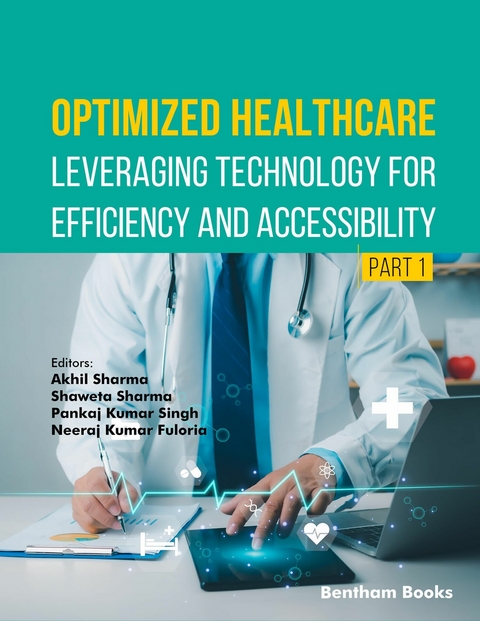
Optimized Healthcare: Leveraging Technology for Efficiency and Accessibility (Part 1) (eBook)
260 Seiten
Bentham Science Publishers (Verlag)
979-8-89881-156-3 (ISBN)
Explore the transformative impact of cutting-edge technologies on modern healthcare systems with Optimized Healthcare: Leveraging Technology for Efficiency and Accessibility (Part 1). With healthcare organizations worldwide facing mounting pressures to improve efficiency, accessibility, and patient outcomes, this book highlights how innovations such as Artificial Intelligence (AI), the Internet of Things (IoT), robotics, blockchain, and digital therapeutics are reshaping clinical care, health management, and patient engagement. Covering topics from electronic health records, telemedicine, and IoT-enabled monitoring to blockchain in health data management, AI-driven diagnostics, and sustainability in healthcare, the book bridges theory with real-world application. Readers gain an in-depth view of how emerging technologies are modernizing patient care, revolutionizing hospital operations, and driving equitable access to health services. Key Features: Comprehensive coverage of emerging technologies transforming healthcare delivery. Insights into AI, IoT, blockchain, and robotics applications in patient care and health management. Focus on sustainability, data analytics, and human-centered design in digital health innovation. Practical guidance on challenges, implementation, and future trends. Multidisciplinary perspectives combining medicine, engineering, policy, and data science.
Evolution of Technology in Healthcare
Sumita Singh1, Ashish Verma2, Akhil Sharma3, Shaweta Sharma4, Swasti Arora1, *
Abstract
The technology in healthcare has improved to a level where the healthcare systems can work more efficiently than they could in earlier times, and it has had a direct impact on patient care, accessibility, and efficiency. In this chapter, we will look into the major technological inventions that have transformed the contemporary healthcare scene, such as Electronic Health Records (EHR), Artificial Intelligence (AI), telemedicine, wearables, and robotics. These innovations have made it easier to manage patients, allowed better result deliverance from diagnoses, and made healthcare seamlessly accessible. The proliferation of AI, IoT, and automation is enabling personalised medicine and operational efficiency, as well as the optimisation of hospital management systems. Within health insurance, technology has influenced the claiming process, fraud detection, and the design of personalised health plans, incorporating data within real-time data from wearables and telemedicine. This is where Blockchain comes to the forefront, facilitating secure and transparent transactions. Additionally, technology has elevated healthcare quality standards through data-driven decision-making and continuous improvement frameworks. Despite these advancements, challenges such as data security, implementation barriers, and regulatory hurdles remain. This chapter highlights the ongoing role of technology in advancing healthcare, improving patient outcomes, and shaping the future of the industry.
* Corresponding author Swasti Arora: Faculty of Pharmacy, Swami Vivekanand Subharti University, Meerut, U.P, India; E-mail: aroraswasti@gmail.com
INTRODUCTION
Technology has revolutionised the healthcare industry, making a broad impact on patient accessibility, care, and management. Originating from primitive tools, modern technology has changed the game for medicine and healthcare. From EHRs (Electronic Health Records) to telemedicine and even Artificial Intelligence (AI), innovations are improving diagnostic and treatment accuracy while simplifying administrative work and reducing errors to increase access to healthcare services for varied populations. This rapid advancement of healthcare technology continues to influence the way healthcare is delivered, ensuring that patients receive more personalised, efficient, and timely care [1].
The evolution of technology in healthcare has progressed from traditional herbal medicine and surgical tools to advanced digital health, AI-driven diagnostics, and precision medicine. Innovations like X-rays, antibiotics, robotic surgery, telemedicine, and mRNA vaccines have revolutionised patient care, improving diagnosis, treatment, and overall healthcare efficiency [2], are more elaborated in the form of the flow chart given in Fig. (1).
Overview of Technological Advancements in Healthcare
The technological evolution of the healthcare sector has been profound, affecting nearly every area of the system. Significant milestones, such as the introduction of the Electronic Health Record (EHR) that replaced the traditional paper-based system, facilitated greater efficiency in patient information management and reduced errors. Furthermore, telemedicine has broadened the availability of health care, enabling patients to receive remote consultations, overcoming geographical barriers, and enhancing accessibility for marginalised groups. Underpinning these trends has been the rise of Artificial Intelligence (AI) in diagnostics, treatment planning and allowing healthcare providers rapid access to accurate decision-making advice. Robotics in surgery has increased precision and minimised recovery times for patients. Wearable devices and health-monitoring apps enable individuals to take command of their health, giving them ongoing input for a more proactive approach. In addition, patient data security and transparency in healthcare systems have been opened up with Blockchain technology. Together, these technologies synergistically help to solve complex healthcare problems, leading to better efficiencies, improved patient outcomes, and cost-effective solutions [3, 4].
Fig. (1))Evolution of technology in healthcare.
The Role of Technology in Modernizing Healthcare Infrastructure
The modernization of healthcare infrastructure focuses on the enhancement of physical and digital platforms to improve healthcare delivery using technology. Integrated digital platforms, including Electronic Health Records (EHRs) and Health Information Exchanges (HIEs), are a critical part of modernisation, allowing patient data to move across providers, making for better coordination of care. The use of advanced data analytics and AI is helping to optimise hospital operations, predict patient volumes, manage resources more efficiently, and improve the operational efficiency of healthcare facilities. Secondly, using innovative technologies in hospitals, such as automated medication dispensing systems, robotic surgery, AI-assisted diagnostics, etc., enhances patient outcomes and operational efficiency [5].
Cloud computing in healthcare provides real-time accessibility, storage, and sharing of medical data, thereby ensuring faster access to information while making it more secure. Digital infrastructure is also designed to facilitate research and innovation, such as enabling platforms for clinical trials, joint studies, and health data analytics. Together, these technological advances allow for a more dynamic and responsive healthcare infrastructure that can meet both the ongoing challenges and the demands of future healthcare [6].
TECHNOLOGICAL ADVANCEMENTS IN HEALTHCARE
The role of technology in transforming the healthcare sector by improving efficiency, accessibility, and outcomes is depicted in Fig. (2). Healthcare technology works together to create a more efficient and patient-focused healthcare ecosystem where providers and patients can have data-focused reach to more accessible, high-quality care [7].
Electronic Health Records (EHRs)
EHR reshaped the Healthcare segment and helped bring patient information in a digitized format to bring more power to managing data. Such systems can integrate medical histories, test results, and treatment plans to give healthcare providers streamlined access to patient data. They help reduce mistakes which could occur as a result of unreadable handwriting or missing records, thus contributing to better patient care. Besides, they facilitate the exchange of information among providers, specialists, and patients, implementing an all-inclusive model of healthcare delivery. In addition, they allow integration with other technologies, including telehealth and wearable devices that facilitate real-time decision-making and interoperability [8].
Fig. (2))Technological advancements in healthcare system.
Streamlining Patient Information Management
EHRs also help make patient information more manageable, as they combine all the data into a single, fully integrated digital system. This streamlines paper records and minimizes redundancy in diagnostic tests. Providers retrieve patient data within minutes, even at different facilities, helping to ensure continuity of care. Clinicians can follow progress, results, and medication changes in real-time as they are updated in records. This is particularly necessary during emergencies when a doctor needs to have immediate access to a patient record, which requires saving lives. They allow integration with clinical decision-support tools, incorporating current evidence to ensure appropriate treatment (the right patient getting the proper treatment for the right condition at the right time). Automating administrative functions, like scheduling and billing, increases the efficiency of workflow so that...
| Erscheint lt. Verlag | 29.10.2025 |
|---|---|
| Sprache | englisch |
| Themenwelt | Sachbuch/Ratgeber ► Freizeit / Hobby ► Sammeln / Sammlerkataloge |
| ISBN-13 | 979-8-89881-156-3 / 9798898811563 |
| Informationen gemäß Produktsicherheitsverordnung (GPSR) | |
| Haben Sie eine Frage zum Produkt? |
 EPUB (Ohne DRM)
Digital Rights Management: ohne DRM
Dieses eBook enthält kein DRM oder Kopierschutz. Eine Weitergabe an Dritte ist jedoch rechtlich nicht zulässig, weil Sie beim Kauf nur die Rechte an der persönlichen Nutzung erwerben.
Dateiformat: EPUB (Electronic Publication)
EPUB ist ein offener Standard für eBooks und eignet sich besonders zur Darstellung von Belletristik und Sachbüchern. Der Fließtext wird dynamisch an die Display- und Schriftgröße angepasst. Auch für mobile Lesegeräte ist EPUB daher gut geeignet.
Systemvoraussetzungen:
PC/Mac: Mit einem PC oder Mac können Sie dieses eBook lesen. Sie benötigen dafür die kostenlose Software Adobe Digital Editions.
eReader: Dieses eBook kann mit (fast) allen eBook-Readern gelesen werden. Mit dem amazon-Kindle ist es aber nicht kompatibel.
Smartphone/Tablet: Egal ob Apple oder Android, dieses eBook können Sie lesen. Sie benötigen dafür eine kostenlose App.
Geräteliste und zusätzliche Hinweise
Buying eBooks from abroad
For tax law reasons we can sell eBooks just within Germany and Switzerland. Regrettably we cannot fulfill eBook-orders from other countries.
aus dem Bereich