


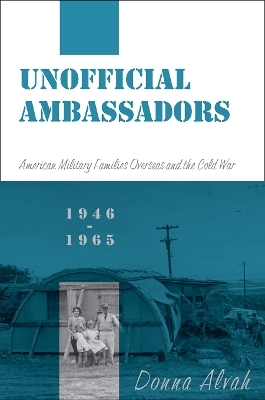
Unofficial Ambassadors
American Military Families Overseas and the Cold War, 1946-1965
Seiten
2007
New York University Press (Verlag)
978-0-8147-0501-8 (ISBN)
New York University Press (Verlag)
978-0-8147-0501-8 (ISBN)
As thousands of wives and children joined American servicemen stationed at overseas bases in the years following World War II, the military family represented a friendlier, more humane side of the United States' campaign for dominance in the Cold War. This title tells the story of Cold War diplomacy.
As thousands of wives and children joined American servicemen stationed at overseas bases in the years following World War II, the military family represented a friendlier, more humane side of the United States' campaign for dominance in the Cold War. Wives in particular were encouraged to use their feminine influence to forge ties with residents of occupied and host nations. In this untold story of Cold War diplomacy, Donna Alvah describes how these "unofficial ambassadors" spread the United States' perception of itself and its image of world order in the communities where husbands and fathers were stationed, cultivating relationships with both local people and other military families in private homes, churches, schools, women's clubs, shops, and other places.
Unofficial Ambassadors reminds us that, in addition to soldiers and world leaders, ordinary people make vital contributions to a nation's military engagements. Alvah broadens the scope of the history of the Cold War by analyzing how ideas about gender, family, race, and culture shaped the U.S. military presence abroad.
As thousands of wives and children joined American servicemen stationed at overseas bases in the years following World War II, the military family represented a friendlier, more humane side of the United States' campaign for dominance in the Cold War. Wives in particular were encouraged to use their feminine influence to forge ties with residents of occupied and host nations. In this untold story of Cold War diplomacy, Donna Alvah describes how these "unofficial ambassadors" spread the United States' perception of itself and its image of world order in the communities where husbands and fathers were stationed, cultivating relationships with both local people and other military families in private homes, churches, schools, women's clubs, shops, and other places.
Unofficial Ambassadors reminds us that, in addition to soldiers and world leaders, ordinary people make vital contributions to a nation's military engagements. Alvah broadens the scope of the history of the Cold War by analyzing how ideas about gender, family, race, and culture shaped the U.S. military presence abroad.
Donna Alvah is assistant professor and Margaret Vilas Chair of U.S. History at St. Lawrence University in Canton, New York.
AcknowledgmentsIntroduction1 Going Overseas 2 Unof?cial Ambassadors 3 A U.S. Lady's World 4 "Shoulder to Shoulder" with West Germans 5 "Dear Little Okinawa" 6 Young Ambassadors Conclusion Notes Bibliography IndexAbout the Author
| Erscheint lt. Verlag | 1.4.2007 |
|---|---|
| Verlagsort | New York |
| Sprache | englisch |
| Maße | 152 x 229 mm |
| Gewicht | 522 g |
| Themenwelt | Geschichte ► Allgemeine Geschichte ► Zeitgeschichte |
| Geisteswissenschaften ► Geschichte ► Regional- / Ländergeschichte | |
| Geschichte ► Teilgebiete der Geschichte ► Militärgeschichte | |
| Sozialwissenschaften ► Politik / Verwaltung ► Staat / Verwaltung | |
| ISBN-10 | 0-8147-0501-4 / 0814705014 |
| ISBN-13 | 978-0-8147-0501-8 / 9780814705018 |
| Zustand | Neuware |
| Informationen gemäß Produktsicherheitsverordnung (GPSR) | |
| Haben Sie eine Frage zum Produkt? |
Mehr entdecken
aus dem Bereich

aus dem Bereich
die großen Jahre der Soziologie 1949-1969
Buch | Hardcover (2025)
Klett-Cotta (Verlag)
CHF 39,20
eine Deutschlandreise im Jahr 1958
Buch | Hardcover (2024)
C.H.Beck (Verlag)
CHF 29,90


