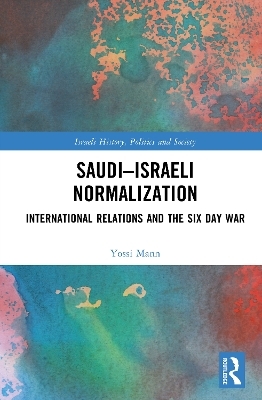
Saudi–Israeli Normalization
Routledge (Verlag)
978-1-041-02405-7 (ISBN)
Offering the first in-depth exploration of Saudi Arabia’s political, social, and diplomatic role in the Six‑Day War, this study sheds light on the kingdom’s overlooked but pivotal contributions to one of the most consequential conflicts in modern Middle Eastern history. Drawing on both newly available material and a fresh analytical approach, it also highlights how the war influenced Saudi Arabia’s evolving identity and regional positioning.
Far from being a peripheral actor, Saudi Arabia played a crucial role in shaping Arab responses to Israel during and after the 1967 war—from economic warfare via the oil embargo to internal shifts in leadership, ideology, and governance. Drawing on archival material and extensive analysis, this book situates Saudi Arabia’s wartime decisions within the broader framework of its internal transformations and evolving regional ambitions. Through a close examination of King Faisal’s leadership, domestic tensions, oil diplomacy, and the kingdom’s strategic recalibration, this study reveals how the Six‑Day War became a pivotal moment in Saudi Arabia’s emergence as a regional power. It shows how the conflict reshaped Saudi–Israeli dynamics and laid the foundation for the kingdom’s complex—and at times contradictory—approach to Israel in the decades that followed.
Essential reading for scholars and students of Middle East politics, Gulf studies, and international relations, this book also appeals to anyone seeking to understand the historical roots of today’s Saudi–Israeli engagement. It offers fresh insights into the intersection of domestic upheaval and regional diplomacy.
Yossi Mann is a senior researcher and lecturer at Bar‑Ilan and Reichman Universities, where he previously headed the Middle Eastern Studies Department at both institutions. A former research fellow at Oxford, Gdańsk, and Renmin Universities, his expertise covers Saudi Arabia and the Gulf states, with a focus on energy and technology. He leads AI‑driven research funded by Israel’s Innovation Authority and Ministry of Science and advises Israel’s Prime Minister’s Office. A former energy‑tech entrepreneur, he is also a prominent media commentator and columnist who frequently appears on podcasts discussing Gulf affairs, regional policy, and the energy market.
Introduction: The Six Days That Changed Saudi Arabia
1. A Kingdom at the Crossroads: King Faisal’s Leadership before the Six-Day War
2. Behind Faisal’s Reign: Unraveling Saudi Arabia’s Society, Economy, and Foreign Policy on the Eve of the Six-Day War
2.1 The Most Traditional Society
2.2 The Saudi Economy
2.3 Foreign Policy
3. Israel, Conflict, and Dissent: Saudi Arabia’s Internal Struggles During and After the Six-Day War
3.1 The Atmosphere in Saudi Arabia in the Weeks before the War
3.2 Saudi Society During the War
3.3 Reinforcements to the East and Arrests of Subversive Parties
4. The Six-Day War Oil Crisis
4.1 The Oil Weapon: A Tool for Advancing Political and Economic War against Israel
4.2 The Arab–Israeli Oil Weapon
4.3 The Oil Embargo after the Six-Day War
4.4 Did the Market Conditions Make an Effective Embargo Possible?
4.5 From Failure to Victory
5. A Region Reshaped: Saudi Arabia, Israel, International Affairs, and the Lasting Impact of the Six-Day War
5.1 A Defensive Foreign Policy
5.2 From a Defensive Posture to Formulating a Policy
5.3 Shifting Political Attention from the Israeli Arena to Resolving Regional Threats
Summary and Conclusions
Epilogue
Index
| Erscheinungsdatum | 12.09.2025 |
|---|---|
| Reihe/Serie | Israeli History, Politics and Society |
| Verlagsort | London |
| Sprache | englisch |
| Maße | 156 x 234 mm |
| Gewicht | 440 g |
| Themenwelt | Geschichte ► Allgemeine Geschichte ► Zeitgeschichte |
| Geisteswissenschaften ► Geschichte ► Regional- / Ländergeschichte | |
| Sozialwissenschaften ► Politik / Verwaltung ► Europäische / Internationale Politik | |
| ISBN-10 | 1-041-02405-3 / 1041024053 |
| ISBN-13 | 978-1-041-02405-7 / 9781041024057 |
| Zustand | Neuware |
| Informationen gemäß Produktsicherheitsverordnung (GPSR) | |
| Haben Sie eine Frage zum Produkt? |
aus dem Bereich