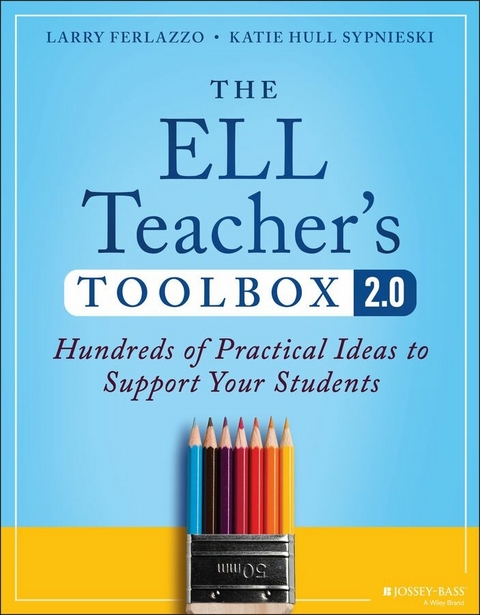
The ELL Teacher's Toolbox 2.0 (eBook)
935 Seiten
Jossey-Bass (Verlag)
9781394171682 (ISBN)
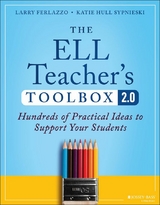
Set your English language learners up for success with this effective resource
The ELL Teacher's Toolbox 2.0 is a valuable, updated resource that teachers of English Language Learners (ELLs) can use to improve student outcomes. With hundreds of innovative strategies and activities to bring to your classroom, this book can be used with learners of all levels and in any instructional setting. This revised edition provides the latest enhancements to the instructional tools-along with 16 new chapters that you can add to your teaching repertoire. New content includes coverage of artificial intelligence, online learning environments, and differentiated instruction. Graphics and visuals make it easy to understand and adapt the content to your unique teaching situation.
Written by proven authors in the field, the book is divided into two main sections: Reading/Writing and Speaking/Listening. Each of those sections includes 'Top Ten' favorites and between 40 and 70 strategies that can be used as part of multiple lessons and across content areas.
- Contains 60% new strategies
- Features ready-to-use lesson plans
- Includes reproducible handouts
- Offers technology integration ideas
For the growing number of ELLs in public schools, effective ELL instruction can mean the difference between long-term academic success and continued struggling. In this book, you'll find countless practical ideas to add to your teaching arsenal-or for training and coaching ELL teachers-so you can support your students on their journey.
Larry Ferlazzo teaches English Language Learners and English-proficient students at Luther Burbank High School in Sacramento, California. He has written, co-authored, or edited thirteen books on education, including The ELL Teacher's Toolbox and The ESL/ELL Teacher's Survival Guide.
Katie Hull Sypnieski has co-authored three books on teaching ELLs, including The ELL Teacher's Toolbox and The ESL/ELL Teacher's Survival Guide. She teaches English Language Learners and English-proficient students in California. She is also a Teacher Consultant with the Area 3 Writing Project at the University of California.
Set your English language learners up for success with this effective resource The ELL Teacher's Toolbox 2.0 is a valuable, updated resource that teachers of English Language Learners (ELLs) can use to improve student outcomes. With hundreds of innovative strategies and activities to bring to your classroom, this book can be used with learners of all levels and in any instructional setting. This revised edition provides the latest enhancements to the instructional tools along with 16 new chapters that you can add to your teaching repertoire. New content includes coverage of artificial intelligence, online learning environments, and differentiated instruction. Graphics and visuals make it easy to understand and adapt the content to your unique teaching situation. Written by proven authors in the field, the book is divided into two main sections: Reading/Writing and Speaking/Listening. Each of those sections includes Top Ten favorites and between 40 and 70 strategies that can be used as part of multiple lessons and across content areas. Contains 60% new strategies Features ready-to-use lesson plans Includes reproducible handouts Offers technology integration ideas For the growing number of ELLs in public schools, effective ELL instruction can mean the difference between long-term academic success and continued struggling. In this book, you'll find countless practical ideas to add to your teaching arsenal or for training and coaching ELL teachers so you can support your students on their journey.
STRATEGY 1
Independent Reading
What Is It?
Independent reading, also called free voluntary reading, extensive reading, leisure or pleasure reading, and silent sustained reading, is the instructional strategy of providing students with time in class on a regular basis to read books of their choice. Students are also encouraged to do the same at home. In addition, no formal responses or academic exercises are tied to this reading.
Why We Like It
We believe that one of the best ways for our ELL students to become more motivated to read and to increase their literacy skills is to give them time to read what they like! That being said, we don't just stand back and watch them read. We do teach reading strategies during classroom lessons and encourage students to apply them, conduct read alouds to generate interest, take our classes to the school library, organize and maintain our classroom library, conference with students during reading time, and encourage our students to read outside the classroom, among other things. All of these activities contribute to a learning community in which literacy is valued and reading interest is high.
In addition to independent reading having multiple language‐learning benefits, we like it as a “warm‐up” or “do‐now” routine that students can easily begin before the bell even rings to officially start the class. It requires no initial teacher instruction after it becomes a routine, and it lets us focus, instead, on relationship‐building activities like greeting each student by name, “checking in” with those we have reason to believe might be facing personal challenges, and helping those who aren't sure what book to read or online site to visit (see Strategy 45: Beginning and Ending of Class).
Supporting Research
Research shows there are many benefits of having students read self‐selected books during the school day (Ferlazzo, 2011, February 26; Miller, 2015). These benefits include enhancing students' comprehension, vocabulary, general knowledge, and empathy, as well as increasing their self‐confidence and motivation as readers. These benefits apply to English language learners who read in English and in their native languages (International Reading Association, 2014).
Encouraging students to read in their home language, as well as in English, can facilitate English language acquisition and build literacy skills in both languages (Ferlazzo, 2017, April 10). Extensive research has found that students increasing their first language (L1) abilities are able to transfer phonological and comprehension skills as well as background knowledge to second language (L2) acquisition (Genessee, n.d.). Research shows that providing choices is one way to support autonomy, a critical element in creating the conditions where student intrinsic motivation can flourish (see Strategy 38: Motivation).
Common Core Connections
According to the Common Core ELA Standards, “students must read widely and deeply from among a broad range of high‐quality, increasingly challenging literary and informational texts” in order to progress toward career and college readiness (Common Core State Standards Initiative, n.d.b). The lead authors of the Common Core advocate for daily student independent reading of self‐selected texts and specifically state that students should have access to materials that “aim to increase regular independent reading of texts that appeal to students' interests while developing their knowledge base and joy in reading” (Coleman & Pimentel, 2012, p. 4).
Application
Our students are allowed to choose whatever classroom‐appropriate reading material they are currently interested in and are often given time to read each day (perhaps 10 minutes, and sometimes more, especially for students who might be more proficient in English). Our schools support ELLs with peer tutors (older students who receive class credit for working in our classrooms), and often ELLs will go into another room or outside and read their book to a tutor (see Strategy 39: Peer Teaching and Learning).
Our students' use of digital reading materials in the classroom has dramatically increased in the past few years. As part of our supporting student autonomy, in addition to providing hard‐copy and online books, they may also choose to use that time to work on other independent practice sites that may provide oral or grammar practice, in addition to reading. We share these digital resources in the Technology Connections section.
For this time to be effective—in other words, for our ELL students to experience the various benefits of independent reading discussed in the research section—we scaffold the independent reading process in several ways.
SELECTING BOOKS
At the beginning of the year, we familiarize our students with the way our classroom libraries are organized—ours are leveled (beginner, intermediate, advanced) and categorized (fiction, nonfiction, bilingual). We organize our books in this way so that students don't have to waste time looking through many books that are obviously not accessible to them. For example, for a newcomer, having to thumb through 10 intermediate or advanced books before finding a readable one can easily lead to a feeling of frustration, not anticipation. Students, however, are free to choose a book from any section of the library, even if that means selecting a book at a higher reading level than we would select for them. That being said, we do our best to help students find books they are interested in that are also accessible to them.
We take Dr. Rudine Sims Bishop's (2015) perspective on diverse literature seriously and ensure that our students have access to texts that are “windows” and “sliding glass doors” where they can see other worlds and use their imagination, as well as “mirrors” where they can see themselves and their experiences reflected in what they read.
We also teach our students how to identify whether a book is too hard, too easy, or just right by reading the first couple of pages and noticing if most of the words seem unfamiliar (too hard right now), if they know the majority of the words (too easy), or if some of the words are familiar and some are new (just right). We also emphasize to students the importance of challenging themselves to improve (using a sports analogy works well—if you want to get better at basketball, you don't just work on the same shot every day) by sometimes practicing a little out of their comfort zones. We do allow students to use their phones or classroom dictionaries to look up words, but we also explain that having to look up every word usually indicates a book is too hard for now.
To ensure that all our students, including newcomers, have a hard‐copy book option, we also have various bilingual and English‐only (we can't ensure that we have a bilingual version for every student's home language) picture dictionaries, as well as bilingual books in various languages, available.
We do a similar series of introductions to the various online resources we use. Typically, we will introduce one site a day and require that all students use it for 20 minutes during class. That length of time typically provides them with enough of a sense of the site to know if they would like to revisit it—either during class or at home.
Speaking of online resources, we are writing this new edition near the beginning of what appears to be an artificial intelligence (AI) “revolution.” We, like most educators, are experimenting with how and if to use it in the classroom, which is complicated by the fact that some AI tools are blocked by some districts.
One experiment we have been trying with ELLs is to provide “sentence frames” for students to get AI to write texts that they want to read. After all, you can't get much more high‐interest than having students say what they want to read about!
Here are some sentence frames we have had students complete:
- Write a story in English featuring (put your name here) as a soccer star that can be understood by a beginning English Language Learner.
- Tell me about (put any topic here) so a beginning English Language Learner can understand it.
Unfortunately, we've found that some AI tools don't really recognize the language skills of a “beginning English Language Learner,” so, instead, students have had to write “first‐grader” or “second‐grader.” We assume that by the time you read this, AI abilities will have advanced considerably so that this problem no longer exists.
However, we believe that whatever AI exists at the time you are reading this book, the idea of ELLs using it to create their own accessible high‐interest texts will still be a good one. See Technology Connections for up‐to‐date related resources.
STUDENT‐TEACHER CHECK‐INS
We use independent reading time to check in with individual students about their engagement, comprehension, and future reading interests. These are not formal assessments but are brief, natural conversations about reading (“Why did you choose this book? What is your favorite part so far? Which part is most confusing? How are you feeling...
| Erscheint lt. Verlag | 24.1.2025 |
|---|---|
| Reihe/Serie | The Teacher's Toolbox Series |
| Sprache | englisch |
| Themenwelt | Sozialwissenschaften ► Pädagogik ► Bildungstheorie |
| Schlagworte | efl activities • EFL teaching • ELL • ell activities • ELL instruction • ell reproducible • ell teacher • ell teacher book • ell teacher resource • English Language Learner • English language teaching • ESL Activities • esl resource • esl teacher • k-12 ell |
| ISBN-13 | 9781394171682 / 9781394171682 |
| Informationen gemäß Produktsicherheitsverordnung (GPSR) | |
| Haben Sie eine Frage zum Produkt? |
 EPUB (Adobe DRM)
Kopierschutz: Adobe-DRM
Adobe-DRM ist ein Kopierschutz, der das eBook vor Mißbrauch schützen soll. Dabei wird das eBook bereits beim Download auf Ihre persönliche Adobe-ID autorisiert. Lesen können Sie das eBook dann nur auf den Geräten, welche ebenfalls auf Ihre Adobe-ID registriert sind.
Details zum Adobe-DRM
Dateiformat: EPUB (Electronic Publication)
EPUB ist ein offener Standard für eBooks und eignet sich besonders zur Darstellung von Belletristik und Sachbüchern. Der Fließtext wird dynamisch an die Display- und Schriftgröße angepasst. Auch für mobile Lesegeräte ist EPUB daher gut geeignet.
Systemvoraussetzungen:
PC/Mac: Mit einem PC oder Mac können Sie dieses eBook lesen. Sie benötigen eine
eReader: Dieses eBook kann mit (fast) allen eBook-Readern gelesen werden. Mit dem amazon-Kindle ist es aber nicht kompatibel.
Smartphone/Tablet: Egal ob Apple oder Android, dieses eBook können Sie lesen. Sie benötigen eine
Geräteliste und zusätzliche Hinweise
Buying eBooks from abroad
For tax law reasons we can sell eBooks just within Germany and Switzerland. Regrettably we cannot fulfill eBook-orders from other countries.
aus dem Bereich