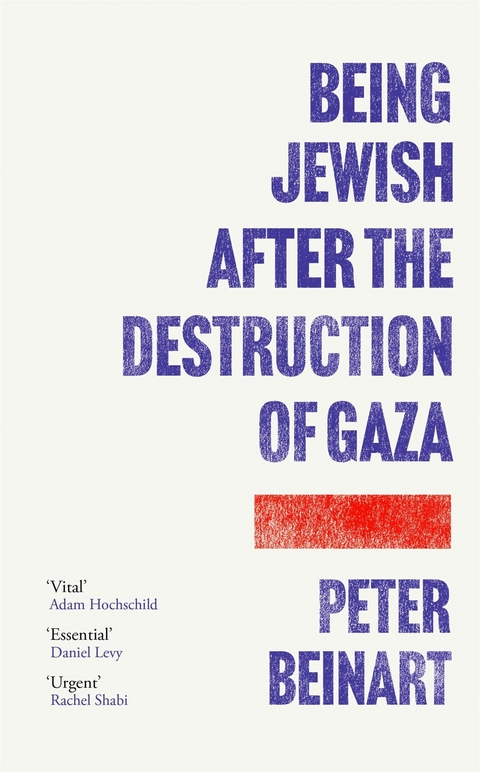
Being Jewish After the Destruction of Gaza (eBook)
192 Seiten
Atlantic Books (Verlag)
978-1-80546-453-2 (ISBN)
A frequent contributor to the New York Times and an MSNBC analyst, Peter Beinart is a professor of journalism and political science at the Craig Newmark Graduate School of Journalism at CUNY. He is also the editor at large of Jewish Currents and writes The Beinart Notebook, a weekly newsletter. He lives with his family in New York City.
***THE INSTANT NEW YORK TIMES BESTSELLER***In Peter Beinart's view, one story dominates Jewish communal life: that of persecution and victimhood. It is a story that erases much of the nuance of Jewish religious tradition and warps our understanding of Israel and Palestine. After Gaza, where Jewish texts, history and language have been deployed to justify mass slaughter and starvation, Beinart argues, Jews must tell a new story. After this war, whose horror will echo for generations, they must do nothing less than offer a new answer to the question: What does it mean to be a Jew?Beinart imagines an alternate narrative, which would draw on other nations' efforts at moral reconstruction and a different reading of Jewish tradition. A story in which Israeli Jews have the right to equality, not supremacy, and in which Jewish and Palestinian safety are not mutually exclusive but intertwined. One that recognizes the danger of venerating states at the expense of human life. Being Jewish After the Destruction of Gaza is a provocative argument that will expand and inform one of the defining conversations of our time. It is a book that only Peter Beinart could write: a passionate yet measured work that brings together his personal experience, his commanding grasp of history, his keen understanding of political and moral dilemmas, and a clear vision for the future.
A frequent contributor to the New York Times and an MSNBC analyst, Peter Beinart is a professor of journalism and political science at the Craig Newmark Graduate School of Journalism at CUNY. He is also the editor at large of Jewish Currents and writes The Beinart Notebook, a weekly newsletter. He lives with his family in New York City.
1
___
They Tried to Kill Us, We Survived, Let’s Eat
Every year, on the holiday of Purim, Jews dress in silly costumes, eat triangular pastries, and listen to an ancient story about attempted genocide. It comes from the book of Esther. The tale begins with a dissolute Persian king. He hosts a banquet, gets drunk, orders his queen to “display her beauty” to the revelers, and, when she refuses, banishes her from the throne. As her replacement he chooses Esther, a beautiful young maiden who, unbeknownst to him, is a Jew. Then he makes a calamitous personnel decision: He selects Haman, a pathological Jew-hater, to be his right-hand man. The stage is now set for an epic clash.
Haman persuades the king to sign an edict exterminating the Jews. Esther’s uncle, Mordechai, hears the news and sends word that she must save her people. Although protesting puts her own life at risk, Esther appeals to the king and, through a series of daring maneuvers, turns him against Haman. Haman is hanged. Mordechai takes his job. Good triumphs over evil.
When we tell the story of Purim today, many of us stop there. But that’s not quite right. The book of Esther doesn’t end with Haman’s death. It continues because although Haman is gone, his edict to kill the Jews remains. The king can’t reverse it. What he can do is empower Mordechai and his kinsmen to take matters into their own hands. Which they do. “The Jews struck at their enemies with the sword,” proclaims the book of Esther, “slaying and destroying; they wreaked their will upon their enemies.” On the thirteenth day of the month of Adar, the Jews kill seventy-five thousand people. They make the fourteenth “a day of feasting and merrymaking.” With the blood of their foes barely dry, the Jews feast and make merry. That’s the origin of Purim.
Purim isn’t only about the danger gentiles pose to us. It’s also about the danger we pose to them.
For most of our history, when Jews had little capacity to impose our will via the sword, the conclusion of the book of Esther was a harmless and even understandable fantasy. Who can blame a tormented people for dreaming of a world turned upside down? But the ending reads differently when Jews wield life-and-death power over millions of Palestinians who lack even a passport. Today, these blood-soaked verses should unsettle us. When we recite them aloud in synagogue, we should employ the anguished, sorrowful tune in which we chant the book of Lamentations, which depicts the destruction of our ancient temples.
Instead, most of us ignore the violence that concludes the Esther scroll. Some contemporary Jews justify it as self-defense. On the far right, some revel in it. But they’re the exception. More often, we look away. We focus on what they tried to do to us. There’s a joke that every Jewish holiday has the same plot: “They tried to kill us, we survived, let’s eat.” That’s how many Jews narrate not only Purim but many of our other best-loved holidays. Passover recounts our liberation from bondage in Egypt. Chanukah celebrates the Maccabees, who freed us from persecution by the Syrian-Greek emperor Antiochus.
Festivals we can’t fit into this script tend not to capture our collective imagination. Why is Shavuot, which commemorates the giving of the Torah, less well-known among contemporary Jews than Purim and Chanukah, holidays of lesser religious significance? There are various reasons: American Jews like Chanukah because it’s our answer to Christmas; Israeli Jews like Chanukah because they’ve made it a proto-Zionist story of regained sovereignty; everyone likes Purim because it involves costumes. But there’s one more explanation: Shavuot no longer fits the story we tell about ourselves. In modernity, Jews have grown more secular. Except for a religiously observant minority, we no longer describe ourselves as a people chosen by God to follow laws engraved at Sinai. We instead describe ourselves as a people fated by history to perpetually face annihilation but, miraculously, to survive.
With this secularization has come moral evasion. When explicating Jewish suffering, the rabbinic tradition relentlessly demands that Jews look inward and reckon with our sins. The Talmud blames the Jews for Haman’s rise because we participated in the king’s drunken debauchery. A midrash on the Song of Songs suggests that the Israelites enslaved in Egypt were unworthy of freedom because we worshipped idols. The Talmud devotes almost an entire tractate to how Jews should respond to drought. Its answer: fast and repent for our misdeeds.
This theology is hard to stomach. When it is applied to modern calamities like the Holocaust, most Jews rightly consider any suggestion that we blame ourselves to be obscene. But in the absence of a belief in divine reward and punishment, we no longer wrestle in the same way with what our sacred texts say about Jewish ethical responsibility. Too often, we turn them into tales of Jewish innocence.
We’ve lost sight of our holidays’ moral complexity. We generally end the story of Chanukah when the Maccabees defeat the Greeks and rededicate the Temple. But the Maccabees didn’t disappear. They became the Hasmonean dynasty, which the rabbis of the Talmud disdained for amassing unchecked power and subverting the rule of law. We leave that part out.
When telling the Passover story, many American Jews emphasize the holiday’s universal themes of tyranny and freedom. We acknowledge that other peoples endured bondage too. Lurking in the biblical text, however, is a more subversive message: not just that gentiles can be oppressed, but that Jews can be oppressors. Contemporary scholars note a remarkable inversion. In language strikingly similar to that used by the book of Exodus to describe Egyptian slavery, the book of Genesis describes how our patriarch and matriarch, Abraham and Sarah, enslaved a woman named Hagar, who according to one rabbinic tradition was Pharaoh’s daughter. You rarely hear this at Passover seders, but according to the Bible, our ancestors were slaves and slaveholders too.
“They tried to kill us, we survived, let’s eat” isn’t the story of our festivals. It’s a choice about what to see, and what not to see, in Judaism, and in ourselves. It imagines us as virtuous victims who survive great horrors. And then it brings down the curtain, until the show begins again.
I understand this narrative’s power for our still-scarred people. My maternal grandmother traced her ancestry to northeastern Spain, from which Jews were expelled in the fifteenth century. Her mother was born in Rhodes, a Mediterranean island she was fortunate enough to leave before the Nazis deported its Jews to Auschwitz. My grandmother herself was born in Egypt but left as a child as antisemitism grew. She reminded me of these experiences when I expressed faith in America. She strongly advised me not to take Jewish safety for granted.
Many Jewish families project these personal histories onto our holidays. Mizrachi Jews, when reading about the Israelites who fled Pharaoh’s Egypt without waiting for the dough to rise, sometimes recall their grandparents’ hasty departure from Morocco, Yemen, or Iraq in the late 1940s and early 1950s. Many Ashkenazi Jews were raised on memories of the latter-day Pharaohs, Antiochuses, and Hamans, who in the nineteenth and twentieth centuries spilled Jewish blood like water in the lands between the Black and the Baltic Seas. Some have older relatives who chanted the Haggadah’s famous refrain, “We were once slaves to Pharaoh in Egypt, now we are free,” on the first Passover after being liberated from Bergen-Belsen or Majdanek. This is not ancient history. Within the lifetime of some older Jews, European Jewry was largely wiped out. There are still fewer Jews alive today than there were in 1939.
It’s not surprising, then, that victim often feels like our natural role. But it’s also a costume that our community urges upon us and re-tailors for the specifications of the moment. It evokes something familiar while concealing something unnerving, something our tradition knows: that Jews can be Pharaohs too.
This selective vision pervades contemporary Jewish life. Consider the way establishment Jewish groups invoke the Bible to validate the Jewish people’s relationship to the land of Israel. In February 2024, the American Jewish Committee set out to rebut the claim that Israel is a settler-colonial state. To prove the Jewish connection to the land, it cites the book of Genesis, in which—as the AJC describes it—“God promises the land of Israel to Abraham, the first Jew.” It then moves to the book of Exodus, in which “Moses leads the Israelites out of slavery and oppression in Egypt with a promise to take them back to the land of Israel, the land of their forefathers.” Then it jumps ahead to the “books of Judges and Kings,” which “relate the stories of Jewish rulers over the land of Israel.”
People familiar with the Hebrew Bible will note a glaring omission: the book of Joshua, which explains how those Jewish rulers became rulers in the first place. According to the text, the Israelites under the leadership of Joshua Ben Nun conquered Canaan from the seven nations that lived there. The AJC’s chronology skips over that.
One might reasonably ask: Who cares? The Bible is a religious document, not a historical one. No one knows whether Joshua Ben Nun actually conquered the territory or existed at all....
| Erscheint lt. Verlag | 30.1.2025 |
|---|---|
| Verlagsort | London |
| Sprache | englisch |
| Themenwelt | Geisteswissenschaften ► Geschichte ► Regional- / Ländergeschichte |
| Sozialwissenschaften ► Politik / Verwaltung | |
| Schlagworte | 1948 • America • Crisis • david baddiel • Future • Gaza • Hezbollah • History • Holocaust • Ilan Pappe • i saw ramallah • Israel • Israel/Palestine • Jew • Jewish • Jewry • jews don't count • Lebanon • left • Liberal • Middle East • Mourid Barghouti • Nakba • Netanyahu • October 7 • Palestine • Politics • Progressive • Rashid Khalidi • Refugees • Religion • Reni Eddo-Lodge • Robin DiAngelo • the future is peace • the hundred year war on palestine • Trump • US • Victimhood • war • western response • WHITE FRAGILITY |
| ISBN-10 | 1-80546-453-1 / 1805464531 |
| ISBN-13 | 978-1-80546-453-2 / 9781805464532 |
| Informationen gemäß Produktsicherheitsverordnung (GPSR) | |
| Haben Sie eine Frage zum Produkt? |
 EPUB (Wasserzeichen)
DRM: Digitales Wasserzeichen
Dieses eBook enthält ein digitales Wasserzeichen und ist damit für Sie personalisiert. Bei einer missbräuchlichen Weitergabe des eBooks an Dritte ist eine Rückverfolgung an die Quelle möglich.
Dateiformat: EPUB (Electronic Publication)
EPUB ist ein offener Standard für eBooks und eignet sich besonders zur Darstellung von Belletristik und Sachbüchern. Der Fließtext wird dynamisch an die Display- und Schriftgröße angepasst. Auch für mobile Lesegeräte ist EPUB daher gut geeignet.
Systemvoraussetzungen:
PC/Mac: Mit einem PC oder Mac können Sie dieses eBook lesen. Sie benötigen dafür die kostenlose Software Adobe Digital Editions.
eReader: Dieses eBook kann mit (fast) allen eBook-Readern gelesen werden. Mit dem amazon-Kindle ist es aber nicht kompatibel.
Smartphone/Tablet: Egal ob Apple oder Android, dieses eBook können Sie lesen. Sie benötigen dafür eine kostenlose App.
Geräteliste und zusätzliche Hinweise
Buying eBooks from abroad
For tax law reasons we can sell eBooks just within Germany and Switzerland. Regrettably we cannot fulfill eBook-orders from other countries.
aus dem Bereich