


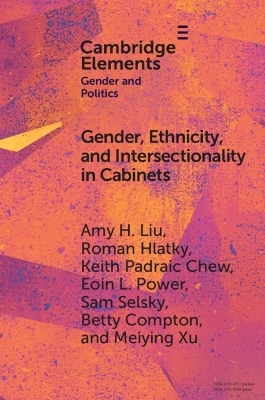
Gender, Ethnicity, and Intersectionality in Cabinets
Asia and Europe in Comparative Perspective
Seiten
2025
Cambridge University Press (Verlag)
978-1-009-57043-5 (ISBN)
Cambridge University Press (Verlag)
978-1-009-57043-5 (ISBN)
What explains patterns of representation – of women and ethnic minorities – in government cabinets? The authors argue governments diversify their cabinets when (1) a minority group is sizable and can mobilize (political competition); and/or (2) the general population believes in and expects the inclusion of minorities (popular norms).
What explains patterns of representation – of women and ethnic minorities – in government cabinets? The authors argue governments diversify their cabinets when (1) a minority group – and it need not be ethnic – is sizable and can mobilize (political competition); and/or (2) the general population believes in and expects the inclusion of minorities (popular norms). The authors test their argument using original cabinet data from Asia and Europe (N=93) 1960-2015 and a most-similar design of four case studies. They identify the gender and ethnicity of 91,000 country-year-minister observations – with consideration of the rank of their ministerial portfolio. They find evidence that in countries where there is political competition and/or popular norms, cabinets have fewer double-hegemons. However, this does not necessarily suggest minorities are holding portfolios of substantive prestige. This project offers a way to study intersectionality in democratic representation and political institutions.
What explains patterns of representation – of women and ethnic minorities – in government cabinets? The authors argue governments diversify their cabinets when (1) a minority group – and it need not be ethnic – is sizable and can mobilize (political competition); and/or (2) the general population believes in and expects the inclusion of minorities (popular norms). The authors test their argument using original cabinet data from Asia and Europe (N=93) 1960-2015 and a most-similar design of four case studies. They identify the gender and ethnicity of 91,000 country-year-minister observations – with consideration of the rank of their ministerial portfolio. They find evidence that in countries where there is political competition and/or popular norms, cabinets have fewer double-hegemons. However, this does not necessarily suggest minorities are holding portfolios of substantive prestige. This project offers a way to study intersectionality in democratic representation and political institutions.
1. Introduction; 2. A Theory on Minorities in Cabinets; 3. Minorities and Cabinet Compositions; 4. Minorities and Portfolio Prestige; 5. Minorities in Cabinets in Four Cases; 6. Democracy and Cabinet Composition; 7. Discussion: What Next?.
| Erscheinungsdatum | 22.01.2025 |
|---|---|
| Reihe/Serie | Elements in Gender and Politics |
| Zusatzinfo | Worked examples or Exercises |
| Verlagsort | Cambridge |
| Sprache | englisch |
| Maße | 152 x 229 mm |
| Gewicht | 161 g |
| Themenwelt | Sozialwissenschaften ► Politik / Verwaltung |
| Sozialwissenschaften ► Soziologie ► Gender Studies | |
| ISBN-10 | 1-009-57043-9 / 1009570439 |
| ISBN-13 | 978-1-009-57043-5 / 9781009570435 |
| Zustand | Neuware |
| Informationen gemäß Produktsicherheitsverordnung (GPSR) | |
| Haben Sie eine Frage zum Produkt? |
Mehr entdecken
aus dem Bereich


aus dem Bereich
eine Geschichte des IfS aus feministischer Perspektive
Buch | Softcover (2025)
Bertz und Fischer (Verlag)
CHF 25,20
Buch | Hardcover (2025)
Springer Fachmedien Wiesbaden GmbH (Verlag)
CHF 139,95


