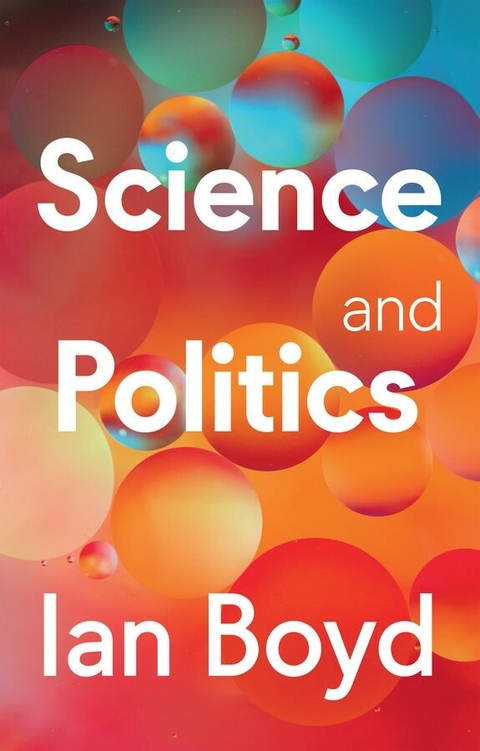
Science and Politics (eBook)
329 Seiten
Polity (Verlag)
978-1-5095-6159-9 (ISBN)
Drawing on his experience as both a research scientist and an expert advisor at the centre of government, Ian Boyd takes an empirical approach to examining the current state of the relationship between science and politics. He argues that the way politicians and scientists work together today results in a science that is on tap for ideological (mis)use, and governance that fails to serve humanity's most fundamental needs. Justice is unlikely-perhaps impossible-while science is not a fully integrated part of the systems for collective decision-making across society.
In Science in Politics, Boyd presents an impassioned argument for a series of conceptual and structural innovations that could resolve this fundamental tension, revealing how a radical intermingling of these (apparently contradictory) professions might provide the world with better politics and better science.
Sir Ian Boyd is Bishop Wardlaw Professor in the School of Biology at the University of St. Andrews, Chair of the UK Research Integrity Office, and President of the Royal Society of Biology. He was Chief Scientific Adviser to the UK Government on Food and the Environment from 2012 to 2019.
The recent coronavirus pandemic proved that the time-old notion seems now truer than ever: that science and politics represent a clash of cultures. But why should scientists simply stick to the facts and leave politics to the politicians when the world seems to be falling down around us?Drawing on his experience as both a research scientist and an expert advisor at the centre of government, Ian Boyd takes an empirical approach to examining the current state of the relationship between science and politics. He argues that the way politicians and scientists work together today results in a science that is on tap for ideological (mis)use, and governance that fails to serve humanity s most fundamental needs. Justice is unlikely perhaps impossible while science is not a fully integrated part of the systems for collective decision-making across society.In Science in Politics, Boyd presents an impassioned argument for a series of conceptual and structural innovations that could resolve this fundamental tension, revealing how a radical intermingling of these (apparently contradictory) professions might provide the world with better politics and better science. Also available as an audiobook.
Introduction: The scientific predicament
During the COVID-19 pandemic, Patrick Vallance, the Chief Scientific Adviser to the UK government, said, ‘I’ve got one piece of advice for any science adviser, it’s: stick to the science.’1
Some people say that science and politics should not mix,2 but I suggest the opposite is true: not only are science and politics closely enmeshed with one another and becoming more so with time, but this is a good thing because it is likely to result in better politics, and maybe even better science. Yet how can we reconcile this with Vallance’s advice?
First, we need to understand what politics actually is, which is something I suspect remarkably few people stop to really think about. In my view, politics is the manifestation of how we negotiate our ways through life as social organisms. Even as spectators of the high politics happening within national democracies, or even autocracies, we are participants. Politics is how we deliberate about making collective decisions.3 It is the process we use to rub along. It involves those who have a voice explaining their own interests and also listening to other perspectives. This happens at all scales, from households to the floor of the United Nations General Assembly. Rules of procedure – some formal, such as voting, and some socially modulated, such as consensus forming or even various forms of coercion – are then used to come to a collective decision. Once this collective decision is made, then it can be encoded as policies which are statements of collective intent. These provide guidance for those who are allocated the duty to implement decisions derived from the collective view. Some of these intents end up as laws or regulations, and it is this process of deliberation which mainly shapes the societies we live in.
But politics can also involve lots of mendacious behaviours to shift the balance of power within these debates, and I think this is often how it is viewed. We are all politicians, but many of us do not like to admit this in case it exposes our own mendaciousness, however trivial that may be. Of course, professional politicians have no such defence. Politics exaggerates behavioural pathologies associated with vested interests, tribalism, selfishness and the traits which make humans both successful and rapacious.
It seems to me that scientists need to be intimately involved in the process of deliberation which underlies all politics because without their input some of these pathologies can go unconstrained. Many people might say (as did Solly Zuckerman,4 a former Chief Scientific Adviser to the UK government) that if scientists want more political influence, then they should use the democratic processes by putting themselves up for election. This seems reasonable in principle, except for two caveats. The first is that current political structures require rationalists like scientists to become hooked to a political party, which is equivalent to being hooked to an ideological position. It is, therefore, obvious that such a proposition is absurd. Current political structures are segmented by ideology and simply cannot accommodate people whose wish is to cut across all ideologies by championing objectivity.
The second caveat is that these critics are reinforcing a very narrow but all too prevalent definition of democracy by imagining that power only flows through elected representatives. Democracy is more than just about being elected to representative assemblies like parliaments. The institutions of democratic societies, from legislatures to the judiciary and the executive, plus all the paraphernalia of public, commercial and third-sector bodies surrounding these, many of which provide essential services across society, are just as much a part of the democratic process.5 Science can easily play its role through these, and often does. For example, science happening within government, academia and industry worked synergistically to solve the COVID-19 crisis. Government science provided public health surveillance; academic science came up with new vaccines and diagnostics; and industry science took those ideas and rapidly scaled them up making them available to everybody. This was an illustration of how science can operate effectively in a democracy without the need for scientists to stand for election.
Even if it showed what can be achieved, however, the COVID-19 experience was an exception in terms of the constructive mixing of science with politics. Making this the norm will require people to ditch some old ideas, and this applies as much to scientists as to politicians. These old ideas involve the suggestion that science is not about values and seeing politics just as a process practised by a few people – sometimes generically and stereotypically referred to as ‘decision-makers’ – rather than everybody.
It is a common stereotype to see politics as concerning values whereas science concerns facts. This is something political scientist Leo Strauss called the fact–value distinction,6 but he concluded that claims about the value-free nature of science are bogus and toxic. We need to openly acknowledge that scientists always bring values to any argument; otherwise facts and values become blurred and we lose our bearings in the resulting fog, something which the new age of disinformation aptly illustrates.
There can be no better illustration of the toxicity of the separation of facts and values than the role which science played within Nazi tyranny. Carl Schmitt, a political theorist who was a prominent member of the Nazi Party, promoted the idea that politics exists independently of science. This justified disengaging the morality of politics from the analysis of its consequences. It allowed falsehoods to bloom as if they were truths and, in the present day, it is part of the playbook of the proto-tyranny of populism and the idea that science functions simply to amplify narrow political objectives like economic growth and competitiveness.
Other prominent political scientists of the 20th century, including Max Weber, but also Hannah Arendt and Hans Morgenthau (both, like Strauss, refugees from Nazi tyranny), saw an additional problem concerned with applying science to politics by reducing politics to rational paradigms and frameworks, essentially turning politics into technocracy.7 Weber saw politics as ‘a strong and slow boring of hard boards’ involving ‘passion and perspective’,8 but he also emphasized that it had a practical, dispassionate, pragmatic side which prioritized reality over imagination, and science provides the bulwark for this earthy aspect of politics.
Facts – the domain of science – and values become merged within politics. So politics is something more profound than pure passion or aspiration and science is more than just paradigms and frameworks: they both represent the hard work of making society function by merging reality with aspiration. Together, they are about establishing the rules of the game of life to achieve a balance between collective and individual good. Much political debate becomes centred on where this balance should sit, and science has a legitimate role in this debate. It can be the vehicle deployed to satisfy aspiration by driving the process of discovery and invention, but it also tends to observe that not all aspirations are feasible. When these messages become portrayed as restrictions of liberties, science can be unfairly viewed as a left-leaning conspiracy. It then becomes a target for those who think that re-engineering the uncomfortable messages from science, or ignoring science altogether, is the fairest way forward.
One constraint on making Weber’s merger work is that public politics is necessarily a highly abstracted (and in many ways deeply dishonest) depiction of what happens in private politics, where there can be genuine efforts to include science in deliberations about policy. The predicament faced by politicians is that they cannot afford to tell those who vote for them that many of those voters are bigots who fail to recognize that life is full of trade-offs and that compromise is essential. This means politicians can look like liars because, to please the bigots, they get trapped into making undeliverable promises. Of course, some politicians are themselves bigots, but it is the general fear of being exposed as such, and as liars, that mainly makes them wary of scientists.
Therefore, those who suggest that science should not mix with politics are making the case that science should not inform the collective decisions which lead to the codes by which society functions. The mistake they make, I believe, is in equating politics with the passionate spinning of dreams rather than Weber’s ‘boring of hard boards’. As a result, either they tend to join these people in the spinning of dreams or they walk away and allow the dream spinners to have a free run. Neither seems right.
A basic principle of creating tolerance and common understanding is to connect rather than to isolate differing parties, and scientists need to promote the making of connections.9 But this requires an especially energetic approach by scientists. In an essay written in 1945 called ‘The Evil of Politics and the Ethics of Evil’, Morgenthau began with the statement ‘Man is a political animal by nature; he is a scientist by chance or choice.’10 He saw science as something which was not innate, meaning that scientists are always having to educate, re-educate and...
| Erscheint lt. Verlag | 4.10.2024 |
|---|---|
| Sprache | englisch |
| Themenwelt | Sozialwissenschaften ► Pädagogik ► Bildungstheorie |
| Schlagworte | Decision-Making • Government • government adviser • government policy • health policy • Justice • Pandemic • pandemic preparedness • policymaking • Politics • Sage • Science • Science Policy • scientific adviser • Social Policy |
| ISBN-10 | 1-5095-6159-5 / 1509561595 |
| ISBN-13 | 978-1-5095-6159-9 / 9781509561599 |
| Informationen gemäß Produktsicherheitsverordnung (GPSR) | |
| Haben Sie eine Frage zum Produkt? |
 EPUB (Adobe DRM)
Kopierschutz: Adobe-DRM
Adobe-DRM ist ein Kopierschutz, der das eBook vor Mißbrauch schützen soll. Dabei wird das eBook bereits beim Download auf Ihre persönliche Adobe-ID autorisiert. Lesen können Sie das eBook dann nur auf den Geräten, welche ebenfalls auf Ihre Adobe-ID registriert sind.
Details zum Adobe-DRM
Dateiformat: EPUB (Electronic Publication)
EPUB ist ein offener Standard für eBooks und eignet sich besonders zur Darstellung von Belletristik und Sachbüchern. Der Fließtext wird dynamisch an die Display- und Schriftgröße angepasst. Auch für mobile Lesegeräte ist EPUB daher gut geeignet.
Systemvoraussetzungen:
PC/Mac: Mit einem PC oder Mac können Sie dieses eBook lesen. Sie benötigen eine
eReader: Dieses eBook kann mit (fast) allen eBook-Readern gelesen werden. Mit dem amazon-Kindle ist es aber nicht kompatibel.
Smartphone/Tablet: Egal ob Apple oder Android, dieses eBook können Sie lesen. Sie benötigen eine
Geräteliste und zusätzliche Hinweise
Buying eBooks from abroad
For tax law reasons we can sell eBooks just within Germany and Switzerland. Regrettably we cannot fulfill eBook-orders from other countries.
aus dem Bereich