


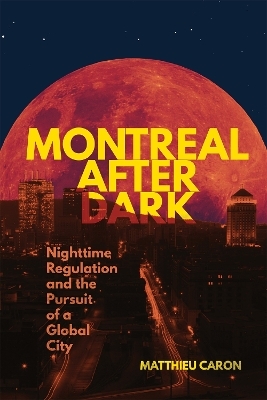
Montreal After Dark
Nighttime Regulation and the Pursuit of a Global City
Seiten
2025
McGill-Queen's University Press (Verlag)
978-0-2280-2477-4 (ISBN)
McGill-Queen's University Press (Verlag)
978-0-2280-2477-4 (ISBN)
In the mid-twentieth century, Montreal’s influential mayor Jean Drapeau endeavoured to transform Montreal into a world-class global city by regulating its nightlife. Montreal After Dark elucidates how the desires of politicians would come to reorganize how consumption and leisure, labour and dissent, noise, sex, and art were lived in Montreal after the sun went down.
Sex and jazz, liquor and gambling: Montreal in the early twentieth century was a city that offered an exceptional nighttime scene in North America. By mid-century that scene came under scrutiny, and Montreal's influential mayor Jean Drapeau would be elected for the first time on a reformist platform that promised to end corruption. Over more than three decades, Drapeau would endeavour to transform Montreal into a world-class global city by regulating its nightlife.
Montreal After Dark chronicles the spaces where nighttime regulations were enforced and contested. City authorities understood the night as enabling disorder, and they reorganized policing and crafted bylaws to gain control over it. Police and politicians mutually reinforced each other's drive to morally cleanse the urban landscape, especially for international events like Expo 67 and the 1976 Olympics. But in an era of social unrest Drapeau's administration also found itself responding to the protective services' discontent. The political culture of the city was quickly transformed following terrifying nights without their services. Matthieu Caron shows how, in an effort to incorporate the night into the expansionary tendencies of consumer capitalism, municipal authorities took sides in a debate over who had the right to public space at night, what constituted acceptable behaviour or expression, whose sexual activity sustained the social order – and whose threatened to destroy it.
In terms that are strikingly familiar today, Montreal After Dark elucidates how the desires of politicians would come to reorganize how consumption and leisure, labour and dissent, noise, sex, and art were lived in Montreal after the sun went down.
Sex and jazz, liquor and gambling: Montreal in the early twentieth century was a city that offered an exceptional nighttime scene in North America. By mid-century that scene came under scrutiny, and Montreal's influential mayor Jean Drapeau would be elected for the first time on a reformist platform that promised to end corruption. Over more than three decades, Drapeau would endeavour to transform Montreal into a world-class global city by regulating its nightlife.
Montreal After Dark chronicles the spaces where nighttime regulations were enforced and contested. City authorities understood the night as enabling disorder, and they reorganized policing and crafted bylaws to gain control over it. Police and politicians mutually reinforced each other's drive to morally cleanse the urban landscape, especially for international events like Expo 67 and the 1976 Olympics. But in an era of social unrest Drapeau's administration also found itself responding to the protective services' discontent. The political culture of the city was quickly transformed following terrifying nights without their services. Matthieu Caron shows how, in an effort to incorporate the night into the expansionary tendencies of consumer capitalism, municipal authorities took sides in a debate over who had the right to public space at night, what constituted acceptable behaviour or expression, whose sexual activity sustained the social order – and whose threatened to destroy it.
In terms that are strikingly familiar today, Montreal After Dark elucidates how the desires of politicians would come to reorganize how consumption and leisure, labour and dissent, noise, sex, and art were lived in Montreal after the sun went down.
Matthieu Caron is a postdoctoral fellow in the Department of History at Simon Fraser University.
| Erscheinungsdatum | 14.05.2025 |
|---|---|
| Reihe/Serie | Studies on the History of Quebec/Études D'histoire Du Québec |
| Zusatzinfo | 30 images, 2 tables |
| Verlagsort | Montreal |
| Sprache | englisch |
| Maße | 152 x 229 mm |
| Themenwelt | Geschichte ► Allgemeine Geschichte ► Zeitgeschichte |
| Geisteswissenschaften ► Geschichte ► Regional- / Ländergeschichte | |
| Sozialwissenschaften ► Politik / Verwaltung | |
| ISBN-10 | 0-2280-2477-3 / 0228024773 |
| ISBN-13 | 978-0-2280-2477-4 / 9780228024774 |
| Zustand | Neuware |
| Informationen gemäß Produktsicherheitsverordnung (GPSR) | |
| Haben Sie eine Frage zum Produkt? |
Mehr entdecken
aus dem Bereich


aus dem Bereich
die großen Jahre der Soziologie 1949-1969
Buch | Hardcover (2025)
Klett-Cotta (Verlag)
CHF 39,20
von den Versprechen der Neunziger zu den Krisen der Gegenwart
Buch | Hardcover (2025)
Aufbau (Verlag)
CHF 36,40


