


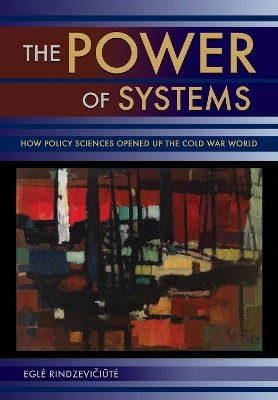
The Power of Systems
How Policy Sciences Opened Up the Cold War World
Seiten
2025
Cornell University Press (Verlag)
978-1-5017-8220-6 (ISBN)
Cornell University Press (Verlag)
978-1-5017-8220-6 (ISBN)
Explores how computer modeling, cybernetics, and the systems approach challenged Soviet governance by undermining the linear notions of control on which Soviet governance was based and creating new objects and techniques of government.
In The Power of Systems, Eglė Rindzevičiūtė introduces readers to one of the best-kept secrets of the Cold War: the International Institute of Applied Systems Analysis (IIASA), an international think tank established by the US and USSR to advance scientific collaboration.
From 1972 until the late 1980s, IIASA was one of the very few permanent platforms where policy scientists from both sides of the Cold War could work together to articulate and solve world problems: a rare zone of freedom, communication, and negotiation.
East-West scientists coproduced computer simulations of the long-term world future, using global modeling to explore the possible effects of climate change and nuclear winter. Their concern with global issues also became a vehicle for transformation inside the Soviet Union. The Power of Systems explores how computer modeling, cybernetics, and the systems approach challenged Soviet governance by undermining the linear notions of control on which Soviet governance was based and creating new objects and techniques of government.
In The Power of Systems, Eglė Rindzevičiūtė introduces readers to one of the best-kept secrets of the Cold War: the International Institute of Applied Systems Analysis (IIASA), an international think tank established by the US and USSR to advance scientific collaboration.
From 1972 until the late 1980s, IIASA was one of the very few permanent platforms where policy scientists from both sides of the Cold War could work together to articulate and solve world problems: a rare zone of freedom, communication, and negotiation.
East-West scientists coproduced computer simulations of the long-term world future, using global modeling to explore the possible effects of climate change and nuclear winter. Their concern with global issues also became a vehicle for transformation inside the Soviet Union. The Power of Systems explores how computer modeling, cybernetics, and the systems approach challenged Soviet governance by undermining the linear notions of control on which Soviet governance was based and creating new objects and techniques of government.
Eglė Rindzevičiūtė is Associate Professor in Criminology and Sociology at Kingston University, London. She is the author of The Will to Predict and coeditor of The Struggle for the Long-Term in Transnational Science and Politics.
| Erscheinungsdatum | 03.02.2025 |
|---|---|
| Zusatzinfo | 8 halftones - 8 Halftones, black and white |
| Verlagsort | Ithaca |
| Sprache | englisch |
| Maße | 152 x 229 mm |
| Gewicht | 454 g |
| Themenwelt | Geschichte ► Allgemeine Geschichte ► Zeitgeschichte |
| Sozialwissenschaften ► Politik / Verwaltung ► Europäische / Internationale Politik | |
| ISBN-10 | 1-5017-8220-7 / 1501782207 |
| ISBN-13 | 978-1-5017-8220-6 / 9781501782206 |
| Zustand | Neuware |
| Informationen gemäß Produktsicherheitsverordnung (GPSR) | |
| Haben Sie eine Frage zum Produkt? |
Mehr entdecken
aus dem Bereich



aus dem Bereich
die großen Jahre der Soziologie 1949-1969
Buch | Hardcover (2025)
Klett-Cotta (Verlag)
CHF 39,20
eine Deutschlandreise im Jahr 1958
Buch | Hardcover (2024)
C.H.Beck (Verlag)
CHF 29,90


