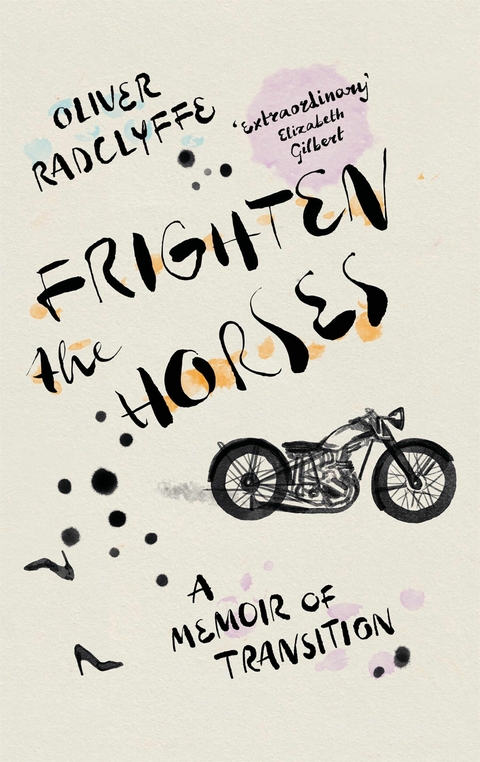
Frighten the Horses (eBook)
352 Seiten
Grove Press UK (Verlag)
978-1-80471-089-0 (ISBN)
Oliver Radclyffe's work has appeared in the New York Times and Electric Literature, and he recently published Adult Human Male, a monograph on the trans experience under the cisgender gaze. He currently lives on the Connecticut coast, where he is raising his four children.
Oliver Radclyffe's work has appeared in the New York Times and Electric Literature, and he recently published Adult Human Male, a monograph on the trans experience under the cisgender gaze. He currently lives on the Connecticut coast, where he is raising his four children.
Chapter Three
The secret was contained in the car as I drove down Main Street towards Henry’s a few days later. It was hovering around somewhere among the empty chip packets and crushed water bottles, over by a half-eaten Fruit Roll-Up that had melted onto the dashboard. I balanced my palms lightly on the steering wheel, trying to lessen the pain in my fingers. The secret drifted into my head and I let it float away like the meditation guide had instructed: Fly away, little dark cloud. A strand of hair released itself from my scalp and drifted slowly down the front of my sweater. Two hundred and sixty-seven, I counted as another strand sloughed off. Two hundred and sixty-eight.
Henry’s building—the destination I half hoped I’d never reach—was only a couple of miles away. Henry had once told me a story about how he used a rock hidden below the surface of the water as his base when he went surfing; as long as he could swim back to the rock, he knew he was safe. I assumed he meant it as an allegory. I couldn’t picture him in a wet suit, so instead I imagined him sitting on the rock in his armchair, his yellow legal pad on his knee, his wire-rimmed glasses balanced on his nose. Waves thrashing around him, a storm brewing in the sky, and Henry calmly taking notes.
A twinge of pain shot up my left leg, followed by the familiar prickling sensation in my scalp. I ran my fingers through my hair, glancing at the strands that fell out into my hand before shaking them onto the car floor. Tension myositis syndrome. At least now I had a diagnosis, even if I wasn’t quite sure what to do with it. I’d thought I’d been suffering from some kind of nervous breakdown induced by the stress of looking after four kids under the age of seven, but it seemed to be getting worse, not better. Henry had prescribed medication for anxiety, but it didn’t feel like anxiety to me, it felt like panic. In the middle of the night it felt like sheer bloody terror.
It was a year ago that the symptoms had started, an unexplained ache in my feet when I got out of bed in the morning that made it hard to stand upright. Then I noticed shooting pains in my thighs as I sat on a picnic blanket on the edge of a soccer field, watching Alfie careen around in every direction except towards the ball. Finally it took over my hands, steadily increasing until I could barely hold a pen or a cup of tea. It was hard to tell whether it was in my muscles or my joints; sometimes it almost felt like it was in my bones. I mentioned it to Charles, and he said what he always said when he didn’t know what else to say, “Let’s wait, and see what happens.” But when I started losing weight for no reason, I became more concerned. Over the previous six months I’d lost almost fifteen pounds and still the scales kept dropping, and now I was losing my hair too, handfuls of it falling out while I was in the shower, clumps of it appearing in my hairbrush every day. I’d stopped having baths because the sight of so much hair lying in the bottom of the tub after I let out the water was freaking me out. I went to see a dermatologist, who told me to count the hairs in my hairbrush each morning. “If there are over two hundred, we might have a problem,” he said. I held up my bag of hair. “We might have a problem,” he confirmed.
My doctor sent me off for a series of tests to check for everything from cancer to autoimmune disease to multiple sclerosis, but nobody found anything conclusive, until eventually a doctor at Greenwich Hospital suggested that the symptoms might stem from something psychological rather than physical.
“Tension myositis syndrome is when your body creates pain as a defense mechanism against unconscious mental stress,” he told me. “Which is not to say the symptoms aren’t real, just that they can’t be treated medically. Do you have a therapist?”
I admitted that I did, although I’d been attending my monthly sessions with Henry in a somewhat desultory manner, sharing only as much information as I thought necessary for him to keep prescribing my meds.
“If you’ve been bottling something up, it might be a good idea to talk to your therapist about it,” the doctor suggested.
I bought a book on the subject and took it with me to my next session, leaving it in my bag while I tried to explain to Henry that something was terribly wrong. I seemed to have developed some sort of agoraphobia-induced OCD, obsessively checking my keys, my cell phone battery, the gas level of the car every time I had to leave the house. Being out in public felt terrifying, although I couldn’t explain why. I’d been bursting into tears randomly for no reason, crying uncontrollably at inopportune moments, and the insomnia that had first surfaced in my midtwenties returned. I could just about cope with the anxiety and hair loss, but I couldn’t cope with the nights spent lying awake, my mind racing in uncontrollable loops. Eventually I pulled the book from my bag and asked Henry for his opinion on the diagnosis.
“I’m familiar with the syndrome,” he said. “The body uses pain to divert the mind from repressed anger it’s trying not to acknowledge.”
I sat silently, waiting for Henry to fill in the blank space between us.
“So I’ve got one question,” he said eventually.
“Which is?”
“What are you angry about?”
My cell phone buzzed just as I turned onto Henry’s street. I clicked on the speakerphone. “Hello, Mum,” I said.
“Your father’s in France, darling. He’s been looking at war graves.”
“That’s great, Mum. Nice for you to have some time off.”
“Are you there?”
“I’m in the car.”
“You sound echoey. I’ve got so much done while he’s been away. Took down all the caging around the vegetable garden, it’s been up for twenty years, remarkable how it’s lasted. Can you hear me, darling?”
“I’m just parking,” I said as I pulled into the small lot behind Henry’s building.
“And I finished the latest Ian McEwan. Climate change, very topical. Have you picked up anything new?”
“No, old. Beckett. I just reread The Unnamable,” I said.
“You’re not . . . indulging, are you, darling? I don’t want you to . . .”
“It’s fine, Mum.”
“I just worry that you’re going to . . .”
“Mum, please. I’m at my therapist’s, I must go.”
“Good heavens,” she responded. The use of the mild invective as a form of disapproval was so familiar I had to consciously prevent myself from apologizing. “I went to a therapist once,” she said. “I was trying to get over the traumatic event of your father’s retirement. Never went back. I worried he’d trick me into telling him something I didn’t want him to know.”
“Everyone has a therapist over here,” I said. “It’s like having a dentist.”
“Nobody goes to the dentist over here either,” she said. “What on earth do you find to talk to him about after all this time?”
“The brutality of the British boarding school system and the fact that you never hugged me as a child.”
“Nonsense,” she sniffed. “You had a perfectly happy childhood.”
“I know, Mother. Your exuberant affection knew no bounds.”
“Don’t be facetious, darling. It doesn’t suit you.”
I clicked the telephone out of its holder. “Mum, I really do have to go.”
I turned the engine off and leaned back. I didn’t have to tell Henry what had happened at the motorcycle rally. I could talk and say nothing; that was a workable option. After all, I’d been doing it all my life. The inside of the car felt cold, like a holding room between one world and the next. I looked through the car window at Henry’s building. It was nondescript, moss green, and didn’t exactly inspire feelings of safety. The sign hanging over the optometrist store at the front was slightly crooked. Maybe I could spend the whole hour sitting in silence. Or perhaps I could just not go in, send an excuse by email, pretend I’d moved back to England, never see him again. I could hear the sound of my own breathing. The seat belt light flickered on the dash. I pushed open the door, wincing as a bolt of pain shot up my arm, and stepped out.
I sat in my usual armchair, my bag in my lap, my foot tapping anxiously. Henry rummaged through the drawer beside him, looking for my folder, while I thought about his question from our previous session. What are you angry about? I’d sat in silence for the rest of the session, not wanting to answer. Henry hadn’t pushed. He was at ease with the sort of lengthy silences that would feel awkward in any other situation, and I was usually fine with this; sitting in silence with Henry was strangely comforting. He was the only person I’d ever met who was still interested in me when I said nothing—the only person who listened closely enough to hear what I wasn’t saying—but now the pills weren’t working, and my hair was falling out, and I weighed under a hundred pounds, and everything hurt, and the lack of sleep was beginning to make me feel like I was going quietly mad. If...
| Erscheint lt. Verlag | 27.2.2025 |
|---|---|
| Verlagsort | London |
| Sprache | englisch |
| Themenwelt | Literatur ► Biografien / Erfahrungsberichte |
| Literatur ► Romane / Erzählungen | |
| Sozialwissenschaften ► Soziologie ► Gender Studies | |
| Schlagworte | butchness • gender dysphoria • gender transition • internalised transphobia • Queer • Queer Families • Queerness • queer parenting • reinvention • Trans • Transgender • transgender parenting • Transphobia • Unconventional Families |
| ISBN-10 | 1-80471-089-X / 180471089X |
| ISBN-13 | 978-1-80471-089-0 / 9781804710890 |
| Informationen gemäß Produktsicherheitsverordnung (GPSR) | |
| Haben Sie eine Frage zum Produkt? |
 EPUB (Wasserzeichen)
DRM: Digitales Wasserzeichen
Dieses eBook enthält ein digitales Wasserzeichen und ist damit für Sie personalisiert. Bei einer missbräuchlichen Weitergabe des eBooks an Dritte ist eine Rückverfolgung an die Quelle möglich.
Dateiformat: EPUB (Electronic Publication)
EPUB ist ein offener Standard für eBooks und eignet sich besonders zur Darstellung von Belletristik und Sachbüchern. Der Fließtext wird dynamisch an die Display- und Schriftgröße angepasst. Auch für mobile Lesegeräte ist EPUB daher gut geeignet.
Systemvoraussetzungen:
PC/Mac: Mit einem PC oder Mac können Sie dieses eBook lesen. Sie benötigen dafür die kostenlose Software Adobe Digital Editions.
eReader: Dieses eBook kann mit (fast) allen eBook-Readern gelesen werden. Mit dem amazon-Kindle ist es aber nicht kompatibel.
Smartphone/Tablet: Egal ob Apple oder Android, dieses eBook können Sie lesen. Sie benötigen dafür eine kostenlose App.
Geräteliste und zusätzliche Hinweise
Buying eBooks from abroad
For tax law reasons we can sell eBooks just within Germany and Switzerland. Regrettably we cannot fulfill eBook-orders from other countries.
aus dem Bereich