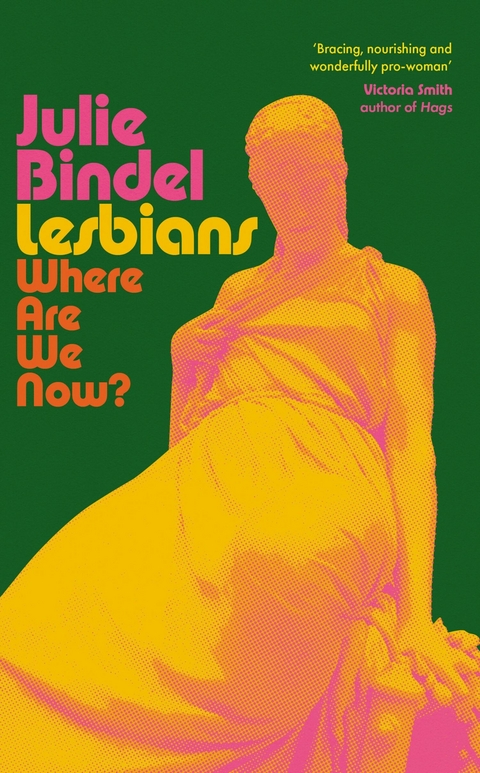
Lesbians (eBook)
208 Seiten
Forum (Verlag)
978-1-80075-428-7 (ISBN)
Julie Bindel is journalist, author and feminist campaigner. She is co-director and founder of 'The Lesbian Project', and has been campaigning for the rights of abused and marginalised women and against male violence for four decades. Her previous books include Feminism for Women: The Real Route to Liberation and The Pimping of Prostitution: Abolishing the Sex Work Myth.
1
What Does ‘Lesbian’ Mean to Me?
While all identities and sexualities are welcome at La Cam, [the owners] were intentional in labelling the bar ‘lesbian’, as both a reclamation and a celebration. While some people tend to think lesbian means cis women who love other cis women, for Loveless and Solis it is ‘open to whoever wants to claim it’… They are also happy with Flinta (female, lesbian, intersex, nonbinary, trans and agender)… thanks to its inclusive overtones.
La Camionera: this lesbian bar in Hackney is London’s new hotspot’, Hattie Collins, , 8 June 2024
If I didn’t define myself, I would be crunched into other people’s fantasies for me and eaten alive.
From a 1982 address given by Audre Lorde as part of the Celebration of Malcolm X Weekend at Harvard University
In 1982, I was 20 and living in Leeds with a job on a Youth Opportunities Programme at a National Health Service project. My manager there, Lesley, was an out lesbian and proud feminist, which is what bonded us, despite significant differences in age (she was about fifteen years older than me), class background and social status. She asked me to help her set up a Lesbian Line for the region, a helpline for lesbians equivalent to the Gay Switchboard.
Having no premises, we asked the men who ran the Gay Switchboard if we could use theirs every Tuesday between 7 and 9pm. Lesley explained to them why this was necessary: even though they advertised their service as being open to both men and women, we knew that lesbians would not want to speak to gay men about their lives, no matter how warm and friendly they were. The gay men resisted this argument, telling us that there was no such thing as a ‘typical lesbian’; the women calling the helpline would come from every walk of life, and could have as much in common with gay men as with other lesbians. We explained that there are certain issues that bind lesbians together, and that only we could really understand one another. We asked them if they thought the gay men would find it reassuring to speak to a lesbian on the switchboard about some of their problems. They looked bewildered – but they gave us a set of keys.
Every Tuesday evening from then on, whoever was on shift would sit in a dingy basement for two hours to take calls from women of all ages and circumstances. To raise funds for the line, and to give callers desperate to meet other lesbians a place to go, we persuaded the landlord of a pub called the Dock Green to let us use his (otherwise empty) upstairs bar to host a fortnightly women-only disco. Given how much the Leeds lesbians drank, it was a very good business move on his part.
Word got around, and local lesbians were soon joined by those from neighbouring towns and cities – Todmorden, Hebden Bridge and Manchester – turning up every two weeks to talk, dance, plot and connect. I’d find myself in conversations with self-described ‘gay women’ who would tell me why they were voting Tory as I sat there aghast. There were women who would spend all evening talking about who they fancied, and explaining that when a butch takes a femme out, she never allows her to pay. I was appalled: to me it sounded just the same as staying at home on my housing estate and marrying a local boy. Except it wasn’t – because it was being said by another woman.
When running Lesbian Line, the importance of a specific lesbian-only support network became clear to me through the women who needed our help. Carrie first called us in great distress because her violent ex-husband was applying for full custody of their little boy. She had felt she had to hide the fact that she was now in a relationship with a woman, but had eventually told her parents and a few close friends. She then turned up at the Dock Green, distraught, after the court granted full custody of her child to his father. She was worried both that she would never see her son again and that his father would abuse and neglect him. She said something I have never forgotten: ‘He only wants him to punish me.’ Among the Dock Green regulars was a solicitor who had dealt with similar terrible cases in the family court, who on hearing the story sat down beside Carrie, offering both reassurance and immediate advice. Members of a feminist group supporting lesbian mothers came over to speak to her. The bar dykes (working-class lesbians, often butch identified) bought her a drink, and one of them talked her into a couple of games of pool. When I next saw Carrie, a few months later, she told me that there was a hearing in a week’s time, and that she was hoping to regain custody of her child. ‘I’ve joined the club,’ she said bashfully. ‘I’m one of you now.’ She meant, of course, that she had become a feminist.
On another occasion, a young woman, Mary, who was probably still in her teens, turned up and told the women working the door that she couldn’t afford the entrance fee, but please could we let her in because she desperately needed to talk to her friends. She explained that a neighbour had spotted her kissing a girl and told her parents. They threw her out because their religious beliefs were the kind that didn’t hold with same-sex attraction, and they didn’t want her influencing her younger sister. It turned out that in reality she had no friends at the disco, but she had known that we would look after her. Between us – the bar dykes (again), the older feminists and everyone else – we found her a place to stay, gave her some money and took her for a curry. We had all, to some extent, been through what she had: every single one of us had at some point faced rejection, homelessness, self-exclusion or stigmatisation. The next time I saw Mary was at a demonstration organised by Women Against Violence Against Women, a protest group I was involved in, outside a new strip club on its opening night. Most of us were lesbians. There was a fairly big crowd, and there was Mary with her new girlfriend. She was living in a squat with a lesbian collective and having a great time.
Both Carrie and Mary had, through our work on the Lesbian Line, discovered what we all knew: our only way forward was through feminist support, solidarity and connections.
◆
How I define a lesbian
My definition of a lesbian is a woman (i.e. female) who is sexually attracted to other women (i.e. other females). It is not a requirement to be sexually active or in a relationship with another woman to claim that identity of ‘lesbian’; you don’t stop being a lesbian because your relationship ends, and there are women who have never had a sexual encounter or relationship who nevertheless use this term to describe themselves. As far as I am concerned, the only requirement for a woman to define herself as a lesbian is that she prioritises other women in her personal life and does not seek out and consensually engage in sexual relationships with men. I recognise of course that many lesbians are in relationships with men because they have not yet come out, for whatever reason. And there are others who have chosen to remain in a relationship that does not sexually or emotionally fulfil them for the sake of financial security, or a desire for family unity. And there are others still who are coerced into heterosexual lives because the alternative is total rejection by family and other punitive consequences. Some women may well have lesbian tendencies, feelings or aspirations, but the element of choice in being an out lesbian is crucial to lesbian feminism. If you could choose to be a lesbian, would you willingly make that choice?
There are endless discussions around lesbian sexuality. Are babies born with a sexual orientation that emerges around the time of puberty, or is the way our sexuality evolves more complicated than that? Is there such a thing as a ‘gay gene’, or does sexual attraction and orientation develop through a nexus of circumstances, opportunity and other factors not connected to our genes or DNA? Is there a bisexual gene? Is everyone who doesn’t conform to the norm some type of rebel or, as some now would have it, ‘queer’? To what extent is lesbianism a political identity?
In my experience, being a lesbian is not about sexual orientation; it is about belonging to a community in which women prioritise each other, where there is a sense of political solidarity with other women, and with other lesbians. As the only sexual orientation that excludes men, we are a danger to the established social and political order, and as I pointed out earlier, we are the first group to be targeted in the backlash against feminism.
My beginnings
I was raised by loving parents in Darlington in the north-east of England. We lived on a council estate, and I attended a failing comprehensive school. When I was 12, I developed a crush on a school friend. It wasn’t about sex – I was too young for that; it was more of a puppy-love sort of thing. I wanted her to be my friend. I thought everything about her was wonderful. She was less interested in me than I was in her, which broke my heart a bit.
I was never interested in boys, and the ones at my school – most of them horrible bullies – informed me that I was a lesbian before I even knew what a lesbian was. There were only two types of girls at my school – ‘slags’ and ‘lezzers’. It was the boys who decided who fell into which category. To be a slag, you had to have had sex (or it had to be rumoured that you had), whether consensual or not, with at least one boy. All you had to do to be a lezzer was avoid having sex with boys and show no interest in them at all.
At 15, I...
| Erscheint lt. Verlag | 10.4.2025 |
|---|---|
| Verlagsort | London |
| Sprache | englisch |
| Themenwelt | Sozialwissenschaften ► Soziologie ► Gender Studies |
| Schlagworte | Feminism • Gay Liberation • Gay Rights • Homosexuality • lesbianism • Lesbians • misogyny • Patriarchy • progressive misogyny • second wave feminism • Sexism |
| ISBN-10 | 1-80075-428-0 / 1800754280 |
| ISBN-13 | 978-1-80075-428-7 / 9781800754287 |
| Informationen gemäß Produktsicherheitsverordnung (GPSR) | |
| Haben Sie eine Frage zum Produkt? |
 EPUB (Wasserzeichen)
DRM: Digitales Wasserzeichen
Dieses eBook enthält ein digitales Wasserzeichen und ist damit für Sie personalisiert. Bei einer missbräuchlichen Weitergabe des eBooks an Dritte ist eine Rückverfolgung an die Quelle möglich.
Dateiformat: EPUB (Electronic Publication)
EPUB ist ein offener Standard für eBooks und eignet sich besonders zur Darstellung von Belletristik und Sachbüchern. Der Fließtext wird dynamisch an die Display- und Schriftgröße angepasst. Auch für mobile Lesegeräte ist EPUB daher gut geeignet.
Systemvoraussetzungen:
PC/Mac: Mit einem PC oder Mac können Sie dieses eBook lesen. Sie benötigen dafür die kostenlose Software Adobe Digital Editions.
eReader: Dieses eBook kann mit (fast) allen eBook-Readern gelesen werden. Mit dem amazon-Kindle ist es aber nicht kompatibel.
Smartphone/Tablet: Egal ob Apple oder Android, dieses eBook können Sie lesen. Sie benötigen dafür eine kostenlose App.
Geräteliste und zusätzliche Hinweise
Buying eBooks from abroad
For tax law reasons we can sell eBooks just within Germany and Switzerland. Regrettably we cannot fulfill eBook-orders from other countries.
aus dem Bereich