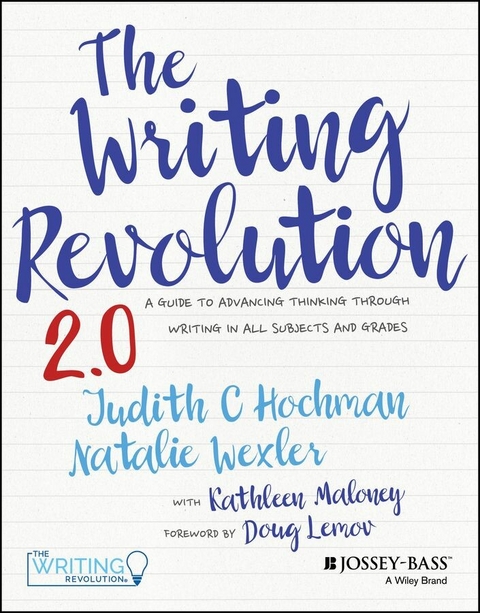
The Writing Revolution 2.0 (eBook)
483 Seiten
John Wiley & Sons (Verlag)
978-1-394-18205-3 (ISBN)
Lead a writing revolution in your classroom with the proven Hochman Method
Building on the success of the original best-seller, this new edition of The Writing Revolution adds valuable guidance for teachers seeking a way to bring their students' writing ability up to rigorous state standards. As thousands of educators have already discovered, The Writing Revolution provides the road map they need, clearly explaining how to incorporate the Hochman Method into their instruction, no matter what subject or grade they're teaching and regardless of the ability level of their students. The new edition provides a reorganized sequence of activities and even more student-facing examples, making it easier than ever to bring the method to your classroom.
The Writing Revolution isn't a separate curriculum or program teachers need to juggle. Rather, it is a method providing strategies and activities that teachers can adapt to their preexisting curriculum and weave into their content instruction. By focusing on specific techniques that match their students' needs and providing them with targeted feedback, The Writing Revolution can turn weak writers into strong and confident communicators. In addition, the method can:
- Identify misconceptions and gaps in knowledge
- Boost reading comprehension and learning
- Improve organizational skills
- Enrich oral language
- Develop analytical abilities
The Writing Revolution takes the mystery out of teaching students to write well.
Judith C. Hochman is the founder of The Writing Revolution, a not-for-profit organization serving educators both in the United States and internationally. She is the former superintendent of the Greenburgh Graham Union Free School District in Hastings, New York, and the head of The Windward School in White Plains, New York. Dr. Hochman is the founder of the Windward Teacher Training Institute and the author of many articles and books on the topic of writing.
Natalie Wexler is the author of The Knowledge Gap: The Hidden Cause of America's Broken Education System-And How to Fix It. She has a Substack newsletter, Minding the Gap, and her writing on education has appeared in the Atlantic, the Washington Post, the New York Times, and other publications. She was the host of the first season of the Knowledge Matters Podcast, a six-episode series called Reading Comprehension Revisited.
Kathleen Maloney is the chief operating officer of The Writing Revolution, where she brings her passion for literacy and experience in education to her role, overseeing the organization's daily operations and strategizing its future direction in collaboration with the co-CEOs. Before joining the team, she was an English teacher and literacy coach using The Hochman Method in her own classroom and leading its school-wide implementation.
Lead a writing revolution in your classroom with the proven Hochman Method Building on the success of the original best-seller, this new edition of The Writing Revolution adds valuable guidance for teachers seeking a way to bring their students' writing ability up to rigorous state standards. As thousands of educators have already discovered, The Writing Revolution provides the road map they need, clearly explaining how to incorporate the Hochman Method into their instruction, no matter what subject or grade they're teaching and regardless of the ability level of their students. The new edition provides a reorganized sequence of activities and even more student-facing examples, making it easier than ever to bring the method to your classroom. The Writing Revolution isn't a separate curriculum or program teachers need to juggle. Rather, it is a method providing strategies and activities that teachers can adapt to their preexisting curriculum and weave into their content instruction. By focusing on specific techniques that match their students' needs and providing them with targeted feedback, The Writing Revolution can turn weak writers into strong and confident communicators. In addition, the method can: Identify misconceptions and gaps in knowledge Boost reading comprehension and learning Improve organizational skills Enrich oral language Develop analytical abilities The Writing Revolution takes the mystery out of teaching students to write well.
Foreword
Judith Hochman and Natalie Wexler's The Writing Revolution is a timeless book that is grounded in practical wisdom, refined by application in thousands of classrooms, and supported by learning science. It meticulously describes how to effectively teach a skill that is, and will always be, profoundly important to students. It's a book that stands the test of time.
Perhaps fittingly, this foreword, originally published in the first edition of the book, remains as relevant to me now as it was when I first wrote it. It is a personal reflection of encountering many of the ideas in The Writing Revolution and testing them with my own children. Every application of the principles within the book reaffirms their enduring value.
I am not alone in my high regard for this book. Since its publication, hundreds of thousands of teachers have read and used it with great success. It has, honestly, become something of a sensation.
However, while the book remains timeless, the world—both in society at large and within schools—has been rapidly changing. Recognizing this, and in light of Hochman and Wexler's dedication to updating the entire text, I will add a few new thoughts of my own at the end of the original foreword.
A few years ago our family spent a couple of months in London. My kids were thirteen, eleven, and six at the time, and I had work there, so we decided to take the once-in-a-lifetime opportunity to live in one of the world's great capitals. We paid regular visits to the British Museum, combed through the food stalls at Borough Market, and traced on foot the remains of the city's medieval wall. There were day trips to Bath and Cambridge. We even had a local—pub, that is, which really should go without saying.
It was an incredible experience, thanks in no small part to what I learned at a lunch I had with one of the authors of this book before we left. I'd read an article about Judith Hochman's work at New Dorp High School in the Atlantic a year or two before, and it had stayed with me. Hochman espoused embedding writing instruction in content. She thought sentences were overlooked and rarely taught. She thought syntax—“syntactic control”—was the link to unlock the connection between better writing and better reading. She believed in the power of deliberate practice to build reading skills. Her work was technical and granular. And the results were hard to ignore. It was the kind of thing I was drawn to.
A friend had connected us and I drove down to meet her—with what soon revealed itself as her typical graciousness, she had invited me to her home near New York City—and the result was one of the most memorable days of my working life. I remember scratching notes furiously on page after page of my notebook, trying to capture everything she observed—about writing, its connection to reading and thinking, and why so many kids struggled to learn it. Over and over Hochman would hit on an idea that had been swirling in my head in inchoate wisps and put it into a clear, logical formulation of practice. Here was the idea you were fumbling with, described perfectly; here was how you'd make it work.
I couldn't write fast enough, but I remember thinking that when I got home, I would read everything she'd written. This, however, turned out to be the only disappointment. There wasn't, until now, any place where the ideas Hochman had talked about were written down in one cohesive place for a reader like me. I was left with the observations in my notebook, the hope that Hochman would someday write the book you are now holding, and her sentence expansion activities.
It was these activities that were the gift that transformed our trip to London. Hochman had spent about twenty minutes riffing on the idea the day we met. The sentence was the building block of writing and thinking, the “complete thought,” we agreed, but if you looked at the complete thoughts students produced in their writing, they were too often wooden, repetitive, inflexible. If the task of wrestling ideas into written words was to memorialize thinking, students—at least most of them—did not often have control of a sufficient number of syntactic forms and tools to capture and express complex thoughts. They could not express two ideas happening at once, with one predominating over the other. They could not express a thought interrupted by a sudden alternative thesis. Their ideas were poor on paper because their sentences could not capture, connect, and, ultimately, develop them. That last part was the most damning of all. One way to generate complex ideas is to write them into being—often slowly adding and reworking and refining, as I find myself doing now as I draft and revise this foreword for the tenth or twentieth or one hundredth time. Because students could not say what they meant, and because, as a result, they did not practice capturing and connecting complex ideas with precision in writing, they had fewer complex ideas. Or they had ideas like the sentences they wrote: predictable, neither compound nor complex. What might have been a skein of thought was instead a litter of short broken threads, each with a subject-verb-object construction.
Hochman's solution was regular intentional exercises to expand students' syntactic range. You could ask students to practice expanding their sentences in specific and methodical ways, and they'd get better at it. Crucially, she pointed out, this must be done in a content-rich environment because “the content drives the rigor.” Sentences need ideas pressing outward from inside them to stretch and expand their limits. Only rich content gives them a reason to seek and achieve nuance.
One example of a Hochman sentence expansion exercise was called because-but-so. The idea was deceptively simple: you gave students a sentence stem and then asked them to expand it three different ways—with the common conjunctions because, but, and so. This would help them to see each sentence as constantly expandable. And it would, as Hochman writes in this book, “prod them to think critically and deeply about the content they were studying—far more so than if you simply asked them to write a sentence in answer to an open-ended question.” It would build their ability to conjoin ideas with fluidity. It would help them to understand, through constant theme and variation, the broader concepts of subordination and coordination.
I want to pause here to digress on the seemingly underwhelming concepts of coordination and subordination. I will ask you to stifle your yawn as I acknowledge that they are easy to dismiss—ancient, faintly risible, uttered once long ago by acolytes of sentence diagramming in the era of chalk dust. They smack of grammar for grammar's sake, and almost nobody cares about that. Teachers instead seek mostly to make sure the sentences work and dispense with the parsing of parts. It is so much simpler to tell kids to go with “sounds right” (an idea that inherently discriminates against those for whom the sounds of language are not happily ingrained by luck or privilege) or to make the odd episodic correction and not worry about the principle at work.
But coordination and subordination are in fact deeply powerful principles worth mastering. They describe the ways that ideas are connected, the nuances that yoke disparate thoughts together. It is the connections as much as the ideas that make meaning. To master conjunctions is to be able to express that two ideas are connected but that one is more important than the other, that one is dependent on the other, that one is contingent on the other, that the two ideas exist in contrast or conflict. Mastering that skill is immensely important not just to writing but to reading. Students who struggle with complex text can usually understand the words and clauses of a sentence; it is the piecing together of the interrelationships among them that most often poses the problem. They understand the first half of the sentence but miss the cue that questions its veracity in the second half. And so without mastery of the syntax of relationships, which is what coordination and subordination are, the sentence devolves—for weak readers—into meaninglessness.
For weeks I reflected on the power of these simple activities for teachers and students, but my reflections were not limited to my role as an educator. As a father I was intrigued as well, and I suppose this is the truest test of an educational idea.
Fast-forward to London some months later, where I found myself for three months essentially homeschooling the Lemov children, those regular and long-suffering subjects of a thousand of their father's teaching ideas. To keep them writing and thinking I had them keep journals, and in those journals I found myself using and adapting Hochman's exercises. They were the perfect tidy-wrap summation to a long day out exploring.
Here are some early because-but-so exercises I rediscovered a few weeks ago in my then eleven-year-old daughter's journal.
I gave her the sentence stem: “The Great Fire of London burned 4/5 of the city . . .”
She wrote:
- The Great Fire of London burned 4/5 of the city, because at the time, citizens didn't have the knowledge or equipment to stop the fire before it spread.
- The Great Fire of London burned 4/5 of the city, but London survived and...
| Erscheint lt. Verlag | 4.6.2024 |
|---|---|
| Co-Autor | Kathleen Maloney |
| Vorwort | Doug Lemov |
| Sprache | englisch |
| Themenwelt | Sozialwissenschaften ► Pädagogik ► Bildungstheorie |
| Schlagworte | Bildungswesen • common core writing • Education • english teacher • Hochman Method • how to teach writing • k-12 writing • Lehrpläne / Schreiben • Schreiben • Teaching writing • Teach kids to write • teach students to write • teach writing • Writing • writing activities • Writing instruction • Writing Pedagogy • writing teacher book |
| ISBN-10 | 1-394-18205-8 / 1394182058 |
| ISBN-13 | 978-1-394-18205-3 / 9781394182053 |
| Informationen gemäß Produktsicherheitsverordnung (GPSR) | |
| Haben Sie eine Frage zum Produkt? |
 EPUB (Adobe DRM)
Kopierschutz: Adobe-DRM
Adobe-DRM ist ein Kopierschutz, der das eBook vor Mißbrauch schützen soll. Dabei wird das eBook bereits beim Download auf Ihre persönliche Adobe-ID autorisiert. Lesen können Sie das eBook dann nur auf den Geräten, welche ebenfalls auf Ihre Adobe-ID registriert sind.
Details zum Adobe-DRM
Dateiformat: EPUB (Electronic Publication)
EPUB ist ein offener Standard für eBooks und eignet sich besonders zur Darstellung von Belletristik und Sachbüchern. Der Fließtext wird dynamisch an die Display- und Schriftgröße angepasst. Auch für mobile Lesegeräte ist EPUB daher gut geeignet.
Systemvoraussetzungen:
PC/Mac: Mit einem PC oder Mac können Sie dieses eBook lesen. Sie benötigen eine
eReader: Dieses eBook kann mit (fast) allen eBook-Readern gelesen werden. Mit dem amazon-Kindle ist es aber nicht kompatibel.
Smartphone/Tablet: Egal ob Apple oder Android, dieses eBook können Sie lesen. Sie benötigen eine
Geräteliste und zusätzliche Hinweise
Buying eBooks from abroad
For tax law reasons we can sell eBooks just within Germany and Switzerland. Regrettably we cannot fulfill eBook-orders from other countries.
aus dem Bereich