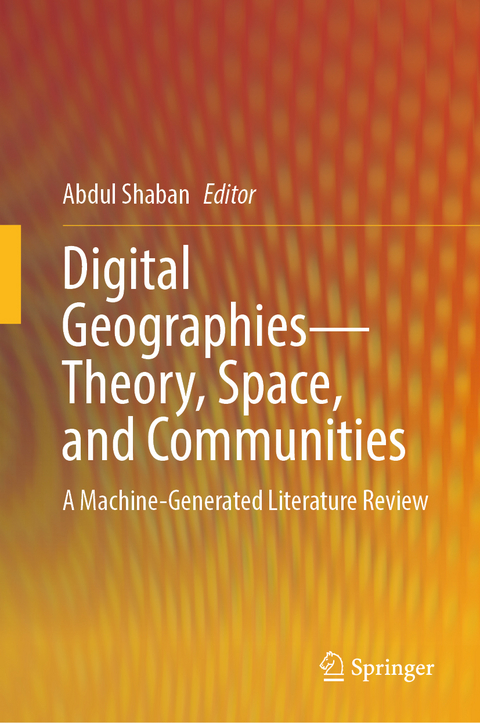
Digital Geographies—Theory, Space, and Communities
Springer Verlag, Singapore
978-981-97-4733-7 (ISBN)
- Titel nicht im Sortiment
- Artikel merken
As a departure to, and in addition to, the usual understanding of digitalisation, society, and space, the present volume engages with some of the critical questions while reviewing existing literature: What are the space relations of digital technologies? What are the forms and consequences of changing physical space–human relations to digital-space-human relations? How is the sense of time and space changing with pervasive performatives of ‘in real-time’ and ‘virtual realities’ or with perceptible or portable spaces? In what ways does digitalisation relate to knowledge and power? Why and how must we theorise the digitalisation-led transformative processes of sociality, materiality and their spatialities?
The book will be useful for teachers, researchers, and students engaged in this new area of digital geography, especially in social science and its subfields of sociology, economics, political sciences, anthropology, psychology, development studies, policy studies, social work, urban studies, and planning. For the full picture, the volume can be read in combination with its companion volume on ‘Digital Geographies – Urbanisation, Economy and Modelling’.
Abdul Shaban is Professor at School of Development Studies, Tata Institute of Social Sciences (TISS), Mumbai. He has been teaching and pursuing research in the field of human geography and urban studies for the last 24 years. He has authored several books, journal papers, and reports for various agencies. His current research interest relates to digital geographies and especially sub-fields of digitalization and urbanization, digital democracy, digital divide, and digitalization and economic geography, and digitalization and creative industries. He has also been visiting fellow and professor at several leading universities outside India, including LSE, Muenster University, Erasmus University, Masaryk University, and Paris Diderot University (University Paris Cite). He has also been associated with different journals as editor or as a member of the editorial boards.
Chapter 1: On digital geographies.- Chapter 2: Digital turn and theorising digital geographies.- Chapter 3: Human-Technology relations.- Chapter 4: Digitalization and exclusion – digital divides and development.- Chapter 5: Ethnicity, race, and identity in the digital age.- Chapter 6: Feminism and Digital Spaces.- Chapter 7: Digital rights, digital representation, and Digital justice – towards digital democracy and freedom of expression.- Chapter 8: Digitalization and spaces of knowledge and power.
| Erscheinungsdatum | 09.01.2025 |
|---|---|
| Zusatzinfo | 1 Illustrations, color; 1 Illustrations, black and white |
| Verlagsort | Singapore |
| Sprache | englisch |
| Maße | 155 x 235 mm |
| Themenwelt | Sozialwissenschaften ► Soziologie ► Spezielle Soziologien |
| Wirtschaft ► Volkswirtschaftslehre ► Makroökonomie | |
| Wirtschaft ► Volkswirtschaftslehre ► Wirtschaftspolitik | |
| Schlagworte | Artificial Intelligence • Digital capitalism • digital communication • Digital Culture • Digital Democracy • Digital Divide • Digital Economy • digital feminism • digital geographies • Digital Identity • digital justice • digital self • digital societies • Gendered Digital Spaces • Sim Cities • smart cities • virtual cities • Virtual Spaces |
| ISBN-10 | 981-97-4733-3 / 9819747333 |
| ISBN-13 | 978-981-97-4733-7 / 9789819747337 |
| Zustand | Neuware |
| Informationen gemäß Produktsicherheitsverordnung (GPSR) | |
| Haben Sie eine Frage zum Produkt? |
aus dem Bereich