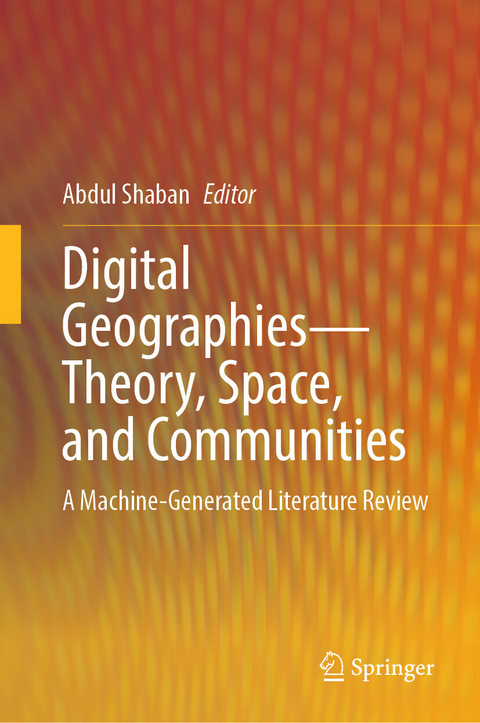
Digital Geographies—Theory, Space, and Communities (eBook)
1031 Seiten
Springer Nature Singapore (Verlag)
978-981-97-4734-4 (ISBN)
This machine-generated volume, with chapter introductions by the human expert, showcases how digital technologies are having deep transformative impacts on geographies and temporalities of social, political, economic, and personal lives. They are altering perceptions and physicality of space and time. They are giving birth to digital communities and societies where distance remains of little significance. Virtual spaces and ICT have disrupted state sovereignties, often liquidating their physical national boundaries. The rise of the digital economy shows that new important raw materials for the future are information rather than coal, oil, and minerals. Digitalisation is also leading to several contradictory processes of democratisation, rising welfare of the citizens, as well as surveillance, peripheralisation and exclusion. States are taking pride in digitalising their services to the citizens, with massive consequences on the welfare of those facing digital divides.
As a departure to, and in addition to, the usual understanding of digitalisation, society, and space, the present volume engages with some of the critical questions while reviewing existing literature: What are the space relations of digital technologies? What are the forms and consequences of changing physical space-human relations to digital-space-human relations? How is the sense of time and space changing with pervasive performatives of 'in real-time' and 'virtual realities' or with perceptible or portable spaces? In what ways does digitalisation relate to knowledge and power? Why and how must we theorise the digitalisation-led transformative processes of sociality, materiality and their spatialities?
The book will be useful for teachers, researchers, and students engaged in this new area of digital geography, especially in social science and its subfields of sociology, economics, political sciences, anthropology, psychology, development studies, policy studies, social work, urban studies, and planning. For the full picture, the volume can be read in combination with its companion volume on 'Digital Geographies - Urbanisation, Economy and Modelling'.
This machine-generated volume, with chapter introductions by the human expert, showcases how digital technologies are having deep transformative impacts on geographies and temporalities of social, political, economic, and personal lives. They are altering perceptions and physicality of space and time. They are giving birth to digital communities and societies where distance remains of little significance. Virtual spaces and ICT have disrupted state sovereignties, often liquidating their physical national boundaries. The rise of the digital economy shows that new important raw materials for the future are information rather than coal, oil, and minerals. Digitalisation is also leading to several contradictory processes of democratisation, rising welfare of the citizens, as well as surveillance, peripheralisation and exclusion. States are taking pride in digitalising their services to the citizens, with massive consequences on the welfare of those facing digital divides.As a departure to, and in addition to, the usual understanding of digitalisation, society, and space, the present volume engages with some of the critical questions while reviewing existing literature: What are the space relations of digital technologies? What are the forms and consequences of changing physical space human relations to digital-space-human relations? How is the sense of time and space changing with pervasive performatives of in real-time and virtual realities or with perceptible or portable spaces? In what ways does digitalisation relate to knowledge and power? Why and how must we theorise the digitalisation-led transformative processes of sociality, materiality and their spatialities?The book will be useful for teachers, researchers, and students engaged in this new area of digital geography, especially in social science and its subfields of sociology, economics, political sciences, anthropology, psychology, development studies, policy studies, social work, urban studies, and planning. For the full picture, the volume can be read in combination with its companion volume on Digital Geographies Urbanisation, Economy and Modelling .
| Erscheint lt. Verlag | 2.1.2025 |
|---|---|
| Zusatzinfo | XXIX, 1031 p. 2 illus., 1 illus. in color. |
| Sprache | englisch |
| Themenwelt | Geisteswissenschaften ► Sprach- / Literaturwissenschaft ► Literaturwissenschaft |
| Informatik ► Datenbanken ► Data Warehouse / Data Mining | |
| Informatik ► Theorie / Studium ► Künstliche Intelligenz / Robotik | |
| Mathematik / Informatik ► Mathematik ► Statistik | |
| Naturwissenschaften | |
| Sozialwissenschaften ► Politik / Verwaltung | |
| Sozialwissenschaften ► Soziologie ► Empirische Sozialforschung | |
| Sozialwissenschaften ► Soziologie ► Spezielle Soziologien | |
| Wirtschaft ► Volkswirtschaftslehre ► Makroökonomie | |
| Wirtschaft ► Volkswirtschaftslehre ► Wirtschaftspolitik | |
| Schlagworte | Artificial Intelligence • Digital capitalism • digital communication • Digital Culture • Digital Democracy • Digital Divide • Digital Economy • digital feminism • digital geographies • Digital Identity • digital justice • digital self • digital societies • Gendered Digital Spaces • Sim Cities • smart cities • virtual cities • Virtual Spaces |
| ISBN-10 | 981-97-4734-1 / 9819747341 |
| ISBN-13 | 978-981-97-4734-4 / 9789819747344 |
| Informationen gemäß Produktsicherheitsverordnung (GPSR) | |
| Haben Sie eine Frage zum Produkt? |
 PDF (Wasserzeichen)
DRM: Digitales Wasserzeichen
Dieses eBook enthält ein digitales Wasserzeichen und ist damit für Sie personalisiert. Bei einer missbräuchlichen Weitergabe des eBooks an Dritte ist eine Rückverfolgung an die Quelle möglich.
Dateiformat: PDF (Portable Document Format)
Mit einem festen Seitenlayout eignet sich die PDF besonders für Fachbücher mit Spalten, Tabellen und Abbildungen. Eine PDF kann auf fast allen Geräten angezeigt werden, ist aber für kleine Displays (Smartphone, eReader) nur eingeschränkt geeignet.
Systemvoraussetzungen:
PC/Mac: Mit einem PC oder Mac können Sie dieses eBook lesen. Sie benötigen dafür einen PDF-Viewer - z.B. den Adobe Reader oder Adobe Digital Editions.
eReader: Dieses eBook kann mit (fast) allen eBook-Readern gelesen werden. Mit dem amazon-Kindle ist es aber nicht kompatibel.
Smartphone/Tablet: Egal ob Apple oder Android, dieses eBook können Sie lesen. Sie benötigen dafür einen PDF-Viewer - z.B. die kostenlose Adobe Digital Editions-App.
Buying eBooks from abroad
For tax law reasons we can sell eBooks just within Germany and Switzerland. Regrettably we cannot fulfill eBook-orders from other countries.
aus dem Bereich