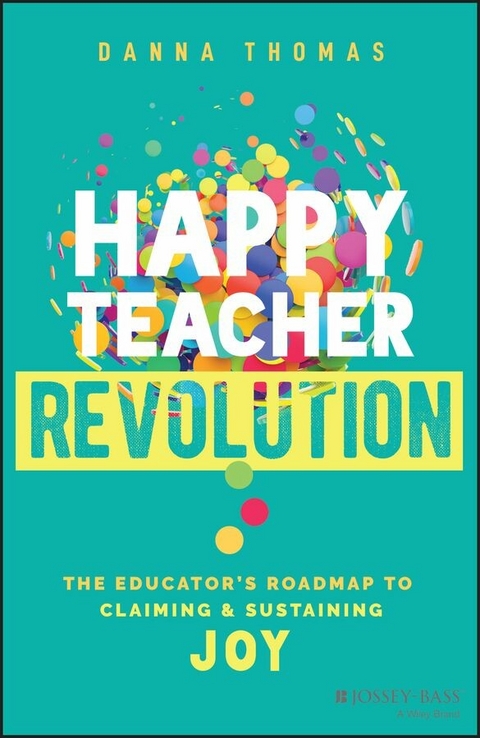
Happy Teacher Revolution (eBook)
353 Seiten
Jossey-Bass (Verlag)
978-1-394-19573-2 (ISBN)
Preserve your mental health while meeting the demands of the education profession using proven tools and research
Happy Teacher Revolution helps educators address burnout and jumpstart their own practices to claim joy. Using the latest developments in neuroscience and her experience as a teacher, author Danna Thomas introduces you to self-care practices that help you prioritize your wellbeing while handling the difficulties of a demanding profession. This research and evidence-based handbook amplifies the voices of a wide range of changemakers, providing data and deliberate action steps to support well-being on both an individual and systemic level in order to enact transformational change. Realize increased self-worth and learn to decrease prolonged stress by pushing back on expectations of time, money, and emotional capacity.
You will:
- Access tools and videos that explore caregiver burnout, vicarious trauma, and the importance of self-care in the field of education
- Understand why it's essential to claim happiness as your own 'best practice' to help students
- Discover practical techniques for identifying your limits and authentically setting boundaries
- Learn to support peers in your community and work together to address the social-emotional and intellectual demands of teaching
Educators, including both teachers and school leaders, will appreciate the practical and person-centered approach in Happy Teacher Revolution. With the techniques in this book, you can build a more resilient classroom, a more resilient community, and, most importantly, a happier you.
DANNA THOMAS, a former Baltimore City Public School teacher, is founder of Happy Teacher Revolution-a global initiative to support the mental health and wellness of educators. The organization has supported the social-emotional welfare of thousands of teachers across the United States, Canada, Nigeria, Brazil, and Senegal.
Preserve your mental health while meeting the demands of the education profession using proven tools and research Happy Teacher Revolution helps educators address burnout and jumpstart their own practices to claim joy. Using the latest developments in neuroscience and her experience as a teacher, author Danna Thomas introduces you to self-care practices that help you prioritize your wellbeing while handling the difficulties of a demanding profession. This research and evidence-based handbook amplifies the voices of a wide range of changemakers, providing data and deliberate action steps to support well-being on both an individual and systemic level in order to enact transformational change. Realize increased self-worth and learn to decrease prolonged stress by pushing back on expectations of time, money, and emotional capacity. You will: Access tools and videos that explore caregiver burnout, vicarious trauma, and the importance of self-care in the field of education Understand why it s essential to claim happiness as your own "e;best practice"e; to help students Discover practical techniques for identifying your limits and authentically setting boundaries Learn to support peers in your community and work together to address the social-emotional and intellectual demands of teachingEducators, including both teachers and school leaders, will appreciate the practical and person-centered approach in Happy Teacher Revolution. With the techniques in this book, you can build a more resilient classroom, a more resilient community, and, most importantly, a happier you.
INTRODUCTION
My journey with the Happy Teacher Revolution Movement began before I was a teacher, before anyone referred to me as Miss Thomas, before I held the responsibility of educating a classroom filled with incredible minds. My story begins when I was still a student myself, a student suffering in silence from severe depression, anxiety, and panic attacks. Not only was I experiencing thoughts of ending my life, but I was expending so much energy pretending like I was “okay” when I really wasn’t by hiding my shadow from family and friends. But I couldn’t hide from my teachers. I refer to my educators as my emotional first responders who recognized the subtle changes in behavior and compassionately encouraged me to seek treatment and get help. They’re the reason why I’m alive today, writing these words, and sharing this very road map to claiming joy. I owe them my life.
After spending nearly a decade as an educator, I recognized both the lack of preparedness and the lack of ongoing support for the emotional demands of the job. I was shocked there was no such thing as a support group for educators, so I decided to create an opportunity for systemic change by organizing support groups through a grassroots network in my community. We called it “Happy Teacher Revolution,” and slowly our movement began to take root and spread beyond the city limits of Baltimore.
Over the past ten years, Happy Teacher Revolution has supported hundreds of individuals in leading communities to support themselves and one another by creating the time and space to feel, deal, and be real about the social-emotional demands that they face on the job. We’ve supported these educators in leading their own support spaces from the West Coast to the East Coast, in rural areas and urban areas, in small schools and massive districts across the United States as well as in Canada, Senegal, Nigeria, Brazil, and Kuwait.
MY WHY
This book is a necessity. While I don’t believe in operating from a sense of scarcity or urgency, I realize as I write this that we need a strong teaching force now more than ever. We are already seeing a reduction in the numbers of people choosing to enter the field, and enrollment in schools of education is down. The effect of educators leaving the field is absolutely immense.
The pandemic of educator burnout existed long before the pandemic of COVID-19. According to a 2022 EdWeek survey described in Forbes magazine, “a whopping 60% of teachers expressed they were stressed out and many educators are considering leaving for the first time ever or have already left the profession altogether due to stress” (Gomez, 2022). When we apply this research to the teachers in the United States alone, that means that of the 3.2 million current teachers—over 1.9 million estimated teachers—are stressed out … which means nearly 31 million children are sitting in the classroom of a stressed-out teacher (National Center for Education Statistics, 2022).
As teachers leave the classroom, we have realized that they are a target market for other employers based on their tenacity, resilience, work ethic, and innovative approaches. Furthermore, social media celebrates individuals who share their stories around leaving the profession, with many posts going viral because so many can relate to hitting an absolute breaking point.
Poor-quality teacher self-care, the lack of systemic change, and the complete ignoring of financial well-being are all topics that folks have been vocal about especially recently, and the voices are only growing.
Here are some of the headlines at the time of this writing:
- “Superficial Self-Care? Stressed-Out Teachers Say No Thanks” (2022)
- “Teachers Are Not OK, Even Though We Need Them to Be” (2021)
- “US Teachers Work More than Teachers in Nearly Every Other Country” (2019)
- “Teachers’ Pay Lags Furthest Behind Other Professionals in U.S., Study Finds” (2017)
- “Teachers in America Were Already Facing Collapse. COVID Only Made It Worse” (2022)
- “Violence, Threats, and Harassment Are Taking a Toll on Teachers, Survey Shows” (2022)
- “More than Half of Teachers Are Looking for the Exits, a Poll Says” (2022)
- “Educators Are More Stressed at Work than Average People, Survey Finds” (2017)
There's a common thread through the voices and perspectives of the hundreds of humans who influenced this text, and that is an overwhelming craving for a sense of belonging. This desire of belonging—especially for new teachers who don’t know what it's like to not be a pandemic or postpandemic teacher. The mentor teachers I’ve talked to share that they are less in the space of coaching new teachers around curriculum, intellectual demands, or academic facets of the job but more so supporting the social-emotional lens from a humanistic perspective. They pick up the phone or start a Zoom call with new teachers who are sobbing, craving someone to just listen and connect with.
What does the teacher turnover crisis mean? First of all, it means there are fewer people in a field that is already experiencing historical shortages. Second, it also means that schools will be out of money, as it's expensive to hire teachers, and even more expensive to hire administrators. Third, it means that children will be missing out on an opportunity to have a stronger teacher—research shows that teaching experience is positively associated with student achievement gains throughout much of a teacher's career. Every year that students get a brand-new teacher means that the students are missing out on the benefit of having a veteran teacher. Things are hard for teachers now. But, in truth, things have always been hard for teachers. We are at a turning point, which I pray will not become an absolute breaking point.
Self-care looks privileged because we think of it as an Instagram feed. Going places, doing things, spending money. But it's not like that. Self-care isn’t treating yourself, self-care is taking care of yourself. It's legit to take care of yourself. Love yourself. Accept yourself. It's noticing what you need. It's using your voice to advocate for your needs.
—Alexis Shepard, former Middle School English Language Arts Teacher, Clemson, South Carolina
In this book, a new definition of self-care works alongside systemic change. (See Part V about systemic change.) The enhanced aspects of the book, including its interactive design, videos, and shareable graphics, are designed to be digested in small doses without being overwhelming. Thus, they make well-being seem a little less daunting. The voices amplified in this text draw from teachers’ experiences in a wide range of locations, with a wide range of backgrounds and a wide range of experiences in their role. Steeped in mental health research, this is the opposite of a “fluffy” book and posits happiness as truly revolutionary not just to pursue but to claim as your own.
This guide is for you if you hope to restore your passion and your why for this work. It was created with you and your colleagues in mind as we collectively crave autonomy now more than ever. We are in the work of supporting the growing minds of the individuals we teach and also in the practice of building relationships (with students and with adults), and we know that the importance around social-emotional learning is only growing. In my decade of work as a national spokeswoman for mental health and well-being awareness for educators, the piece that has translated into financial investment is retention of quality teachers and also quality administration. In the United States alone, before the pandemic, we were spending over $7.3 billion on the constant recruitment and training of new teachers (National Commission on Teaching and America's Future, 2007). Our educators are not a renewable resource, and not only is it financially expensive to train a revolving door of new teachers and new administrators, but the emotional costs are even higher.
- This revolutionary text aims to support you, dear reader, in …
- not just surviving but thriving,
- not just retaining but sustaining,
- not just functioning but flourishing,
- not just identifying problems but building solutions,
- not just focusing on the deficits but leveraging the positives,
- not just curating individual meaning but cultivating collective purpose,
- not just repairing the weaknesses but amplifying strengths,
- not just a singular individual focus but a collaborative humanistic vision,
- not just fixing what is broken but nurturing what is best.
Buckle up. It's about to be quite an adventure on the road to well-being.
A MOMENTOUS ROAD TRIP
As this book was being formed, I realized I wanted to cross off a bucket list item and embark on a personal journey that I have always wanted to do. As I was drafting the very proposal for the book that is in your hands right now, I decided to hop into my tiny red convertible and drive across the United States from Baltimore. And back. Alone.
This was a goal of mine since the day I got into a car accident less than a mile from the school building where I taught. After my car was totaled by a driver who...
| Erscheint lt. Verlag | 23.4.2024 |
|---|---|
| Sprache | englisch |
| Themenwelt | Sozialwissenschaften ► Pädagogik ► Bildungstheorie |
| Schlagworte | Classroom management • Education community • educator burnout • educator trauma • self care for educators • Student Trauma • teacher book • teacher boundaries • Teacher Burnout • teacher resiliency • teacher selfcare • teacher trauma • teacher wellbeing • vicarious trauma |
| ISBN-10 | 1-394-19573-7 / 1394195737 |
| ISBN-13 | 978-1-394-19573-2 / 9781394195732 |
| Informationen gemäß Produktsicherheitsverordnung (GPSR) | |
| Haben Sie eine Frage zum Produkt? |
 EPUB (Adobe DRM)
Kopierschutz: Adobe-DRM
Adobe-DRM ist ein Kopierschutz, der das eBook vor Mißbrauch schützen soll. Dabei wird das eBook bereits beim Download auf Ihre persönliche Adobe-ID autorisiert. Lesen können Sie das eBook dann nur auf den Geräten, welche ebenfalls auf Ihre Adobe-ID registriert sind.
Details zum Adobe-DRM
Dateiformat: EPUB (Electronic Publication)
EPUB ist ein offener Standard für eBooks und eignet sich besonders zur Darstellung von Belletristik und Sachbüchern. Der Fließtext wird dynamisch an die Display- und Schriftgröße angepasst. Auch für mobile Lesegeräte ist EPUB daher gut geeignet.
Systemvoraussetzungen:
PC/Mac: Mit einem PC oder Mac können Sie dieses eBook lesen. Sie benötigen eine
eReader: Dieses eBook kann mit (fast) allen eBook-Readern gelesen werden. Mit dem amazon-Kindle ist es aber nicht kompatibel.
Smartphone/Tablet: Egal ob Apple oder Android, dieses eBook können Sie lesen. Sie benötigen eine
Geräteliste und zusätzliche Hinweise
Buying eBooks from abroad
For tax law reasons we can sell eBooks just within Germany and Switzerland. Regrettably we cannot fulfill eBook-orders from other countries.
aus dem Bereich