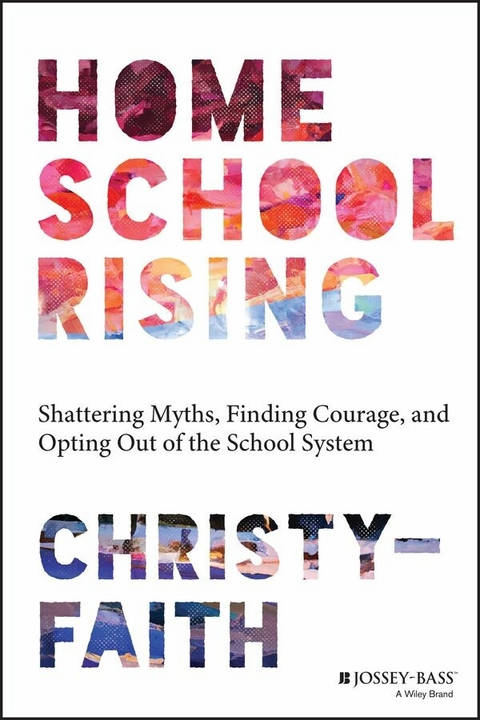
Homeschool Rising (eBook)
295 Seiten
John Wiley & Sons (Verlag)
978-1-394-19154-3 (ISBN)
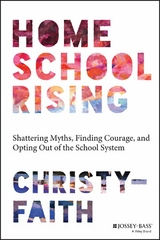
Take a good look at the reasons why homeschooling can help today's kids thrive
Homeschool Rising is a guide for anyone interested in homeschooling their children, regardless of background. It busts through the myths surrounding homeschooling, reveals the failures of our current school system, and demonstrates how home education and loving, motivated parents can provide a solution for students and families everywhere.
There are many assumptions made about homeschooling-that the child will be 'socially awkward' due to lack of social interaction, that parents are not equipped to educate their children, that homeschooling is only for White, Christian, middle-class parents, and more. In Homeschool Rising, educator Christy-Faith offers insights from more than 20 years in the field and her experience working with thousands of students to debunk these myths and misconceptions.
The truth is, homeschooling sets today's students up for success in a way that traditional schooling no longer can. This authoritative yet casual and accessible guide provides parents the tools, courage, and knowledge to opt out of the school system and take charge of their children's education.
- Clear up the confusion and misconception surrounding homeschooling
- See why homeschooling is a great option for kids of any race, religion, and background
- Gain the knowledge you need to start your kids off on the right foot with homeschooling
- Make sure your homeschooled kids are getting the support they need academically and socially
New and experienced homeschoolers looking for support, as well as educators, psychologists, and others who work with homeschooled children, will love the clear, evidence-backed, and conversational information in Homeschool Rising.
Top homeschooling advocate CHRISTY-FAITH has more than two decades of academic and administrative experience, ranging from kindergarten to higher education. She co-founded and ran a premier educational center and consulting firm in Los Angeles before transitioning to the homeschool arena. Today, she supports families in their homeschooling journeys through her membership community, podcast, and social media channels. She lives in Colorado with her husband Scott and four homeschooled children.
Take a good look at the reasons why homeschooling can help today's kids thrive Homeschool Rising is a guide for anyone interested in homeschooling their children, regardless of background. It busts through the myths surrounding homeschooling, reveals the failures of our current school system, and demonstrates how home education and loving, motivated parents can provide a solution for students and families everywhere. There are many assumptions made about homeschooling that the child will be "e;socially awkward"e; due to lack of social interaction, that parents are not equipped to educate their children, that homeschooling is only for White, Christian, middle-class parents, and more. In Homeschool Rising, educator Christy-Faith offers insights from more than 20 years in the field and her experience working with thousands of students to debunk these myths and misconceptions. The truth is, homeschooling sets today s students up for success in a way that traditional schooling no longer can. This authoritative yet casual and accessible guide provides parents the tools, courage, and knowledge to opt out of the school system and take charge of their children's education. Clear up the confusion and misconception surrounding homeschooling See why homeschooling is a great option for kids of any race, religion, and background Gain the knowledge you need to start your kids off on the right foot with homeschooling Make sure your homeschooled kids are getting the support they need academically and socially New and experienced homeschoolers looking for support, as well as educators, psychologists, and others who work with homeschooled children, will love the clear, evidence-backed, and conversational information in Homeschool Rising.
Top homeschooling advocate CHRISTY-FAITH has more than two decades of academic and administrative experience, ranging from kindergarten to higher education. She co-founded and ran a premier educational center and consulting firm in Los Angeles before transitioning to the homeschool arena. Today, she supports families in their homeschooling journeys through her membership community, podcast, and social media channels. She lives in Colorado with her husband Scott and four homeschooled children.
Author's Note xi
Foreword xiii
PART I Rethinking Childhood 1
CHAPTER 1 The Most Dangerous Question: What Makes for a Great Education? 3
CHAPTER 2 The Homeschool Revolution: Why Parents Are Pulling Out Their Kids in Droves 21
PART II The Great Experiment 49
CHAPTER 3 In Plain Sight: The Juicy History and Enduring Legacy of Public Schooling 51
CHAPTER 4 From Helpful to Harmful: What Changed in Education and Why It Matters 77
PART III The Extraordinary Potential of Homeschooling 101
CHAPTER 5 The Homeschooling Edge: Where Possibilities Flourish 103
CHAPTER 6 Understanding Homeschooling: What It Is and Why People Do It 121
PART IV Insight into Homeschooling: Separating Fact from Fiction 137
CHAPTER 7 Flipping the Script on Socialization: The Most Common Objection Is Our Greatest Strength 139
CHAPTER 8 Hitting the Books: Educational Myths about Homeschooling 165
CHAPTER 9 Moving Beyond the Shadow of Doubt: Common Homeschooling Hang-Ups and Fears 183
PART V Finding Your Why and Leaning into Hope 207
CHAPTER 10 Deschooling: Your Bridge over Anxious Waters 209
CHAPTER 11 You Are Enough 233
About the Author 241
Notes 243
Let's Connect 257
Index 259
"Christy-Faith lays down such a watertight homeschooling case that you'll WANT to educate your kids at home. This book gives concrete evidence how this method not only creates a solid foundation for a brighter future but also fosters development for a well-rounded, responsible, socially adept, and independent lifelong learner."
--Jean Burk, CEO, College Prep Genius
"Homeschool Rising is just what parents need as they jump headlong into the adventure that homeschooling can be. Christy-Faith is a natural encourager who backs it all up with sound research and a warm heart for the parents she knows will benefit from reading this timely book. Occasionally we doubt our choices as parents, and this book provides the right combination of helpful reminders, new ideas, and the inspiration a homeschooler needs to see their child's education through to the end. It will be a welcome tool in the hands of any parent - whether they're already homeschooling or are just thinking about getting started."
--Colleen Kessler, M.Ed., Author of The Homeschool Advantage: A Child-Focused Approach to Raising Lifelong Learners and Raising Resilient Sons: A Boy Mom's Guide to Building Strong, Confident, and Emotionally Intelligent Families
"Every parent should read this book as they make educational choices for their children. Christy-Faith reminds us that we don't have to be fearful while we return to the roots of individualized education. Instead, we can confidently impact the future of our children one homeschool at a time."
--Sarah Collins, MSOT, OTR/L, Owner of HomeschoolOT
"Homeschool Rising is the comprehensive, well-researched encouragement I wish I had fifteen years ago when I began homeschooling. With her vast experience in education, Christy-Faith dispels common misconceptions, equips parents, and sheds a bright light on the value and benefit of choosing the transformative educational path of homeschooling."
--Marni Love, Certified Parent Coach and Homeschool Mentor
CHAPTER ONE
The Most Dangerous Question: What Makes for a Great Education?
“To think critically, people must be motivated and free to voice their own ideas and to raise their own questions but in school students learn that their own ideas and questions don't count. What counts are their abilities to provide the correct answers to questions that they did not ask and that do not interest them.”
—Peter Gray, from his book Free to Learn1
“Dad, puh-leeze!”
My 16-year-old self was screaming inside. I was struggling in physics, had a test tomorrow, and my grade was currently a B. Yes, the scarlet letter in my book: a B.
I had reached the limit of my own capacities and needed help. Kinematics was hard and I hate to admit this, but I hadn't even earned that B. I cheated my way there and finally reached the point where I could no longer fake it. I was in dire straits. After all, my GPA was at stake (a.k.a my whole future), and I needed help.
In comes Dad. Now, let me provide some context first. My dad isn't “normal.” He's an actual genius, an engineer (more accurately, an inventor) who's won many awards for what comes out of his mind. He's the curious type when it comes to learning.
When I asked for help, I knew I needed to contain the situation because (cue the eye roll that didn't appreciate it at the time) he was going to become enthused about how cool kinematics is, start explaining superfluous abstractions and applications, and add on a side of tangents that would confuse even the kids I was cheating off of. We had to stay on track if I wanted ACTUAL help.
“The test, Dad … the test is TOMORROW! I don't need to know all this! Just tell me what I need to know to score well.”
In that moment, the last thing I truly cared about was why this material matters, why it's interesting, and how it applies to our world. It was crunch time. To be completely honest, even if my transcripts weren't on the verge of becoming a complete dumpster fire (I did tend to catastrophize back then), I found myself utterly indifferent toward the subject matter. I knew I was never going to use this stuff again in my life. I was only taking the class to fulfill college prerequisites.
Understanding physics was my lowest priority; getting the grade in physics was the highest. That's the whole point anyway, isn't it? To play the game, get the grades, so you can get where you want to go? Of course, it is.
Chasing Grades
Through the years, I've seen this letter grade–chase play out over and over again. As the founder of one of L.A.'s most prominent learning centers, I remember having that conversation hundreds of times. A parent would hire our team to tutor their child. We would have only 50 minutes to work together, so the questions quickly became, “What do you need to know? What does the teacher want? How are we going to give them what they want to nail the right grade?”
Any excitement, interest, or even discussion about the material was nonexistent. Out the window. There was no time for anything but delivering what the teacher wanted.
It's the nonstop treadmill of grades and academic achievement (honor roll, anyone?) with the exhausting chase of looking perfect on your transcript for your dream colleges. The undercurrent of this letter grade–driven madness is anxiety, peer pressure, bullying, wearing the right clothes, the social environment, gobs of insecurities, and real dangers kids face in the traditional schooling system every single day.
The undercurrent of this grade-driven madness is anxiety, peer pressure, bullying, and real dangers kids face in the school system school every single day.
How would I know? This was my story. Grades were everything to me growing up. I should clarify, though. Grades were everything for me starting in the fourth grade. Before that, I was a completely different girl.
The Dawn of Grade Perfectionism (and Performance Anxiety)
It wasn't until fourth grade that I even knew grades were a thing. I was given tests and didn't know it. I thought school was where you go to learn if you wanted to but no big deal either way. My older sister had profound learning challenges and my parents never spoke of grades in the house.
Educating my sister and navigating the school system during a time (the 1980s) when most administrators and teachers did not believe learning disabilities were real was an uphill battle. Getting my sister to learn was a constant trial, and the last thing my parents wanted to do was talk about grades around my sister. She was in and out of therapies for most of her childhood.
But one day, things changed.
My fourth-grade teacher told my mom in a parent-teacher conference that I was very smart but not living up to my potential. Apparently, I was getting Cs (I had no idea). Nor did I even know I was graded at this thing called school. But apparently, I was a smart girl who could be doing better. Or so my parents were told.
My parents did what most parents would do when confronted with this situation. They sat me down and told me I needed to get better grades. They showed me my report card (the first time I'd ever seen one) and told me Cs meant “average” and that I was capable of a lot better. That I could be getting As if I tried, and that A is the best grade.
They then laid out a plan to motivate me to get better grades. Money. That was it.
Apparently, they were right, I wasn't working to my potential because from that day forward, I got those As. Heck, yeah, I did. We didn't have a lot of money back then so to have cash was amazing. Here's how our deal went: if I went up a grade (so if I took a C to a B), I got $20, and once I got that to an A, I would get $20 for keeping every A. My parents were not wealthy by any means, so I know that cash ($100 bucks give or take) every quarter was a lot for them. Overnight I became the student every teacher and parent wants. A straight-A poster child.
From. That. Day. Forward.
The Problem with the Plan
As I got older, though, what started as a rather innocent motivation for money turned into unhealthy perfectionism. I started to get praised for being smart by my parents and teachers, I started comparing my grades with my friends, and I started to tie my self-worth to my marks. Get the A? That means you're smart.
That means your teachers will like you. That means your parents will praise you to their friends. That means you are worthy.
I learned how to perform and deliver. I was doing this childhood thing correctly. My parents loved seeing my accomplishments, but I took this expectation to an unhealthy place. Why not? My school and teachers raved about my academic success. Applause is addicting, especially when you're great at playing to the judges.
This concept held tight as I entered the realms of college and graduate school. The objective was clear-cut: emerge from academia with an unblemished 4.0. It wasn't merely about showcasing intelligence; it was about securing the elusive key to unlocking my aspirations. Yet, beneath the surface of high grades, a more profound truth was taking shape. Behind the veil of flawlessness, there resided a girl carrying hidden scars, driven by an unspoken belief that perfect grades could mend the internal wounds.
In the midst of this narrative unfolding, my experience is far from isolated. What transpired in my journey resonates broadly among children who grapple not only with the pursuit of acceptance, but also with the subtle messages our education system imparts. This yearning runs deep, interwoven into the very fabric of our schools. It's nurtured by the notion that tangible achievements hold the key to future success. Within this intricate choreography, classrooms transform into stages, with assignments and tests as avenues to stand out, to matter. Beneath the pursuit of grades lies a delicate reality: the longing for self-worth entwined with external success. It's a narrative extending beyond my own, painting a poignant image of countless children seeking validation through academic accomplishments.
Back in fourth grade, I couldn't foresee this trajectory unfolding. At that moment, I was simply thrilled about the monetary reward. Little did I know, there was a lot more tied to those good grades. But in retrospect, something shifted within me during that fourth-grade encounter. Learning, with which admittedly I had only maintained a casual relationship until then, suddenly lost its significance.
Beneath the pursuit of grades lies a delicate reality: the longing for self-worth entwined with external success.
Following that meeting with my parents, I found myself spending the subsequent years of my academic journey being more interested in the act of securing good grades than in the actual material I was learning. The only “connections and deep thoughts” that mattered were the ones that impressed teachers, professors, and graduate advisors—all in the pursuit of securing that coveted grade. It wasn't about genuine engagement; it was about achieving the paper that validated an A, honors, or a Master's degree. I held the conviction that having those grades or that degree was a testament to my...
| Erscheint lt. Verlag | 14.3.2024 |
|---|---|
| Sprache | englisch |
| Themenwelt | Sozialwissenschaften ► Pädagogik ► Bildungstheorie |
| Schlagworte | Allg. Lehrpläne • alternative school book • alternative schooling • Bildungswesen • Curriculum Tools - General • Education • Homeschool books • homeschool guide • Homeschool, Homeschooling • Home schooling • Homeschooling • homeschooling books • homeschooling social development • homeschool myths • how to homeschool |
| ISBN-10 | 1-394-19154-5 / 1394191545 |
| ISBN-13 | 978-1-394-19154-3 / 9781394191543 |
| Informationen gemäß Produktsicherheitsverordnung (GPSR) | |
| Haben Sie eine Frage zum Produkt? |
 EPUB (Adobe DRM)
Kopierschutz: Adobe-DRM
Adobe-DRM ist ein Kopierschutz, der das eBook vor Mißbrauch schützen soll. Dabei wird das eBook bereits beim Download auf Ihre persönliche Adobe-ID autorisiert. Lesen können Sie das eBook dann nur auf den Geräten, welche ebenfalls auf Ihre Adobe-ID registriert sind.
Details zum Adobe-DRM
Dateiformat: EPUB (Electronic Publication)
EPUB ist ein offener Standard für eBooks und eignet sich besonders zur Darstellung von Belletristik und Sachbüchern. Der Fließtext wird dynamisch an die Display- und Schriftgröße angepasst. Auch für mobile Lesegeräte ist EPUB daher gut geeignet.
Systemvoraussetzungen:
PC/Mac: Mit einem PC oder Mac können Sie dieses eBook lesen. Sie benötigen eine
eReader: Dieses eBook kann mit (fast) allen eBook-Readern gelesen werden. Mit dem amazon-Kindle ist es aber nicht kompatibel.
Smartphone/Tablet: Egal ob Apple oder Android, dieses eBook können Sie lesen. Sie benötigen eine
Geräteliste und zusätzliche Hinweise
Buying eBooks from abroad
For tax law reasons we can sell eBooks just within Germany and Switzerland. Regrettably we cannot fulfill eBook-orders from other countries.
aus dem Bereich