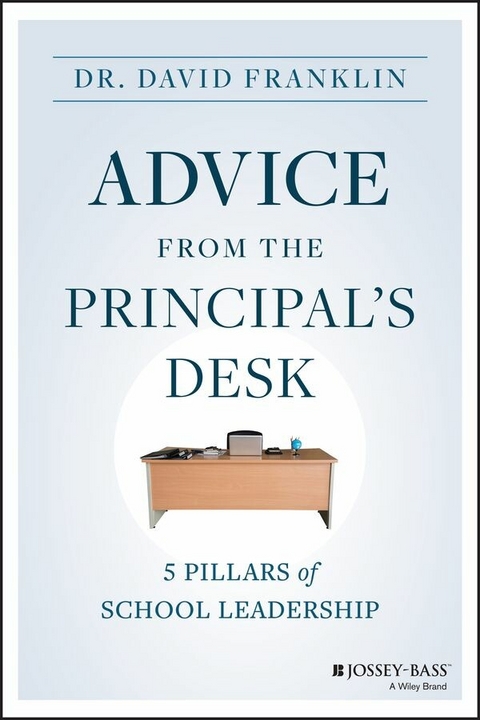
Advice from the Principal's Desk (eBook)
John Wiley & Sons (Verlag)
978-1-394-17090-6 (ISBN)
An insightful and original take on educational leadership
Advice from the Principal's Desk: 5 Pillars of School Leadership is a fresh, new take on school leadership from award-winning former school administrator and professor of education Dr. David Franklin. In the book, you'll find the tools and strategies that veteran school administrators need to succeed in their roles. You'll learn how to increase attendance and parental involvement in student affairs, minimize suspension, navigate budget cuts, and more.
The author explores five key areas that school leaders cannot neglect and examines how busy school leaders should spend their extremely limited time. You'll also discover:
- Strategies you can deploy to best support your students and other stakeholders
- How to navigate the often-conflicting demands of parents, teacher unions, and governing bodies
- How to best use and implement technology to support your work and create a positive and productive school environment
An ideal resource for current and aspiring K-12 principals and school administrators, Advice from the Principal's Desk is packed with the research, real-world examples, and practical techniques that education professionals need to improve the results of their leadership.
David Franklin, EdD, is the owner and chief consultant of The Principal's Desk, as well as the host of a popular online group and virtual conference of the same name. He leads a popular online community for educational leadership, technology, innovation, curriculum, assessment, and research. He's also an award-winning former school administrator and education professor.
An insightful and original take on educational leadership Advice from the Principal s Desk: 5 Pillars of School Leadership is a fresh, new take on school leadership from award-winning former school administrator and professor of education Dr. David Franklin. In the book, you ll find the tools and strategies that veteran school administrators need to succeed in their roles. You ll learn how to increase attendance and parental involvement in student affairs, minimize suspension, navigate budget cuts, and more. The author explores five key areas that school leaders cannot neglect and examines how busy school leaders should spend their extremely limited time. You ll also discover: Strategies you can deploy to best support your students and other stakeholders How to navigate the often-conflicting demands of parents, teacher unions, and governing bodies How to best use and implement technology to support your work and create a positive and productive school environmentAn ideal resource for current and aspiring K-12 principals and school administrators, Advice from the Principal s Desk is packed with the research, real-world examples, and practical techniques that education professionals need to improve the results of their leadership.
David Franklin, EdD, is the owner and chief consultant of The Principal's Desk, as well as the host of a popular online group and virtual conference of the same name. He leads a popular online community for educational leadership, technology, innovation, curriculum, assessment, and research. He's also an award-winning former school administrator and education professor.
Introduction xi
Pillar I: Leadership 1
Chapter 1: Becoming 3
Chapter 2: Principal Leadership Matters 7
Chapter 3: Setting the Tone 13
Chapter 4: A Top-down Approach Versus Collaborative Approach 19
Chapter 5: Be Seen 23
Chapter 6: Professional Learning Communities (PLCs) 31
Chapter 7: Looking at the Right Data 37
Tales from the Principal's Desk 41
Pillar II: Instruction 47
Chapter 8: Instruction Matters 49
Chapter 9: It's Not How Much Time, But What You Do with It 53
Chapter 10: Shifting from Teacher-Led to Teacher-Facilitated Instruction 59
Chapter 11: Classroom Observations (Walkthroughs and Instructional Rounds) 67
Chapter 12: Implementing Instructional Technology 73
Chapter 13: Assessment for Learning 81
Tales from the Principal's Desk 87
Pillar III: Community 93
Chapter 14: We're Not in Kansas Anymore 95
Chapter 15: School and Community Research 97
Chapter 16: Using Social Media in Schools 101
Chapter 17: Know Your Neighborhood 109
Chapter 18: Connecting with the Community 113
Chapter 19: One Call per Day 119
Chapter 20: Video Conferencing for All 123
Tales from the Principal's Desk 127
Pillar IV: Attendance 131
Chapter 21: Get to School, Ferris! 133
Chapter 22: Get Butts in Seats 137
Chapter 23: Conducting Home Visits 141
Chapter 24: Creating Attendance Plans That Work 145
Chapter 25: Holding Parents Accountable 151
Tales from the Principal's Desk 157
Pillar V: Culture 161
Chapter 26: Culture Is Everything 163
Chapter 27: Inclusion for All 171
Chapter 28: Creating a Safe Environment 183
Chapter 29: Sharing Your Own Story 191
Chapter 30: Creating a Collaborative Culture from the Ground Up 195
Tales from the Principal's Desk 201
Conclusion 207
References 213
Acknowledgments 217
About the Author 219
Index 221
"Dr. Franklin's approach to leadership is insightful, realistic, and empowering. Each chapter is grounded in data and strategies that will help all leaders feel connected to a network of principals and avoid feeling isolated from this challenging profession. A must read from all school leaders."
--Meredith Matson, Director of Social Studies, Herricks School District, and author of Educating with Passion and Purpose
Nearly 100 percent of educational leaders, like me, are on their journey alone, trying to manifest their careers one day at a time. There are many books on leadership theory for educators. There are many educational autobiographies by educational leaders. David Franklin has produced something I've yet to see: An actual how-to guide for the aspiring educational leader (and experienced leader) that gives specific techniques and plans to be the school administrator we have in our mind's eye."
--Jon Corippo, Co-author of The Eduprotocol Field Guides
Chapter 3
Setting the Tone
The role of the principal is undeniably linked to student achievement. While principals are not responsible for the direct instruction that students receive, they influence the learning environment in a variety of important ways.
We set the tone.
Culture influences everything that goes on in schools: how staff dress, what they talk about, their willingness to change, the practice of instruction, and the emphasis given student and faculty learning (Deal & Peterson, 1994; Firestone & Wilson, 1985; Newmann & Associates, 1996).
Principals influence everything from actual instructional practices to technology use, to lunchtime (both student and staff), to communication, and areas of focus. I have said for a long time that a visitor can feel the culture of a school from the minute they step foot onto a school campus. From the first glances of the school grounds to the first sounds of both student and staff voices, a school culture can be summed up quickly and, for the most part, effectively.
Picture walking down the halls of a school with students and staff passing by you on either side. What do they look like? Are they smiling? Is anyone saying good morning to someone else? What do the halls look like? Are there positive messages flanking the walls? Are there examples of student work displayed for all to see?
Teachers directly control how their classrooms are run. Principals directly oversee everything else. That positive tone is set by the principal.
Or not.
Have you ever walked onto a school campus where everyone looks miserable and no one acknowledges anyone else? In addition, is the overall look of the school unremarkable and monotone? If it is, I can just about guarantee that the school is struggling academically, as student and staff morale are barely on life support.
Setting the tone is achieved by modeling what you expect of others. It doesn't cost any categorical funds to say good morning and smile when walking past students and staff in the morning. This is the easiest and cheapest way to set a positive tone. However, if you aren't willing to do this, then please close this book and begin looking for another line of work. Don't be mistaken, principals are chief culture officers (CCOs).
Another job of the principal or CCO is developing teachers and staff members. Many teachers are hired straight out of credentialing school. They are bright-eyed and bushy-tailed, and totally unprepared for teaching in the real world. Much like a principal's first year, a teacher's first year or two can be filled with tears, apprehension, self-doubt, and frustration. Principals must be there to coach these teachers as well as be their biggest cheerleaders. In thinking back to every teacher whom I hired over the years, there wasn't one of them that I didn't want to be successful. In addition, I never let a teacher go whose failure I felt responsible for.
Teacher development is essential. No one walks in the door an expert. No one leaves an expert, either, because kids are always changing. The question is, how do you develop teachers when there is so much on everyone's collective plate?
A Three-Pronged Approach
I recommend a three-pronged approach:
- Instructional rounds
- Mindful mentoring
- Tangible models
Instructional Rounds
Instructional rounds help teachers by observing what is working in other classrooms as well as what doesn't work. I always encourage teachers to “steal” ideas that they see during rounds to use in their own classroom. After all, isn't imitation the sincerest form of flattery? It also gives teachers the opportunity to see what happens in classrooms around campus. Regardless of the subject or grade level, good instructional practices can be adapted for any situation.
Mindful Mentoring
All new teachers deserve a great mentor. They need someone to bounce ideas off and to ask for assistance without judgment or evaluation. While new principals often want to be the knight in shining armor for new teachers, it is better that teachers connect with a peer. Even in the most carefully crafted environments, there is still an element of evaluator and evaluatee when the principal is involved that can never be fully expunged. Mentoring can be set up with formal meetings bimonthly as well as informal meetups and classroom observations conducted by the mentor. A mentorship also creates strong bonds between staff members, enhancing job retention and overall satisfaction.
For many new teachers, the first year of teaching can be overwhelming and stressful. Strong mentors can provide emotional support by listening, empathizing, and offering encouragement. Mentors can share practical knowledge and tips based on their own experience, such as classroom management strategies, lesson planning techniques, and assessment methods. This is especially advantageous, as you can't be in more than one classroom at a time! Mentors can demonstrate effective teaching practices by modeling lessons and instructional techniques. This can encourage new teachers to develop a clear understanding of what effective teaching looks like in practice. New teachers can get feedback on their instructional practices, helping them to identify areas of strength and areas for improvement.
Most importantly, mentors can support new teachers to navigate the school culture, including policies, procedures, and expectations. They can also introduce new teachers to other teachers and staff members, encouraging them to feel more connected to the school community. Choose your mentors wisely. You do not want new teachers to be influenced in a negative manner by staff members who are critical of the direction of the school.
Mentors can also guide new teachers to build self-confidence and self-efficacy by providing positive feedback and celebrating their successes. This can serve new teachers in feeling more assured of their abilities and more motivated to continue improving. This, in turn, can lead to higher teacher retention rates and job satisfaction.
Tangible Models
I have never been a fan of giving teachers just a theoretical teaching education. Understanding different philosophies of education isn't a bad thing, but I would want teachers armed with some more tangible ideas when they are standing in front of a classroom of 30 students. Unfortunately, many teacher preparatory programs rely heavily on theoretical teaching, rather than practical application. Instead of launching into the “why we do this,” let's start with a simple “this is what we do.” The “why” will come in time. Concrete examples make concepts more accessible. When teachers are presented with concrete examples, they can better understand how abstract concepts apply in real-world situations. This makes the ideas more accessible and easier to apply in their own teaching. Tangible examples demonstrate practical application of the concept and show teachers how theoretical knowledge can be put into practice, which helps them to understand the practical implications of the concepts they are learning.
Concrete examples can be adapted to fit the specific context of a teacher's classroom, making them more relevant and useful for teachers' own teaching practice. In turn, this can encourage teachers to retain new knowledge and concepts by providing a context for their learning. When teachers have a clear understanding of how a concept can be applied, they are more likely to remember it and be able to apply it in their own teaching.
At every school there are veteran teachers with decades of experience who are amazing educators in every area: instruction, classroom culture, classroom management, creating relationships… and then, there are veteran teachers who struggle with all of those same elements as they have never been provided the right mentoring or support, but just passed on from year to year. Supporting veteran teachers who may be struggling is crucial for their well-being and professional growth. However, this task can be quite daunting for a new principal with far fewer years in education than the teacher. Support of this nature must be thoughtful and empathetic.
Principals should create a safe and nonjudgmental space for veteran teachers to express their concerns, frustrations, or challenges. Chances are, they have seen the school environment change over the years and might be dealing with some resentment or frustrations because of it. Regular check-ins or one-on-one meetings can provide opportunities for teachers to share their struggles. Principals should actively listen, validate their experiences, and offer understanding and empathy.
Providing targeted professional development opportunities for veteran teachers to enhance their skills and address specific areas of need is vital. Often, professional development opportunities are created based on the needs of new teachers. Pairing struggling teachers with experienced mentors can offer them valuable guidance and support. Encouraging this type of collaboration among teachers can be beneficial for struggling veterans. Principals can facilitate collaborative learning communities or teacher-led professional learning groups where experienced teachers can share their expertise and provide support to their struggling colleagues. This promotes a sense of camaraderie, shared learning, and a supportive network within the school.
Some veteran teachers...
| Erscheint lt. Verlag | 17.1.2024 |
|---|---|
| Sprache | englisch |
| Themenwelt | Sozialwissenschaften ► Pädagogik ► Bildungstheorie |
| Schlagworte | Bildungswesen • Education • Educational leadership • educational leadership handbook • education leadership • how to lead a school • how to lead teachers • K-12 • K-12 / Leitung u. Verwaltung • Leadership & Administration (K-12) • Leading in schools • leading teachers • school administration • school leadership guide • school leadership handbook |
| ISBN-10 | 1-394-17090-4 / 1394170904 |
| ISBN-13 | 978-1-394-17090-6 / 9781394170906 |
| Informationen gemäß Produktsicherheitsverordnung (GPSR) | |
| Haben Sie eine Frage zum Produkt? |
 EPUB (Adobe DRM)
Kopierschutz: Adobe-DRM
Adobe-DRM ist ein Kopierschutz, der das eBook vor Mißbrauch schützen soll. Dabei wird das eBook bereits beim Download auf Ihre persönliche Adobe-ID autorisiert. Lesen können Sie das eBook dann nur auf den Geräten, welche ebenfalls auf Ihre Adobe-ID registriert sind.
Details zum Adobe-DRM
Dateiformat: EPUB (Electronic Publication)
EPUB ist ein offener Standard für eBooks und eignet sich besonders zur Darstellung von Belletristik und Sachbüchern. Der Fließtext wird dynamisch an die Display- und Schriftgröße angepasst. Auch für mobile Lesegeräte ist EPUB daher gut geeignet.
Systemvoraussetzungen:
PC/Mac: Mit einem PC oder Mac können Sie dieses eBook lesen. Sie benötigen eine
eReader: Dieses eBook kann mit (fast) allen eBook-Readern gelesen werden. Mit dem amazon-Kindle ist es aber nicht kompatibel.
Smartphone/Tablet: Egal ob Apple oder Android, dieses eBook können Sie lesen. Sie benötigen eine
Geräteliste und zusätzliche Hinweise
Buying eBooks from abroad
For tax law reasons we can sell eBooks just within Germany and Switzerland. Regrettably we cannot fulfill eBook-orders from other countries.
aus dem Bereich