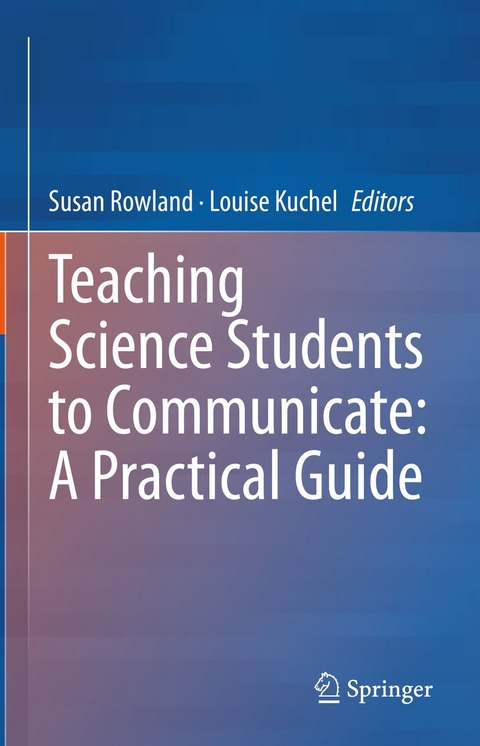
Teaching Science Students to Communicate: A Practical Guide (eBook)
559 Seiten
Springer International Publishing (Verlag)
978-3-030-91628-2 (ISBN)
This highly-readable book addresses how to teach effective communication in science. The first part of the book provides accessible context and theory about communicating science well, and is written by experts. The second part focuses on the practice of teaching communication in science, with 'nuts and bolts' lesson plans direct from the pens of practitioners.
The book includes over 50 practice chapters, each focusing on one or more short teaching activities to target a specific aspect of communication, such as writing, speaking and listening. Implementing the activities is made easy with class run sheets, tips and tricks for instructors, signposts to related exercises and theory chapters, and further resources.
Theory chapters help build instructor confidence and knowledge on the topic of communicating science. The teaching exercises can be used with science students at all levels of education in any discipline and curriculum - the only limitation is a wish to learn to communicate better!
Targeted at science faculty members, this book aims to improve and enrich communication teaching within the science curriculum, so that science graduates can communicate better as professionals in their discipline and future workplace.
Susan Rowland is Vice Provost at the University of Sydney. She was previously Professor of Science Education in the School of Chemistry and Molecular Biosciences at the University of Queensland. A biochemist by training, she now researches employability development and the work of science faculty with education specialties. She enjoys teaching communication to scientists and is co-developer of the CLIPS website (www.clips.edu.au).
Louise Kuchel is an Associate Professor of Biology and Science Education researcher at the University of Queensland, Australia. A biologist by training and award-winning teacher, Louise works on the theory and best practices for teaching science communication to scientists and science students, with her resources adopted in several countries. Louise is a Senior Fellow of the Higher Education Academy and contributor to the CLIPS website (www.clips.edu.au).
| Erscheint lt. Verlag | 25.4.2023 |
|---|---|
| Zusatzinfo | X, 559 p. 32 illus., 19 illus. in color. |
| Sprache | englisch |
| Themenwelt | Naturwissenschaften ► Biologie |
| Sozialwissenschaften ► Pädagogik | |
| Sozialwissenschaften ► Soziologie | |
| Schlagworte | biology education • improve communication in teams • intentional and unintentional messaging • presenting research results • Scientific Writing • theory and practice science communication |
| ISBN-10 | 3-030-91628-6 / 3030916286 |
| ISBN-13 | 978-3-030-91628-2 / 9783030916282 |
| Informationen gemäß Produktsicherheitsverordnung (GPSR) | |
| Haben Sie eine Frage zum Produkt? |
 PDF (Wasserzeichen)
DRM: Digitales Wasserzeichen
Dieses eBook enthält ein digitales Wasserzeichen und ist damit für Sie personalisiert. Bei einer missbräuchlichen Weitergabe des eBooks an Dritte ist eine Rückverfolgung an die Quelle möglich.
Dateiformat: PDF (Portable Document Format)
Mit einem festen Seitenlayout eignet sich die PDF besonders für Fachbücher mit Spalten, Tabellen und Abbildungen. Eine PDF kann auf fast allen Geräten angezeigt werden, ist aber für kleine Displays (Smartphone, eReader) nur eingeschränkt geeignet.
Systemvoraussetzungen:
PC/Mac: Mit einem PC oder Mac können Sie dieses eBook lesen. Sie benötigen dafür einen PDF-Viewer - z.B. den Adobe Reader oder Adobe Digital Editions.
eReader: Dieses eBook kann mit (fast) allen eBook-Readern gelesen werden. Mit dem amazon-Kindle ist es aber nicht kompatibel.
Smartphone/Tablet: Egal ob Apple oder Android, dieses eBook können Sie lesen. Sie benötigen dafür einen PDF-Viewer - z.B. die kostenlose Adobe Digital Editions-App.
Buying eBooks from abroad
For tax law reasons we can sell eBooks just within Germany and Switzerland. Regrettably we cannot fulfill eBook-orders from other countries.
aus dem Bereich