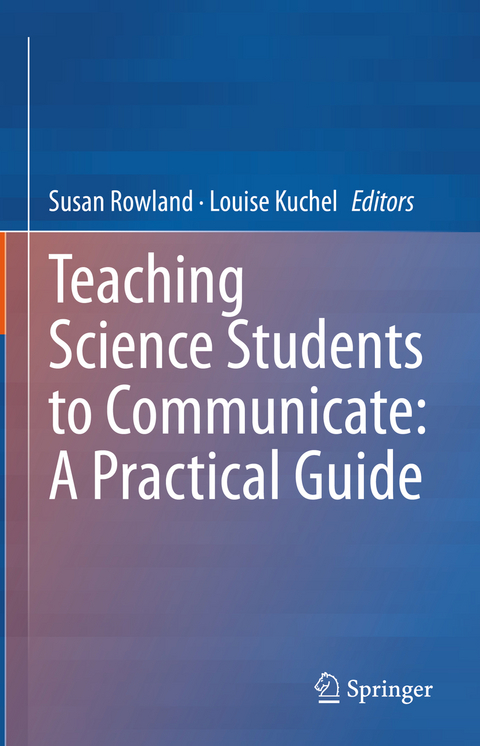
Teaching Science Students to Communicate: A Practical Guide
Springer International Publishing (Verlag)
978-3-030-91627-5 (ISBN)
This highly-readable book addresses how to teach effective communication in science. The first part of the book provides accessible context and theory about communicating science well, and is written by experts. The second part focuses on the practice of teaching communication in science, with 'nuts and bolts' lesson plans direct from the pens of practitioners.
The book includes over 50 practice chapters, each focusing on one or more short teaching activities to target a specific aspect of communication, such as writing, speaking and listening. Implementing the activities is made easy with class run sheets, tips and tricks for instructors, signposts to related exercises and theory chapters, and further resources.
Theory chapters help build instructor confidence and knowledge on the topic of communicating science. The teaching exercises can be used with science students at all levels of education in any discipline and curriculum - the only limitation is a wish to learn to communicate better!
Targeted at science faculty members, this book aims to improve and enrich communication teaching within the science curriculum, so that science graduates can communicate better as professionals in their discipline and future workplace.
lt;p>Susan Rowland (BSc PhD GCEd PFHEA) is a Professor of Biochemistry and Science Education at the University of Queensland. Aa a multi-award-winning teacher, Susan has held Fellowships from HFSPO, the Manning Clark Foundation, and the American Society for Microbiology. Susan and her group study undergraduate research, graduate employability, and science communication. She is recognised as a Principal Fellow of the Higher Education Academy.
Louise Kuchel (BSc PhD GCEd SFHEA) is an Associate Professor of Biology and a Science Education researcher at the University of Queensland, Australia. An award winning teacher, Louise works on the theory and best practices for teaching science communication to scientists and science students. Louise's science communication teaching resources have been adopted around the world. Louise is recognised as a Senior Fellow of the Higher Education Academy.
Part 1. THEORY CHAPTERS.- Chapter 1. The Rhetorical Triangle.- Chapter 2. The social brain and the neuroscience of storytelling.- Chapter 3. Good Science Communication Considers Audience.- Chapter 4. On establishing trust.- Chapter 5. Intentional and unintentional messaging.- Chapter 6. Science graduates & communication in the workplace.- Chapter 7. Models of group decision-making.- Chapter 8. Data Visualisation.- Chapter 9. Misinformation and how to respond.- Chapter 10. Communicating in a space of conflict.- Chapter 11. Critical appraisal of information.- Chapter 12. Communicating risk and uncertainty.- Part 2. PRACTICE Engaging.- Chapter 13. The 5-box talk template for structuring a presentation to any audience.- Chapter 14. Getting students to express an opinion.- Chapter 15. Understanding your target audience through writing their biography.- Chapter 16. Using active learning techniques to engage audiences in oral presentations.- Part 3. PRACTICE Writing.- Chapter 17. Nominalisations - the battle against -me t, -tion, and -ery.- Chapter 18. Learning to write from the way you read.- Chapter 19. How to deconstruct when reading and construct when writing an abstract.- Chapter 20. Using the de-jargonizer and readability scores to help you write clearly.- Part 4. PRACTICE Distilling.- Chapter 21. Statements of Critical Significance (SOCS) for communicating succinctly.- Chapter 22. Infographics.- Chapter 23. Hooks & Headlines.- Chapter 24. Poetry as a device to distil science.- Chapter 25. Put the slides to one side - replacing static slides with a prop.- Part 5. PRACTICE Speaking.- Chapter 26. The think aloud protocol for obtaining feedback on writing.- Chapter 27. Show and speak to design compelling graphs & diagrams.- Chapter 28. Using Sentence Frames and Question Cards to scaffold verbal discourse - Scaffolded practice for engaging in discourse and argumentation in science.- Chapter 29. The power opening - how to grab your audience at the start of your talk.- Chapter 30. Physical presence - how to use your voice and body to be more dynamic speaker.- Chapter 31. Building powerful presentations through framing and a call to action.- Part 6. PRACTICE Listening.- Chapter 32. Mirror-mirror - learning to listen to your audience.- Chapter 33. See it, speak it, draw it and learn to communicate in simple language.- Chapter 34. Understanding the hidden meanings of words using The Word-Association Game.- Chapter 35. Learning to be part of the conversation through blogging and blog commenting.- Part 7. PRACTICE Investigating.- Chapter 36. Using a KLEWS chart to collect and organize information during investigations.- Chapter 37. The RADAR framework for evaluating sources of information.- Chapter 38. Forming a research question.- Part 8. PRACTICE Storytelling.- Chapter 39. Narrative arc, the hero, the villain, and the goal of a story.- Chapter 40. A practical guide to storytelling frameworks.- Chapter 41. The 5 fact story.- Chapter 42. Using the message triangle to distil complex research into a story.- Chapter 43. One-line stories as connections between slides.- Chapter 44. Iconic stories: learn and practice the principles of storytelling using visual cues with and, but, therefore narrative structures.- Chapter 45. Using art and reflection to do a deep dive into science.- Part 9. PRACTICE Communicating with intent.- Chapter 46. So what? Writing an impact statement.- Chapter 47. The Communicate with Intent Framework.- Chapter 48. The values affirmation exercise.- Chapter 49. Identifying personal beliefs and values through group sense making.- Chapter 50. Finding your authentic voice.- Chapter 51. Communicating for inclusion - using powerful images and language to support diversity in science.- Part 10. PRACTICE Genre.- Chapter 52. The Genre Switch Game.- Chapter 53. Creative Podcasting to Develop Content Knowledge and Communication Skills.- Chapter 54. A step-by-step procedure for developing and testing an effective analogy.- C
| Erscheinungsdatum | 28.04.2023 |
|---|---|
| Zusatzinfo | X, 559 p. 32 illus., 19 illus. in color. |
| Verlagsort | Cham |
| Sprache | englisch |
| Maße | 155 x 235 mm |
| Gewicht | 1015 g |
| Themenwelt | Naturwissenschaften ► Biologie |
| Sozialwissenschaften ► Kommunikation / Medien ► Medienwissenschaft | |
| Sozialwissenschaften ► Pädagogik | |
| Schlagworte | biology education • improve communication in teams • intentional and unintentional messaging • presenting research results • Scientific Writing • theory and practice science communication |
| ISBN-10 | 3-030-91627-8 / 3030916278 |
| ISBN-13 | 978-3-030-91627-5 / 9783030916275 |
| Zustand | Neuware |
| Informationen gemäß Produktsicherheitsverordnung (GPSR) | |
| Haben Sie eine Frage zum Produkt? |
aus dem Bereich