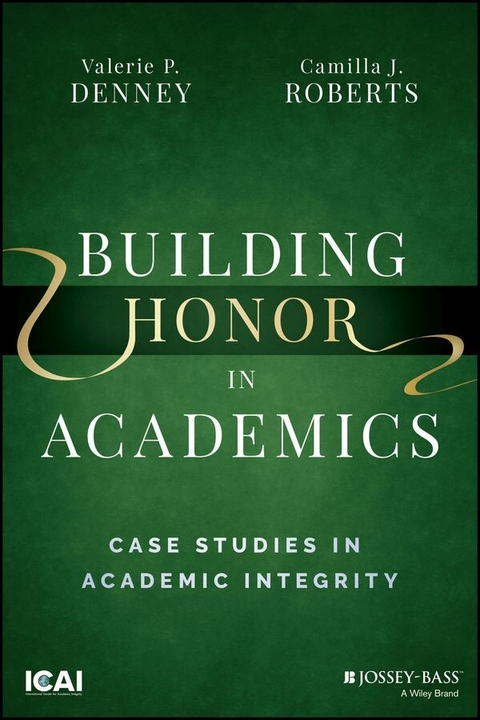
Building Honor in Academics (eBook)
John Wiley & Sons (Verlag)
978-1-119-88056-1 (ISBN)
A 360-degree look at academic integrity with case studies from professors, administrators, and students
Building Honor in Academics: Case Studies in Academic Integrity is a collection of case studies on academic integrity from around the globe. More than case studies, the book is intended to help administrators, faculty, and students start conversations around the topic of cheating and academic integrity, and what to do when they find themselves faced with it firsthand. The case studies will come from honor code administrators, department leaders, faculty, and students across disciplines.
Written by leaders of The International Center for Academic Integrity, this book tracks the ICAI's six values of academic integrity: honesty, trust, fairness, respect, responsibility, and courage. These six values manifest in different ways across different institutions, but they are all relevant in the quest to consider how to promote integrity in higher education. Academic integrity has received increased media attention since the beginning of the covid-19 pandemic, and now is the time to educate academic communities in the ideas, techniques, and strategies that work to enhance the level of personal responsibility in higher education.
- Learn about the six values of academic integrity and how they can guide your institution
- Read case studies from the perspectives of students, administrators, and faculty
- Identify large and small tasks you can undertake to promote academic integrity at all levels
- Become part of the solution as higher education shifts to a new framework for the digital age
Building Honor in Academics is an eye-opening resource for administrators, leaders, and policymakers in higher education, as well as students studying to enter these roles.
VALERIE P. DENNEY, BS, MS, DBA, is an Associate Professor at Embry-Riddle Aeronautical University in the College of Business. Valerie retired from the aerospace industry and the U.S. Navy after 30 years as an engineering and program manager. In addition to her university position, she is currently Vice President of the International Center for Academic Integrity (ICAI).
CAMILLA J. ROBERTS, MEd, PhD, is the Director of the Honor and Integrity System at Kansas State University in Manhattan, KS. Since 2008, Camilla has been a member of the International Center for Academic Integrity (ICAI), serving on the leadership board since 2016, as Vice President for two years, and currently as President.
A 360-degree look at academic integrity with case studies from professors, administrators, and students Building Honor in Academics: Case Studies in Academic Integrity is a collection of case studies on academic integrity from around the globe. More than case studies, the book is intended to help administrators, faculty, and students start conversations around the topic of cheating and academic integrity, and what to do when they find themselves faced with it firsthand. The case studies will come from honor code administrators, department leaders, faculty, and students across disciplines. Written by leaders of The International Center for Academic Integrity, this book tracks the ICAI s six values of academic integrity: honesty, trust, fairness, respect, responsibility, and courage. These six values manifest in different ways across different institutions, but they are all relevant in the quest to consider how to promote integrity in higher education. Academic integrity has received increased media attention since the beginning of the covid-19 pandemic, and now is the time to educate academic communities in the ideas, techniques, and strategies that work to enhance the level of personal responsibility in higher education. Learn about the six values of academic integrity and how they can guide your institution Read case studies from the perspectives of students, administrators, and faculty Identify large and small tasks you can undertake to promote academic integrity at all levels Become part of the solution as higher education shifts to a new framework for the digital ageBuilding Honor in Academics is an eye-opening resource for administrators, leaders, and policymakers in higher education, as well as students studying to enter these roles.
VALERIE P. DENNEY, BS, MS, DBA, is an Associate Professor at Embry-Riddle Aeronautical University in the College of Business. Valerie retired from the aerospace industry and the U.S. Navy after 30 years as an engineering and program manager. In addition to her university position, she is currently Vice President of the International Center for Academic Integrity (ICAI). CAMILLA J. ROBERTS, MEd, PhD, is the Director of the Honor and Integrity System at Kansas State University in Manhattan, KS. Since 2008, Camilla has been a member of the International Center for Academic Integrity (ICAI), serving on the leader-ship board since 2016, as Vice President for two years, and currently as President.
Introduction
Chapter 1: Honesty
Chapter 2: Trust
Chapter 3: Fairness
Chapter 4: Respect
Chapter 5: Responsibility
Chapter 6: Courage
Appendix A: Alphabetical List of Case Studies Mapped to the Fundamental Values
Appendix B: Alphabetical List of Case Studies Mapped to the Target Audience
Appendix C: List of Case Studies by Author's Name
Appendix D: List of Case Studies by Country of Origin
Index
Praise for Building Honor in Academics
"This book does an excellent job of making the fundamental principles, values and practicalities of academic integrity accessible for a wide range of audiences. I plan to use it as part of training for faculty, students, and academic integrity professionals."
- David Rettinger, Professor of Psychological Science, Director of Academic Integrity Programs at University of Mary Washington, Author of Cheating Academic Integrity
"ICAI's fundamental values of academic integrity have long been recognized as the core element of the institution of a culture of academic integrity. This truly international edited volume by Camilla Roberts and Valerie Denney from the ICAI Board, including 67 cases from 11 countries, promises to be a guideline for every stakeholder involved in the establishment of such a culture by exemplifying the implementation of these fundamental values."
- Salim Razi, Canakkale Onsekiz Mart University Centre for Academic Integrity
Introduction
From the early beginnings of the Center for Academic Integrity, now the International Center for Academic Integrity (ICAI), the leadership and membership of the group strived to not only talk about or support academic integrity, but promote integrity and give institutions tools to create a culture of integrity on their own campuses. The Fundamental Values Project was designed to do just that.
According to Sally Cole, the center's first executive director from 1995 to 1999, the purpose of the original Fundamental Values was:
… to identify and affirm the conditions under which student honesty would flourish. And we had the wisdom to recognize that it was an issue with campus climate that we were talking about. It was not just the student behavior but the environment/the settings in which a student decides to cheat or not to cheat. (Gallant, 2022)
After the work of Elizabeth Kiss, Jim Larimore, Gary Pavela, Don McCabe, Bill Kibler, Pat Drinan, Mary Olson, and Sally Cole, the first edition of the Fundamental Values was published in 1999 with the following five values: honesty, trust, fairness, respect and responsibility. In recognition of the Center's 20th anniversary in 2014, the document was reviewed in a second edition and the sixth value of courage was added. In 2021, a third edition was released, maintaining the same six values; however, attempting to connect the values to experiences global colleagues see daily at their institutions and with their students.
It is from this attempt to connect the values to the daily work that the idea of this case study book flourished. Leaders of ICAI saw a request and a need to be able to see examples of the fundamental values at work to help spur and continue conversations about academic integrity while also using these discussions as a training mechanism across the institution. We hope that the case studies found in Building Honor in Academics, organized by the six fundamental values of academic integrity, do just that. May they be talking points for a faculty meeting, training exercises for an honor council, or an ethical discussion in a classroom environment.
The mission of ICAI is to “cultivate integrity and academic communities throughout the world to promote ethical institutions and societies” and so throughout that mission the goal is to build the culture of academic integrity. We want to educate individuals; we want to educate our students; we want to educate our faculty. To have a commitment to academic integrity is to have a commitment to those values. We ask our students at our institutions to have these values, our faculty members to have these values, but also our institutions must maintain these values so our scholarly communities can flourish. Building Honor in Academics strives to help explore what it really means to live the fundamental values. The following is a description of the six fundamental values: honesty, trust, fairness, respect, responsibility, and courage.
Honesty
Honesty forms the indispensable foundation of integrity and is a prerequisite for full realization of trust, fairness, respect, and responsibility. Honesty can be seen as a prerequisite to realize all the other values. The ways we think about being honest is being truthful, giving credit to others, and promoting a culture in which we give credit to others. We keep our promises, and we provide factual evidence for our statements. Honesty is absolutely critical for both faculty and administrators model, not only in our words and what happens in our class in the classroom, but with our policies and procedures. In examining your policies and procedures, explore whether the policy encourages honesty, is learning centered, or encourages a student to be dishonest because it is more legalistic in its approach. We must examine our own situations to be able to answer how we encourage honesty; how we promote a culture of honesty; how we praise acts of honesty when we see them and make it something that's very much part of the value of the institution.
Trust
Trust is the ability to rely on the truth of someone or something. It is a fundamental pillar of academic pursuit. Within academics, we can promote trust by clearly stating our expectations and follow through on those expectations. That is whether we are faculty in the classroom and we are clearly stating the expectations for an assignment or if we are at the institution level where we are stating our expectations for academic integrity and what and how we will respond when breaches occur. Trust helps us promote transparency. Examples of trust in academia are to clearly state expectations, promote transparency, give credence, act with genuineness, and encourage mutual understanding. We want to trust others as we want to be trusted ourselves. We hold each other accountable to trust one another and encourage each other with a mutual understanding and act with genuineness when we have trust.
Fairness
Fairness is focusing on impartial treatment or looking at bias making sure you understand where your biases are associated with this fair or impartial treatment. Fairness emphasizes and reinforces those values of truth within logic and rationality. Fairness can be seen by making sure that the ideas of the rules, policies, and procedures are applied consistently as it applies both to the institution, faculty member, and student. Engaging with others equitably ensures you keep an open mind, taking responsibility for your own actions. A faculty leads by example making sure to uphold those principles associated with the fairness principle and to communicate those expectations as we go through the academic year making sure that the institution has clear, useful, and consistent policies and that there is a degree of transparency.
Respect
Respect in academic communities is reciprocal and requires showing respect for oneself as well. Examples of respect include receiving feedback willingly, practicing active listening, showing empathy, seeking open communication, affirming others, and recognizing the consequences of our word and actions on others. It is not just that it is expecting trust from others but you also want to make sure that it is respectful, which shows that this trust goes both ways. To be clear, this is not only between individuals or between an individual and an institution, but one's self as well—respecting oneself. This can of course be completed in many different ways. As educators, we want students to have an active role in contributing to discussion and it means at times there are going to be some discussions where not everybody is going to agree. Faculty need to recognize students as individuals and to take seriously the ideas that those students have, respectfully. Respect is also having the faculty give full honest feedback and actionable feedback. Within respect in the institution, we must embrace that it is healthy to have some spirited discussions. The respect shown among the discussions gives the ability for individuals to have those disagreements but also to be able to proceed forward and to express their views.
Responsibility
Responsibility identifies that upholding the values of integrity is simultaneously an individual duty and a shared concern. Examples of responsibility in academic life include engaging in difficult conversations, knowing and following institutional rules and policies, holding yourself accountable for your actions, following through with tasks and expectations, and modeling good behavior. It is the idea of making sure that one is holding oneself accountable for their own actions. We also often want our students to take responsibility for their actions. To demonstrate this responsibility, we encourage all at the institution to first know the policies, but then to take responsibility to ask for clarification if needed. Responsibility is also creating understanding and respecting personal boundaries and following through. Just as students should take responsibility for the work they submit; faculty members are responsible for teaching our students and holding our students accountable. The faculty should also take responsibility for when things do not go quite as well as they planned with an assignment or maybe they were not quite as clear on their assignment guidelines. We also ask our institutions to take responsibility possibly through a long‐term 5‐ or 10‐year plan. These long‐term plans allow for transparency of both successes and failures.
Courage
Courage differs from the preceding fundamental values by being more a quality or capacity of character. However, as with each of the values, courage can be practiced and developed. Courage often is interpreted as a lack of fear. In reality, courage is the capacity to act in accordance with one's values despite fear. Examples of courage include being brave when others might not, taking a stand to address wrongdoing, being willing to take risk and risk failure, and being undaunted in defending integrity. One might need courage to be able to act in accordance with the other values. The previous five values sometimes can be intimidating, and one must have the courage to live out the value. For a student to speak up to their peers takes quite a bit of courage, or for our faculty members (especially prior to tenure) to stand up for what they think or what they believe in takes courage. We encourage all to have that voice to be able to take a stand, address wrongdoing, and understand there might be some discomfort but if you are standing...
| Erscheint lt. Verlag | 24.1.2023 |
|---|---|
| Sprache | englisch |
| Themenwelt | Sozialwissenschaften ► Pädagogik ► Bildungstheorie |
| Schlagworte | academic honesty • Academic Integrity • Bildungswesen • cheating • cheating in higher education • college administration • deans • Education • Higher Education Administration • Higher education policy • Hochschulen / Leitung, Verwaltung, Politik • honor code • Leadership, Administration & Policy (Higher Education) • remote learning • university administrator • Unterricht • Virtual Classroom |
| ISBN-10 | 1-119-88056-4 / 1119880564 |
| ISBN-13 | 978-1-119-88056-1 / 9781119880561 |
| Informationen gemäß Produktsicherheitsverordnung (GPSR) | |
| Haben Sie eine Frage zum Produkt? |
 EPUB (Adobe DRM)
Kopierschutz: Adobe-DRM
Adobe-DRM ist ein Kopierschutz, der das eBook vor Mißbrauch schützen soll. Dabei wird das eBook bereits beim Download auf Ihre persönliche Adobe-ID autorisiert. Lesen können Sie das eBook dann nur auf den Geräten, welche ebenfalls auf Ihre Adobe-ID registriert sind.
Details zum Adobe-DRM
Dateiformat: EPUB (Electronic Publication)
EPUB ist ein offener Standard für eBooks und eignet sich besonders zur Darstellung von Belletristik und Sachbüchern. Der Fließtext wird dynamisch an die Display- und Schriftgröße angepasst. Auch für mobile Lesegeräte ist EPUB daher gut geeignet.
Systemvoraussetzungen:
PC/Mac: Mit einem PC oder Mac können Sie dieses eBook lesen. Sie benötigen eine
eReader: Dieses eBook kann mit (fast) allen eBook-Readern gelesen werden. Mit dem amazon-Kindle ist es aber nicht kompatibel.
Smartphone/Tablet: Egal ob Apple oder Android, dieses eBook können Sie lesen. Sie benötigen eine
Geräteliste und zusätzliche Hinweise
Buying eBooks from abroad
For tax law reasons we can sell eBooks just within Germany and Switzerland. Regrettably we cannot fulfill eBook-orders from other countries.
aus dem Bereich