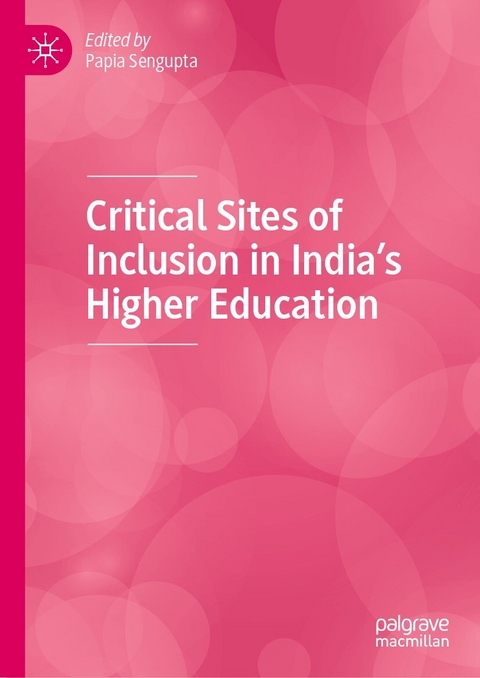
Critical Sites of Inclusion in India’s Higher Education (eBook)
191 Seiten
Springer Singapore (Verlag)
978-981-16-8256-8 (ISBN)
This book acquaints the reader to the often invisible-ized practices and policies under the rhetoric of 'inclusion', through theoretical and empirical analysis. It emphasizes on the complexities of education policies in a multicultural state by identifying the challenges to the idea of 'inclusion' illuminated through judicial interventions, policy-frameworks and everyday experiences of individuals.
Higher education is imperative to empowerment in socially stratified societies marred with deep inequalities like India and many other multicultural countries. Disputes over inclusion remains a critical feature in Indian higher education sector, as it is viewed as facilitating access to economic opportunities and providing vertical mobility for individuals belonging to marginalized communities. Higher education empowers, and expands individual horizons of thought and ideas of freedom, dignity, equality, enabling individuals to participate actively in the political-sociological discourses in democratic polity. Therefore, policy makers, political theorists and educationists have been examining the question of inclusion and education as public-good. Contemporary India has witnessed an unprecedented attack on academic freedom, free exchange of ideas and expressions, challenging the very idea of inclusion and inclusiveness.
Dr. Papia Sengupta is Assistant Professor at the Centre for Political Studies in Jawaharlal Nehru University, New Delhi, India. She was awarded the Distinguished Teacher award by former President A.P.J. Abdul Kalam in 2009 for her contribution to students' mentorship. Dr Sengupta was fellow at the Institute for Advanced Studies in Humanities, University of Edinburgh (2016) and Brown University, USA (2015). Her research interests include politics of language, diversity studies, minority rights and decolonization of knowledge, gender and multiculturalism. She has been awarded fellowships from the Shastri Indo-Canadian Faculty Fellowship, Swiss International Development Agency fellowship, Switzerland and the International Institute of Social History fellowship. Her monograph titled Language as Identity in Colonial India: Policies and Politics, was published in 2018. In 2020 the International Association for Applied Linguistics, Netherlands honored her with the Solidarity Award. Dr. Sengupta's research articles have been published in reputed national and international journals such as Economic and Political Weekly, Social Action, Geoforum and The International Journal on Diversity
This book acquaints the reader to the often invisible-ized practices and policies under the rhetoric of 'inclusion', through theoretical and empirical analysis. It emphasizes on the complexities of education policies in a multicultural state by identifying the challenges to the idea of 'inclusion' illuminated through judicial interventions, policy-frameworks and everyday experiences of individuals.Higher education is imperative to empowerment in socially stratified societies marred with deep inequalities like India and many other multicultural countries. Disputes over inclusion remains a critical feature in Indian higher education sector, as it is viewed as facilitating access to economic opportunities and providing vertical mobility for individuals belonging to marginalized communities. Higher education empowers, and expands individual horizons of thought and ideas of freedom, dignity, equality, enabling individuals to participate actively in the political-sociological discourses in democratic polity. Therefore, policy makers, political theorists and educationists have been examining the question of inclusion and education as public-good. Contemporary India has witnessed an unprecedented attack on academic freedom, free exchange of ideas and expressions, challenging the very idea of inclusion and inclusiveness.
| Erscheint lt. Verlag | 1.3.2022 |
|---|---|
| Zusatzinfo | XXIII, 191 p. 14 illus., 13 illus. in color. |
| Sprache | englisch |
| Themenwelt | Sozialwissenschaften ► Pädagogik ► Erwachsenenbildung |
| Sozialwissenschaften ► Politik / Verwaltung ► Politische Theorie | |
| Sozialwissenschaften ► Politik / Verwaltung ► Staat / Verwaltung | |
| Schlagworte | Discrimination • Education Policy • higher education • Inclusive Education • India • Minorities • Universities |
| ISBN-10 | 981-16-8256-9 / 9811682569 |
| ISBN-13 | 978-981-16-8256-8 / 9789811682568 |
| Informationen gemäß Produktsicherheitsverordnung (GPSR) | |
| Haben Sie eine Frage zum Produkt? |
 PDF (Wasserzeichen)
DRM: Digitales Wasserzeichen
Dieses eBook enthält ein digitales Wasserzeichen und ist damit für Sie personalisiert. Bei einer missbräuchlichen Weitergabe des eBooks an Dritte ist eine Rückverfolgung an die Quelle möglich.
Dateiformat: PDF (Portable Document Format)
Mit einem festen Seitenlayout eignet sich die PDF besonders für Fachbücher mit Spalten, Tabellen und Abbildungen. Eine PDF kann auf fast allen Geräten angezeigt werden, ist aber für kleine Displays (Smartphone, eReader) nur eingeschränkt geeignet.
Systemvoraussetzungen:
PC/Mac: Mit einem PC oder Mac können Sie dieses eBook lesen. Sie benötigen dafür einen PDF-Viewer - z.B. den Adobe Reader oder Adobe Digital Editions.
eReader: Dieses eBook kann mit (fast) allen eBook-Readern gelesen werden. Mit dem amazon-Kindle ist es aber nicht kompatibel.
Smartphone/Tablet: Egal ob Apple oder Android, dieses eBook können Sie lesen. Sie benötigen dafür einen PDF-Viewer - z.B. die kostenlose Adobe Digital Editions-App.
Buying eBooks from abroad
For tax law reasons we can sell eBooks just within Germany and Switzerland. Regrettably we cannot fulfill eBook-orders from other countries.
aus dem Bereich